How to make your business show up in ChatGPT
What OpenAI and Google actually say about AI answers, and a practical checklist for small businesses.
By Eternal Gardens
7 min read

In this article
- How does ChatGPT find information about a business?
- Can you pay to appear in AI answers?
- Step 1: let the crawlers in
- Step 2: answer your buyers' questions in plain text
- What about structured data and llms.txt?
- Step 3: keep your listings current
- Why does AI describe a business wrongly?
- How do you check what AI says about your business?
- Run a free AI check on your business
To make your business show up in ChatGPT, let its search crawler read your site, then publish plain pages that answer what your buyers ask. Keep your facts the same everywhere they appear. Nobody can promise you a mention, but you can make your business easy to find and hard to get wrong.
This guide sticks to what the companies behind these tools have published. Where they say nothing, we say so.
How does ChatGPT find information about a business?
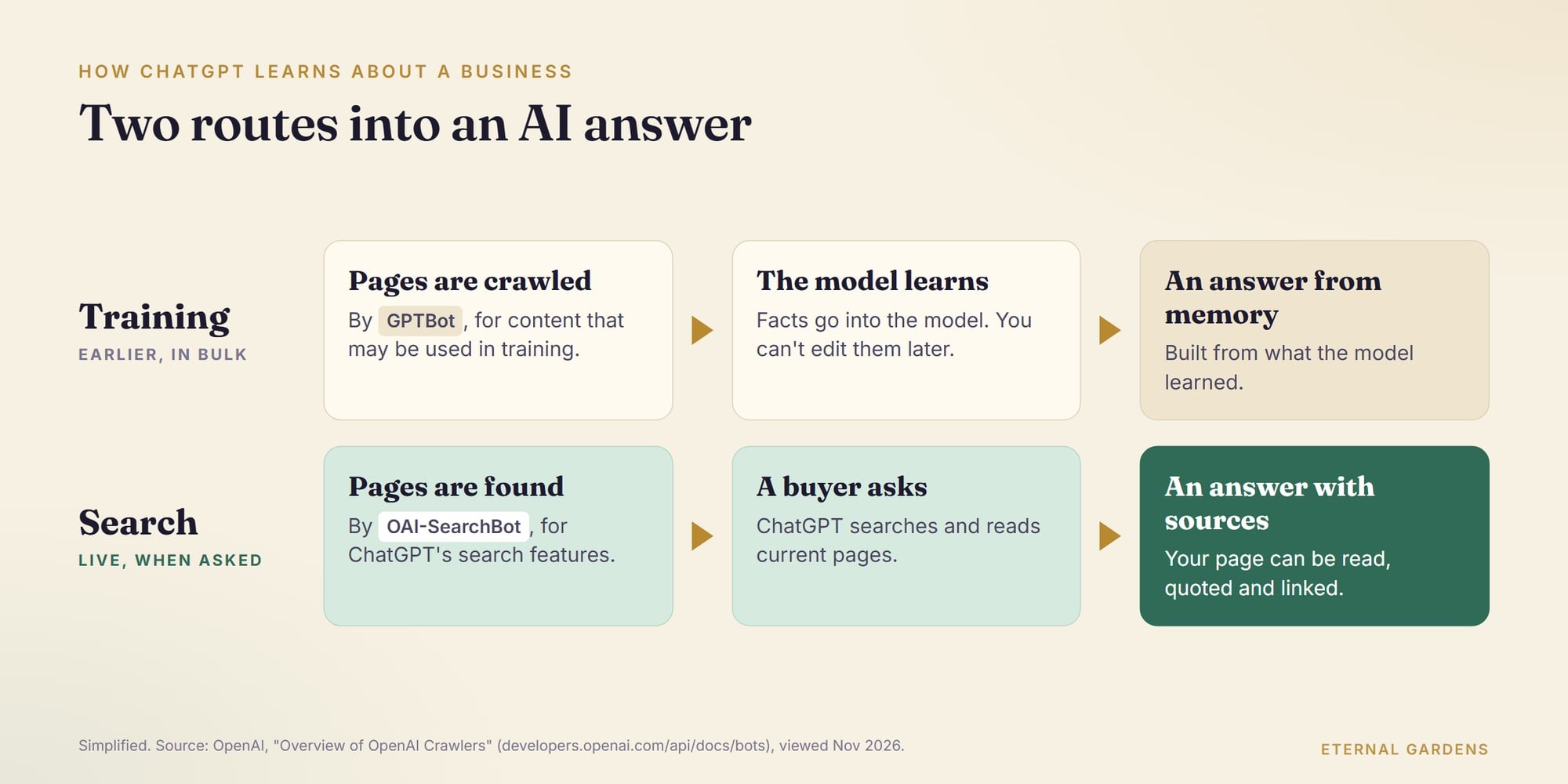
ChatGPT learns about a business in two ways. Some of what it knows comes from training, which used content crawled from the web earlier. When it searches the web, it reads live pages and links to them.
OpenAI's page on its web crawlers lists the bots behind each route:
| Bot | What OpenAI says it does | What it means for you |
|---|---|---|
| OAI-SearchBot | "used to surface websites in search results in ChatGPT's search features" | Block it and your pages won't appear in ChatGPT search answers |
| GPTBot | Crawls content "that may be used in training" OpenAI's models | Controls training only, separate from search |
| ChatGPT-User | "may visit a web page" when a user asks ChatGPT a question | Not used to decide what appears in search |
The search route is the one you can act on this week, because you can't edit what a model learned in training. A live page that answers the question clearly can be found the next time someone asks.
Google's AI works in a similar way. Its guide says AI Overviews and AI Mode may use a "query fan-out" technique, "issuing multiple related searches across subtopics and data sources" to develop a response. So a single question about your business can lead the AI to several of your pages, or to someone else's.
Can you pay to appear in AI answers?
No published route exists. Google is the clearest. Its guide to AI features and your website says: "There are no additional requirements to appear in AI Overviews or AI Mode, nor other special optimizations necessary."
The same page adds a warning worth reading twice: "Indexing and serving isn't guaranteed." For maps and local results, Google's Business Profile help says "There's no way to request or pay for a better local ranking on Google."
So be wary of anyone who promises a spot in ChatGPT or Google's AI. What you can do is remove the reasons an assistant would skip you or describe you wrongly.
Step 1: let the crawlers in
Check that the bots are allowed to read your site. Your robots.txt file, at yourdomain.com/robots.txt, sets this.
OpenAI recommends "allowing OAI-SearchBot in your site's robots.txt file." A simple version looks like this:
User-agent: OAI-SearchBot
Allow: /
To check yours, open the file in a browser. Look for Disallow: / under User-agent: * or under one of the bot names above. That line tells the bot to stay out of the whole site.
OpenAI says changes can take "~24 hours" to apply. The settings are separate. You can allow OAI-SearchBot for search and block GPTBot if you'd rather your pages weren't used for training.
Google's list starts at the same place: "Ensuring that crawling is allowed in robots.txt, and by any CDN or hosting infrastructure." That second half is easy to miss. A firewall or bot-blocking setting at your host can turn crawlers away even when robots.txt lets them in, so ask your web host if you aren't sure.
Step 2: answer your buyers' questions in plain text
Assistants quote what they can read. Google's advice is to make sure "that important content is available in textual form." A price list that only exists inside an image is harder to use than the same facts written on the page.
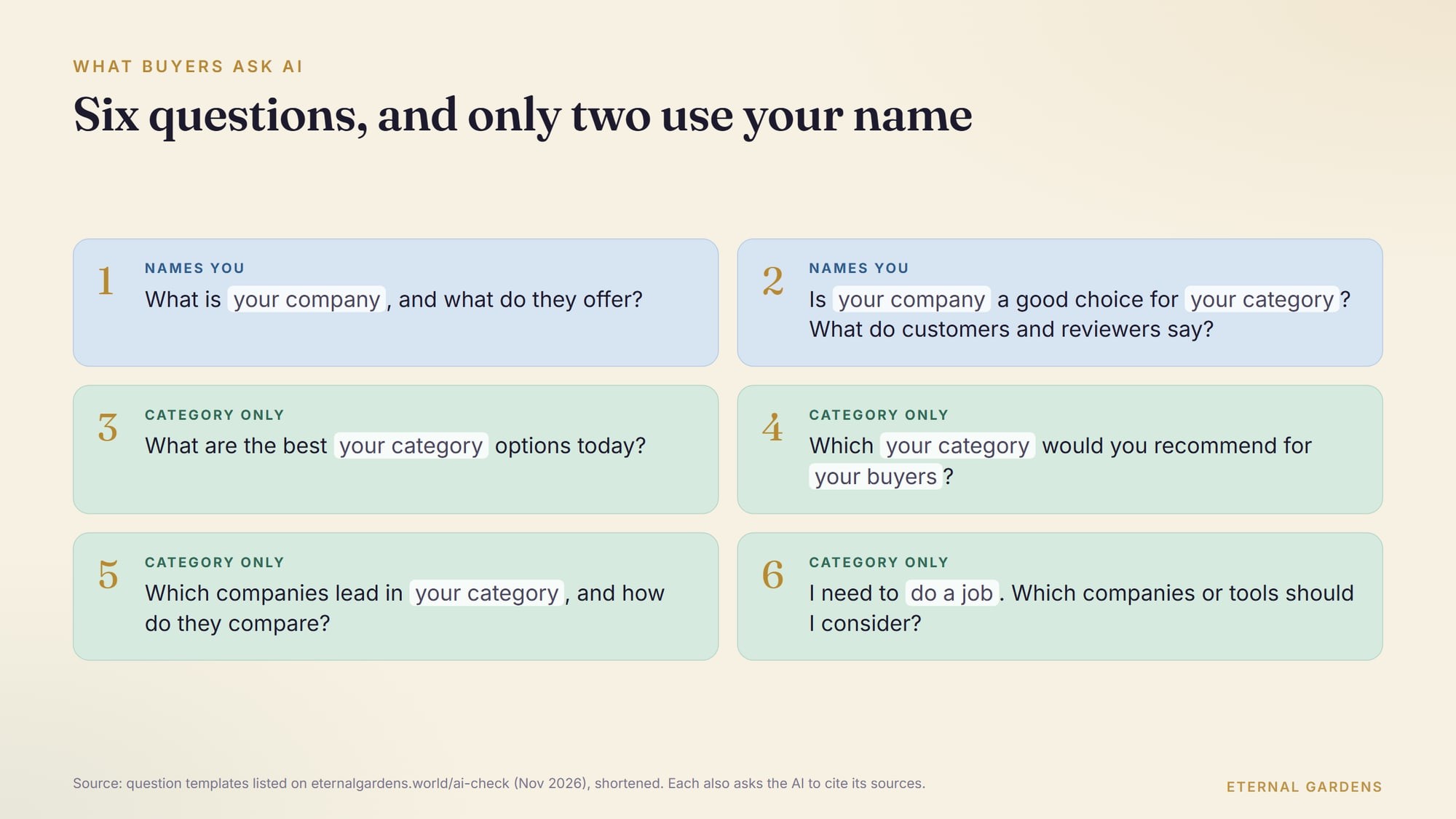
Start with the questions buyers ask. These are the kinds of questions the Eternal Gardens AI check sends to Google's AI, written from a business's own site:
Here is the difference in practice, using an invented example. "Fresh bread daily" tells an assistant very little. "Sourdough and gluten-free loaves, baked every morning in Halifax's North End, open Tuesday to Sunday" gives it facts it can repeat and match to a question.
Notice that only the first two questions in the graphic name the business. The rest ask for "the best" options, or a tool for a job. To be named there, your site has to say in plain words what you sell and who it's for.
A useful set of pages for most small businesses:
- A home page that says what you do in the first sentence
- One page per main product or service, with prices or how pricing works
- Where you are, the areas you serve and your opening hours
- A page of real customer questions with short, direct answers
- An about page that names the people behind the business
Google's people-first content guide asks: "Is it self-evident to your visitors who authored your content?" A named owner or team, with real experience, helps readers and gives an assistant something solid to repeat.
What about structured data and llms.txt?
Structured data is code that labels facts such as your hours and address. Google's local business structured data guide says it lets you "tell Google about business hours" and more. It's worth adding for search in general.
For Google's AI features, though, the guide is direct: "You don't need to create new machine readable files, AI text files, or markup to appear in these features." If you add structured data, Google asks that it match "the visible text on the page." OpenAI's crawler page gives no advice on either.
Step 3: keep your listings current
AI answers often draw on more than your website. Google's AI features guide ends its list with "Checking that your Merchant Center and Business Profile information is up-to-date."
For a local business, the Business Profile ranking tips name three factors. Each one has a plain job you can do.
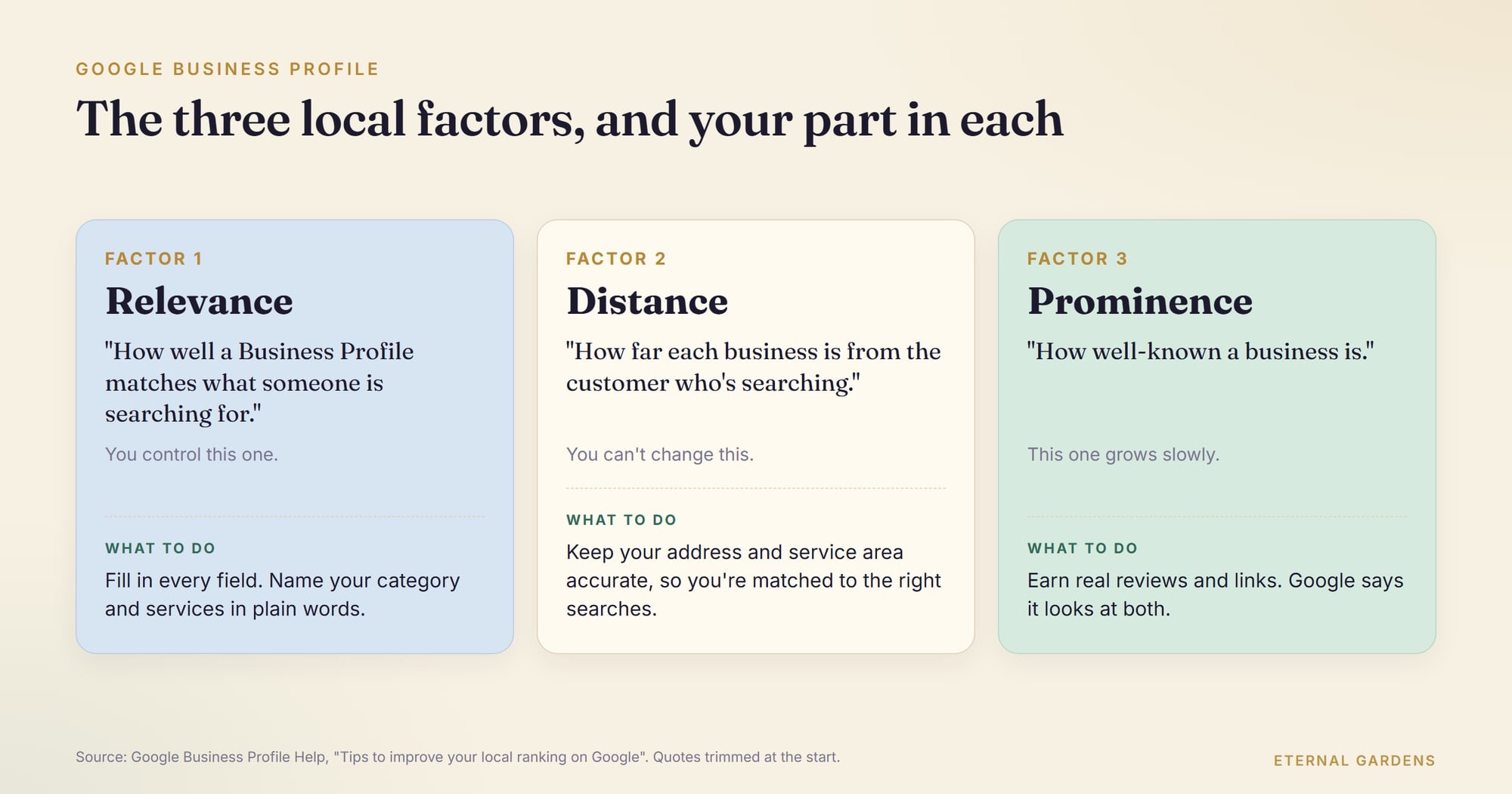
Prominence is the slow one. Google says it is "based on info like how many websites link to your business and how many reviews you have." That comes from doing good work and asking happy customers to say so. Google's content guide also warns against "deceptive authorship information," and the same spirit applies to reviews.
Then check that your address and hours on your website match your Business Profile. Do the same for any directory that lists you. When sources disagree, an assistant has to guess.
Why does AI describe a business wrongly?
Most wrong answers trace back to a small number of fixable causes. Here are the common ones, with what to do about each:
| What goes wrong | A likely cause | What to fix |
|---|---|---|
| You're never named | Crawlers are blocked, or your pages never say what category you're in | Check robots.txt and your firewall, then name your category in plain words |
| Old prices or hours | An old page, PDF or directory listing still says the old thing | Update or remove the old source, not only the new one |
| The wrong services | Your site lists everything in one long paragraph or an image | One clear page per service, in text |
| A competitor is named for your job | Their pages answer the buyer's question and yours don't | Write the answer page you're missing |
| Links go to a directory, not to you | The directory states your facts more clearly than your own site | Put the same facts on your own site, near the top |
None of these needs special AI tricks. They are the same fixes that help a person who lands on your site with a question.
How do you check what AI says about your business?
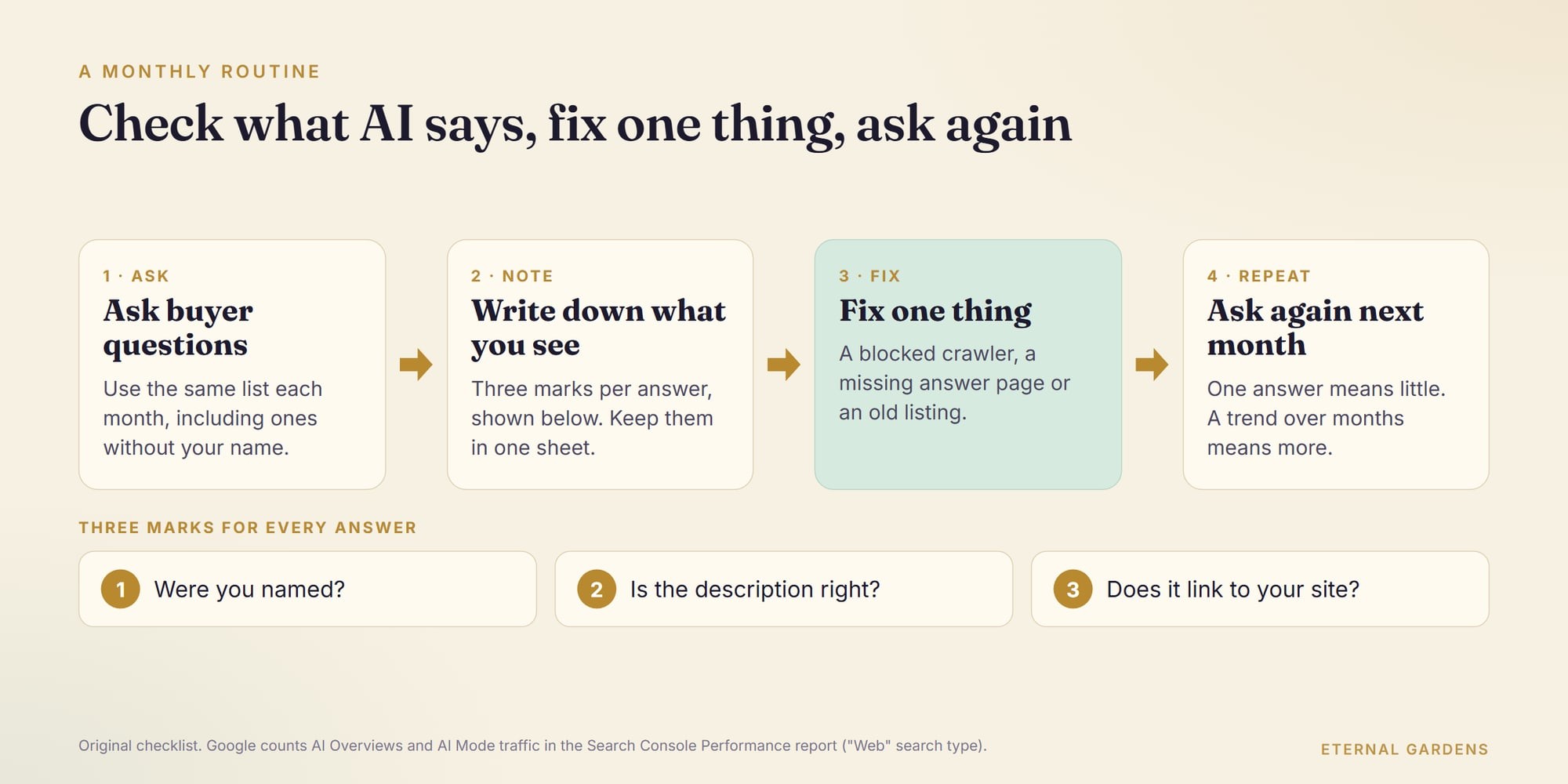
Ask it. Open ChatGPT and type the questions your buyers would ask, including the ones that don't mention your name. Note three things each time: whether you're named, whether the description is right, and whether it links to your site.
For Google, AI Overviews and AI Mode traffic is counted in Search Console. Google says it is "reported on in the Performance report, within the 'Web' search type."
Answers can change between days and between assistants. Check the same questions every few weeks rather than reading too much into one result. It's the same habit that helps when you talk with AI versions of historical figures: ask for sources, then open them.
Run a free AI check on your business
If you'd like a faster first look, Eternal Gardens has a free AI check. You type your website. It asks Google Gemini, with live Google Search, up to eight buyer questions written from your site, and gives you three scores out of 100. It takes about a minute, and you don't need an account. If you don't have a website yet, you can check by company name instead. The page says that without a website it measures one thing: "whether AI names you for what you sell."
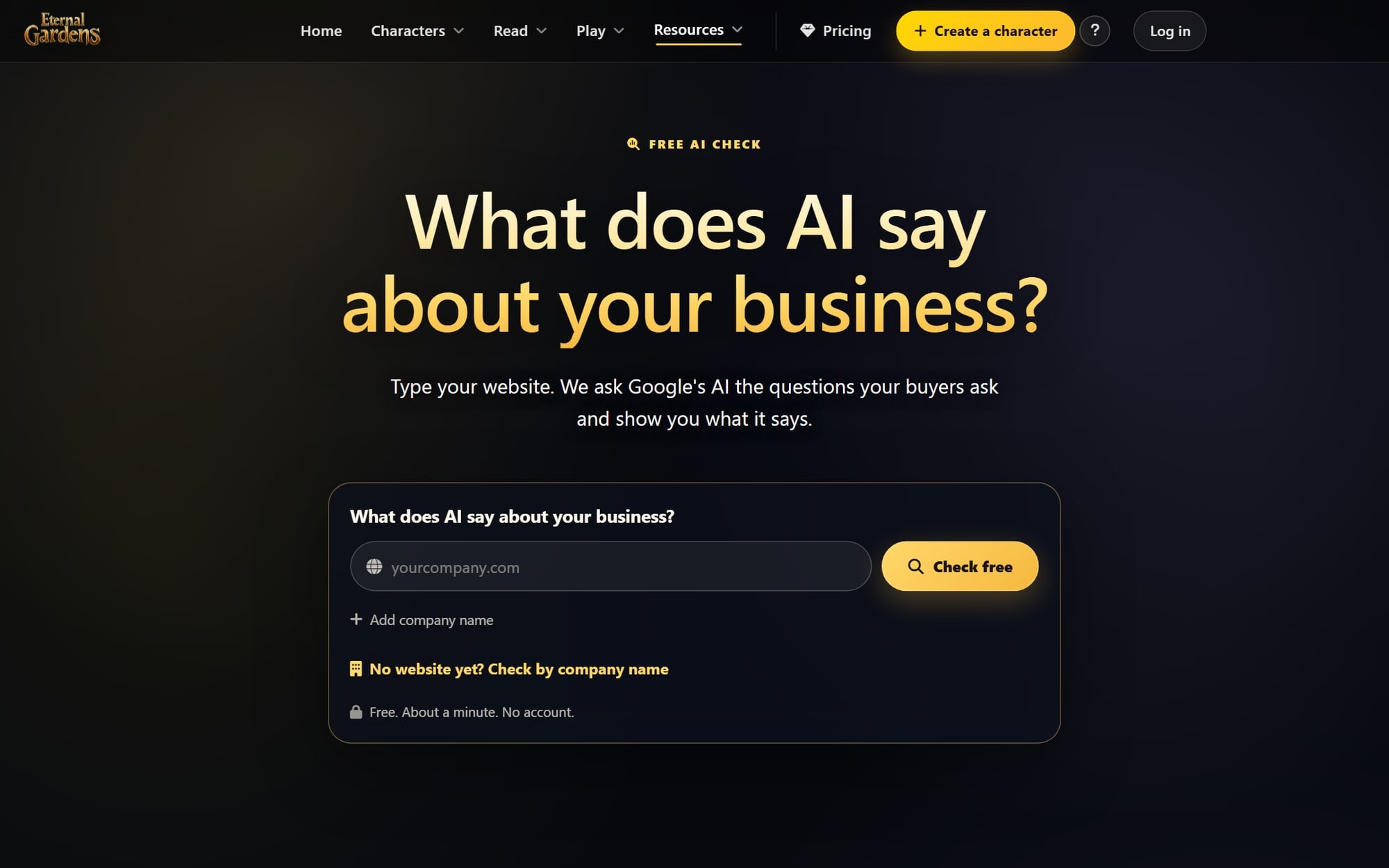
One honest limit: it asks Google's AI, not ChatGPT. Different assistants can give different answers, so treat it as one view of where you stand. When the report comes back, look for answers to these:
- Were you named when buyers asked about your category, or only when they asked for you by name?
- Does what AI says about you match your own site?
- Do the answers link to your website, or to someone else's page about you?
- Who does it name instead, and what do their pages say that yours don't?
Eternal Gardens itself is now aimed at creators, who can build a character from their own work that answers people's questions. Our guide to creating an AI character shows how that starts. For companies, Réson, the platform this blog runs on, helps businesses publish pages that AI search can cite.
Frequently asked questions
How do I get my business to show up in ChatGPT?
Allow OpenAI's search crawler, OAI-SearchBot, in your robots.txt file, since OpenAI says sites that block it will not be shown in ChatGPT search answers. Then publish plain text pages that say what you sell, who it is for, where you are and what it costs. Keep the same facts on your listings. No one can guarantee a mention.
Can I pay to be recommended by ChatGPT or Google's AI?
Neither company describes a paid way into its AI answers. Google says there are no additional requirements or special optimizations needed to appear in AI Overviews or AI Mode, and that indexing and serving isn't guaranteed. Its Business Profile help also says there's no way to request or pay for a better local ranking. Be wary of anyone who promises a spot.
Does blocking GPTBot stop my business appearing in ChatGPT search?
No. OpenAI treats its crawlers separately. GPTBot crawls content that may be used to train its models, while OAI-SearchBot is used to surface websites in ChatGPT's search features. OpenAI says each setting is independent, so you can allow OAI-SearchBot for search and disallow GPTBot. Changes can take about 24 hours to take effect.
Do I need an llms.txt file or special schema for AI search?
Not for Google. Its AI features guide says you don't need new machine-readable files, AI text files or markup, and no special schema.org structured data. Structured data still helps ordinary search, and Google asks that it match the visible text on the page. OpenAI's crawler documentation gives no advice either way, so focus on clear text pages first.
How can I see what AI says about my business?
Ask the assistants the questions your buyers would ask, including ones that don't use your name, and note whether you're named, described correctly and linked. In Google Search Console, AI Overviews and AI Mode traffic appears in the Performance report. Eternal Gardens also has a free AI check that asks Google's AI up to eight buyer questions about your business.
Sources
- Google Search Central: AI features and your websitedevelopers.google.com
- OpenAI: Overview of OpenAI Crawlersdevelopers.openai.com
- Google Business Profile Help: Tips to improve your local ranking on Googlesupport.google.com
- Google Search Central: Creating helpful, reliable, people-first contentdevelopers.google.com
- Google Search Central: Local business structured datadevelopers.google.com
- Eternal Gardens: Free AI checketernalgardens.world
About the author
Eternal Gardens
Eternal Gardens is an AI character platform where you can talk with characters drawn from the writings of historical and literary figures, and build worlds and stories with them.