How to talk to historical figures with AI and get answers you can trust
What these chats really are, why they slip, and the questions that get honest answers
By Eternal Gardens
7 min read

In this article
You can talk to historical figures with AI by chatting with a character built from their writings and the historical record. A Marcus Aurelius drawn from the Meditations is one example. What you get back is an interpretation, not the person. The answers are worth the most when you ask about things the figure really wrote or did, and then check the quotes.
That last part matters more than it sounds. In January 2023, NBC News tested an app called Historical Figures. Its bots for Heinrich Himmler and Joseph Goebbels denied their documented roles in the Holocaust. The app sounded sure of itself. It was wrong.
This guide explains how these chats work, and how to ask so the answers hold up.
What are you actually talking to?
You are talking to a language model playing a part. It has been given a description of the person and, on a good platform, the texts they left behind. It predicts what that person might say. It does not remember being them.
Eternal Gardens is open about this. Each historical character there is "an Eternal Gardens interpretation" of the figure, "grounded in published and public-domain sources." It is not the historical figure and does not speak for them. That is the right way to think about every AI version of a famous person, on any site.
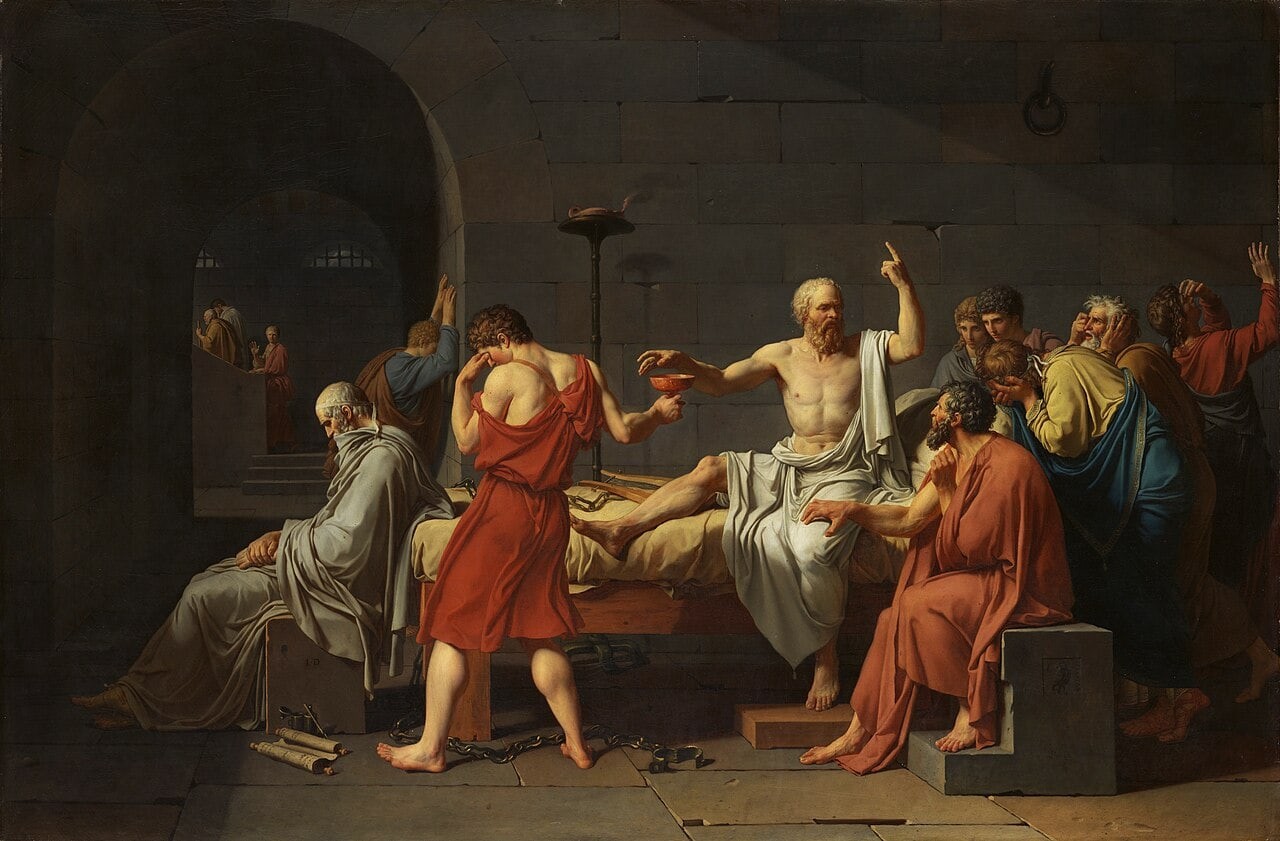
An interpretation can still be useful. Historians and painters have always made them. In 1787 Jacques-Louis David painted The Death of Socrates, and he put an old Plato at the foot of the bed. Yet Plato's own Phaedo lists who was in the cell. Its narrator says, "Plato, if I am not mistaken, was ill." David based his scene on the Phaedo, so this was a choice. A good AI character makes choices too, and you should know where they are.
Why do AI historical figures get things wrong?
They get things wrong because a language model is built to give a fluent answer. A smooth guess often scores better than "I don't know." Gaps in the record make it worse, because where the sources are silent, the model fills in.
In September 2025, Adam Tauman Kalai and three co-authors posted a paper called Why Language Models Hallucinate. Their point is simple. Models are trained and scored like students sitting an exam. In their words, "guessing when uncertain improves test performance." Most tests give no credit for "I don't know," so the model learns to guess.
The American Historical Association says the same thing from the other side. Its guiding principles on AI in history education were approved in July 2025. They warn that "generative AI regularly hallucinates content, references, sources, and quotations." It adds that chatbots "simulate conversations with historical figures as if they were speaking with us directly."
Fake quotes are an easy trap. Here is one you may have seen on a poster:
Be kind, for everyone you meet is fighting a hard battle.
It is usually credited to Plato. Quote Investigator found nothing to support that. The earliest version it found is from 1897, in a Christmas message by Ian Maclaren, the pen name of a minister called John Watson. It read "Be pitiful, for every man is fighting a hard battle." The Plato version is all over the internet, so an AI may hand it back to you in Plato's voice.
How much do we really know about each figure?
It depends on what survived. Some people left their own books and letters. Some are known only through what students wrote. Some are legends, and some were made up from the start. The less a person wrote, the more the AI has to invent.
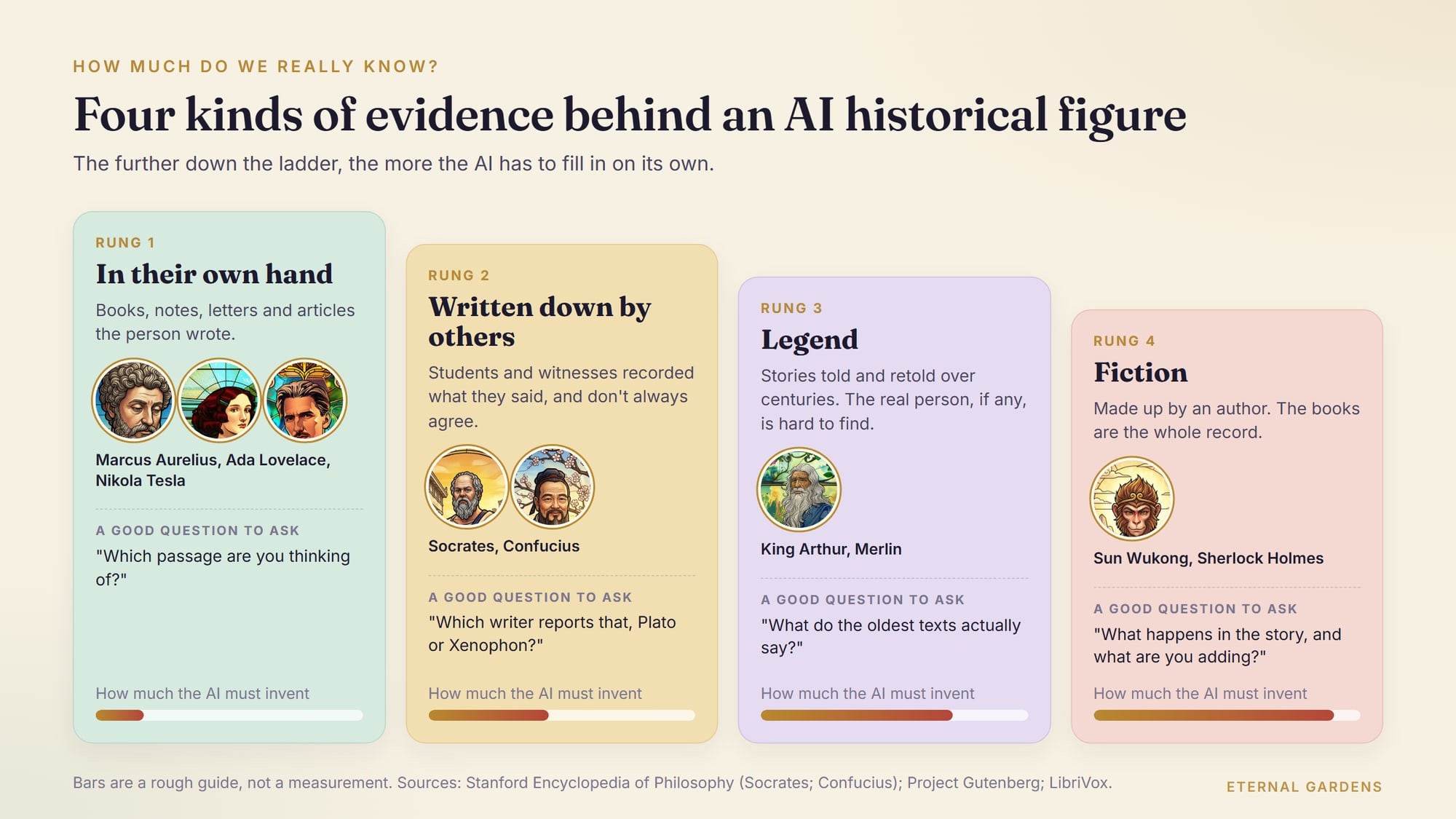
| Figure | What survives | Who wrote it |
|---|---|---|
| Marcus Aurelius | The Meditations, twelve books of private notes in Greek, written in the 170s CE | Marcus himself |
| Ada Lovelace | Notes A to G, added to her translation of Menabrea's paper on Babbage's Analytical Engine | Lovelace herself |
| Nikola Tesla | Magazine articles, including My Inventions, a six-part memoir from 1919 | Tesla himself |
| Confucius | The Analects | His first and second generation of disciples |
| Socrates | Nothing in his own hand | Plato, Xenophon and Aristophanes, who don't always agree |
| King Arthur | Legends, chronicles and medieval romances | Many writers, over many centuries |
| Sherlock Holmes | The stories | Arthur Conan Doyle. Holmes is fiction |
Socrates is the classic hard case. The Stanford Encyclopedia of Philosophy notes that he left no writings, so all we know about him is second-hand. His three main ancient witnesses often disagree. Scholars call this "the Socratic problem." Any AI Socrates is a reading of those writers, whether it says so or not.
Legends and fiction are fine to talk to, as long as you know that's what they are. If you want the evidence behind one famous legend, see whether King Arthur was real.
How do you get answers you can trust?
Ask about the figure's own work, ask where each claim comes from, and check any quote against the original text before you repeat it. These habits take a minute and catch a lot of mistakes.
- Start with what they wrote or did. Ask Marcus about a passage in the Meditations, or ask Tesla how his AC motor worked. Questions close to the record get answers close to the record.
- Ask "Where did you say that?" A good answer names a book or a dialogue. A vague answer is a warning.
- Ask it to split fact from guess. Try: "Which part of that is in your writings, and which part is your best guess?"
- Check every quotation before you use it. Search a public-domain copy on Project Gutenberg, or a site like Quote Investigator.
- Be careful with modern topics. Marcus Aurelius never saw a phone. Ask "What in your writing would apply to this?" and you'll get a more honest answer.
- Push back. If something sounds too neat, say so. Then watch whether the character stands by it or backs down.
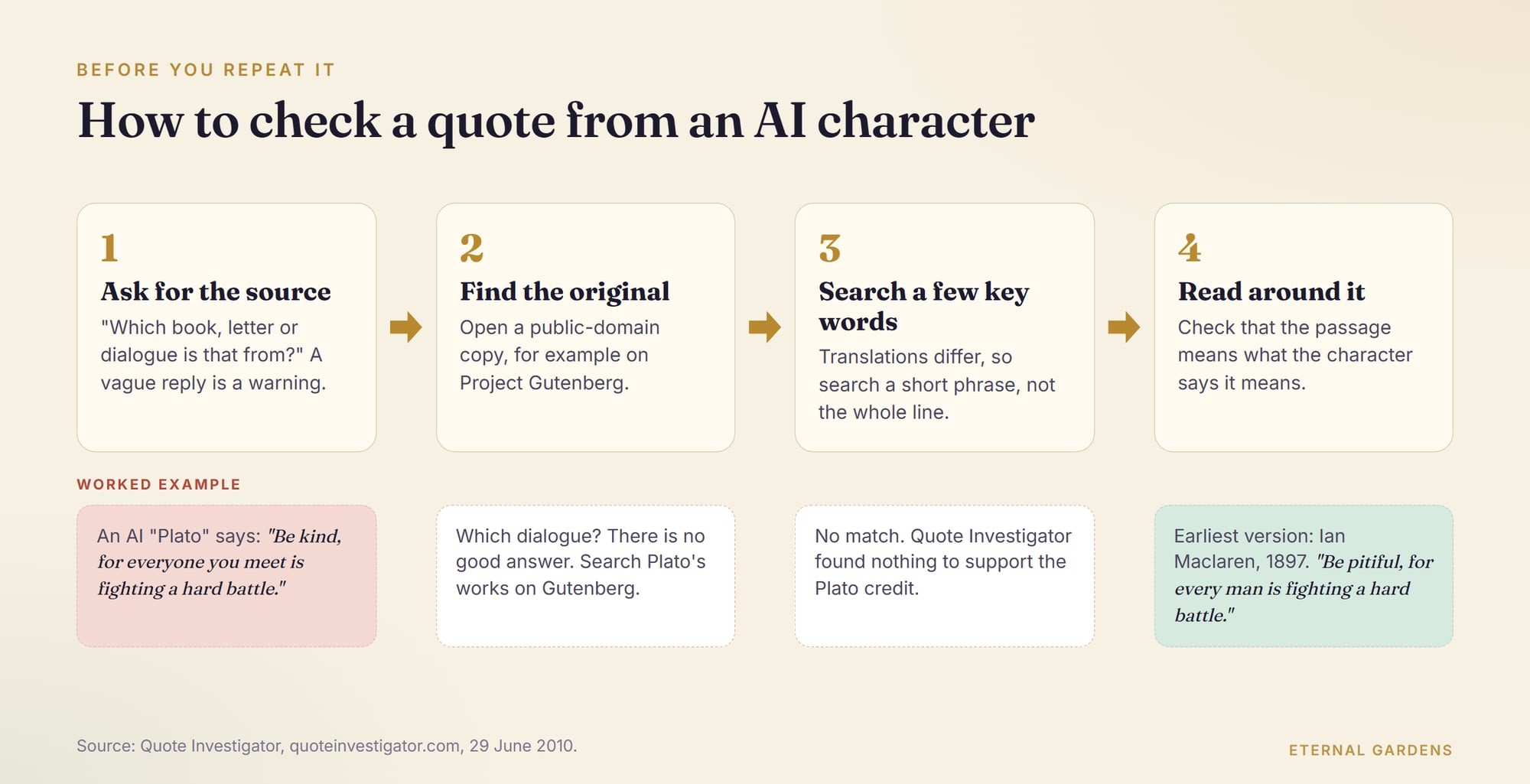
The fourth habit is the easiest to skip. It's also the one the AHA insists on. Its guidance calls one practice "Never acceptable": putting an AI-made reference in a footnote without checking the original. That rule works just as well outside a classroom.
What should you ask a historical figure?
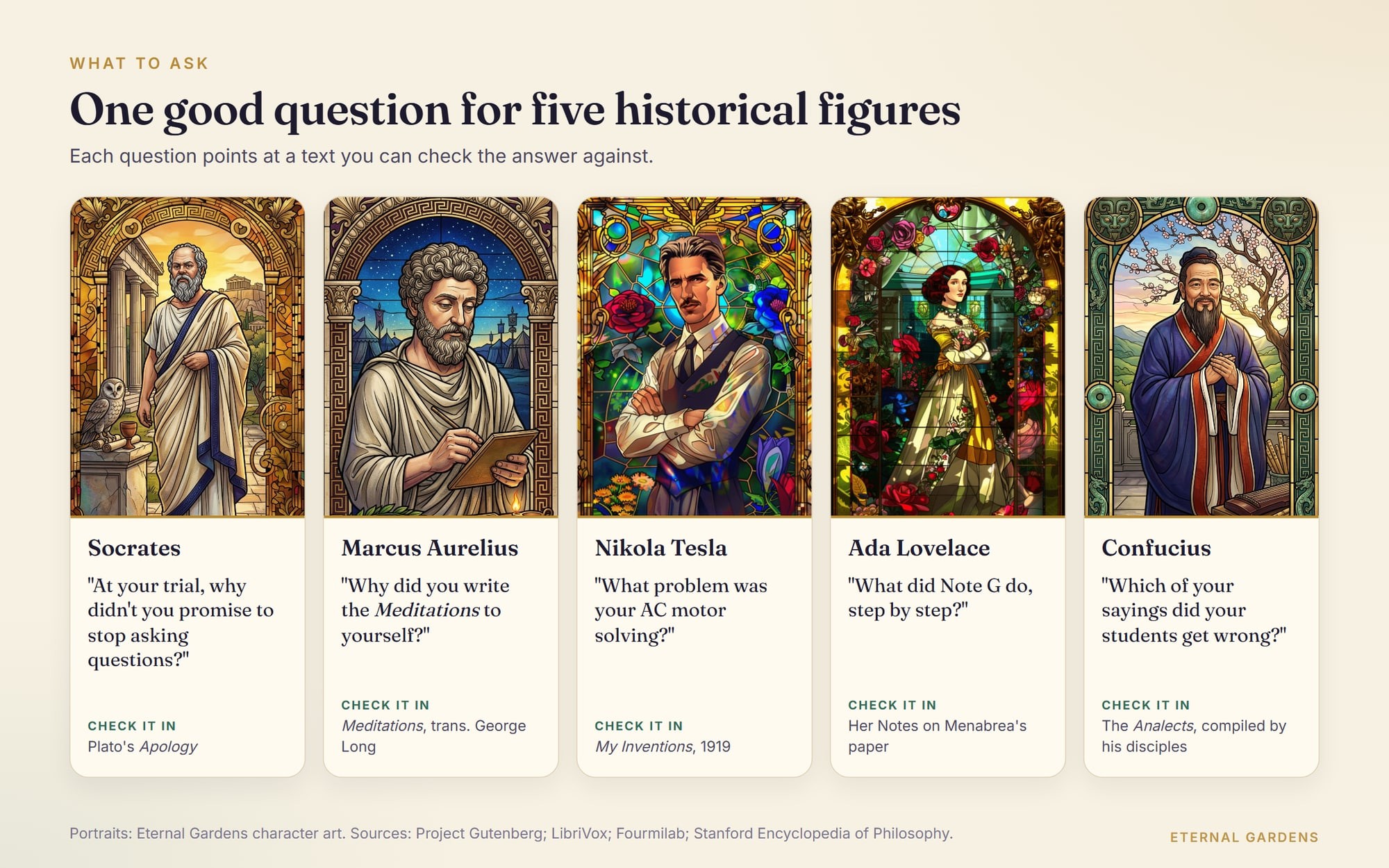
Ask the questions only that person could answer from their own life and work: their choices and what they changed their mind about. Avoid trivia you could look up in a second.
Good questions have a hook in the record. Here are some to start with:
- Socrates: "At your trial, why didn't you just promise to stop asking questions?" Then ask him to question one of your beliefs. Our guide to Socratic method examples shows what a real exchange looks like.
- Marcus Aurelius: "Why did you write the Meditations to yourself?" If you want to read along, see which translation of the Meditations to read.
- A Stoic in general: "What did you practise each morning?" Our beginner's guide to Stoicism lists the exercises they describe.
- Nikola Tesla: "What problem was your AC motor solving?" Compare the answer with what Tesla actually invented.
- Ada Lovelace: "What did Note G do, step by step?" Then read about her first computer program.
Can teachers and students use AI historical figures?
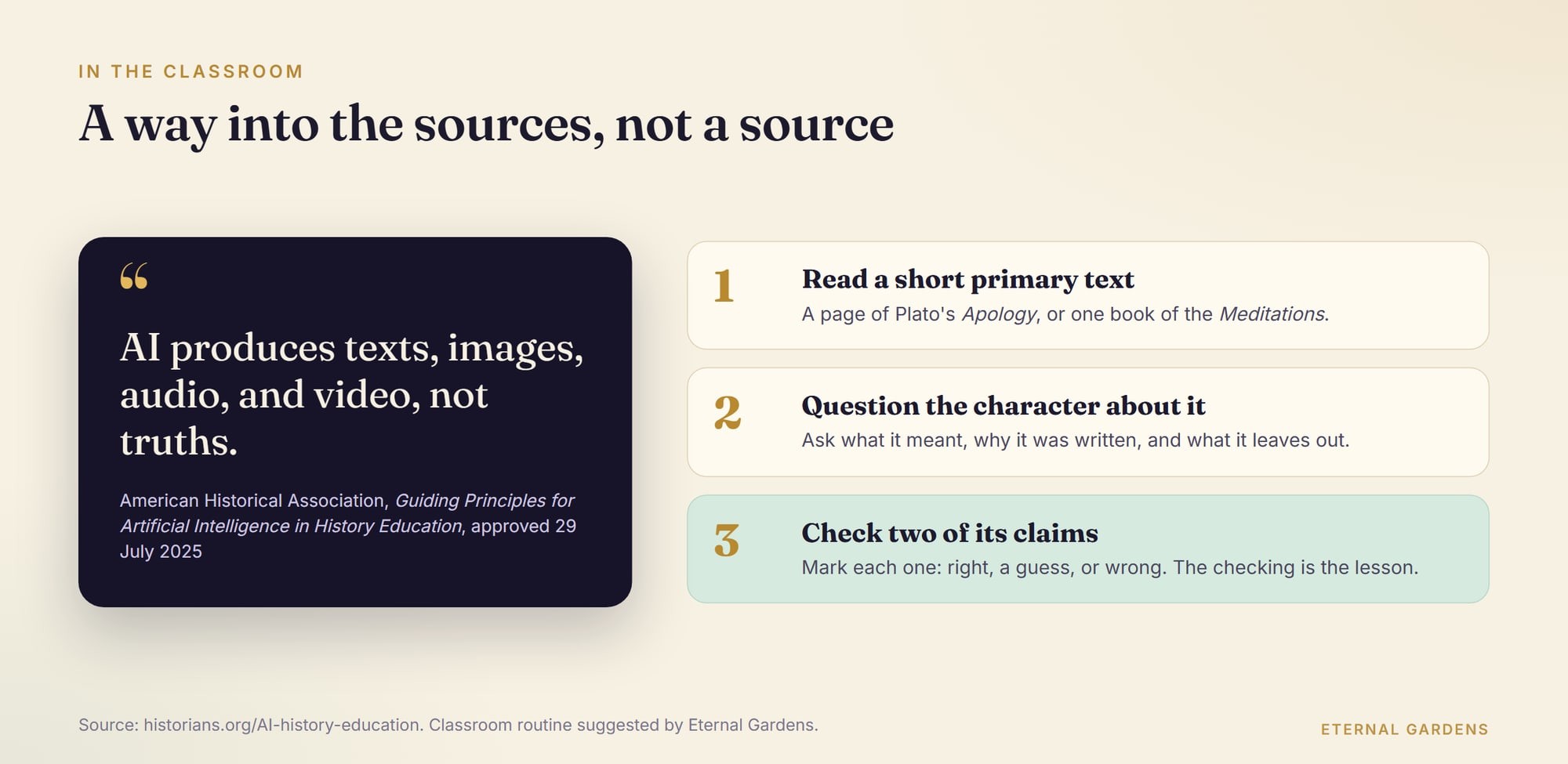
Yes, as a way into the sources, not as a source. The AHA's position is that "AI produces texts, images, audio, and video, not truths," and that it "cannot replace historical methodology."
That suggests a simple classroom routine. Students read a short primary text first, such as a page of the Apology or a book of the Meditations. Then they question the character about it. Then they check two of its claims against the text, and note where it was right, where it guessed, and where it was wrong. The checking is the lesson. A chatbot that makes a mistake gives students something real to catch.
Try it with a character
You can talk with the Socrates character on Eternal Gardens for free, without making an account. It is an AI character drawn from public-domain sources, and the chat page says so plainly. The same goes for the Marcus Aurelius character, whose page points you to the Meditations.
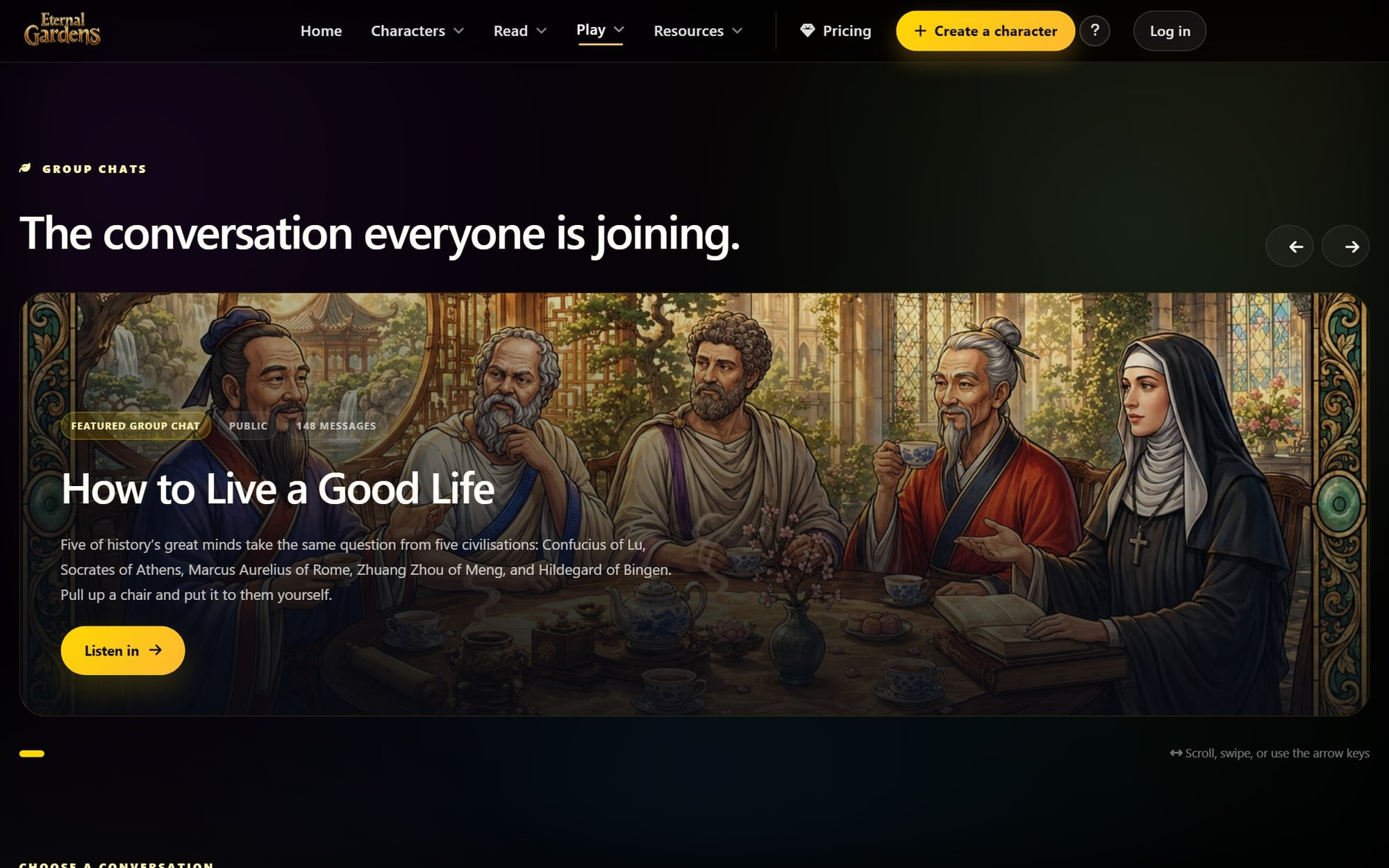
If you'd like to hear several minds at once, Garden Tea runs group chats. When we looked, its featured table put Confucius, Socrates, Marcus Aurelius, Zhuangzi and Hildegard of Bingen around one question: how to live a good life. Anyone can listen in.
A few questions to try first:
- "What is one thing you were sure of and later changed your mind about?"
- "Which of your own sentences do people misquote most?"
- "What would you want me to read before I trust anything you say?"
- "Where are the gaps in what we know about you?"
Then pick one answer and check it against the source. That is where the conversation gets interesting.
Frequently asked questions
Can you really talk to historical figures with AI?
You can talk to an AI character built from a historical figure's writings and the historical record. It is a language model playing a part, so every answer is an interpretation, not the person speaking. On Eternal Gardens each character is labelled as an interpretation grounded in published and public-domain sources. Treat it like a well-read actor: useful for ideas and questions, but check its facts.
Are AI historical figure chats accurate?
They can be accurate on well-documented topics and wrong where the record has gaps. Language models tend to guess when unsure, and the American Historical Association warns that they hallucinate references and quotations. In 2023 NBC News found bots in one app denying documented crimes. Ask where each claim comes from, and check any quote against a public-domain text before you repeat it.
Which historical figures work best for AI conversations?
People who left a lot of their own writing work best, because the AI has more real material to draw on. Marcus Aurelius left the Meditations, Ada Lovelace her Notes on the Analytical Engine, and Tesla his 1919 memoir My Inventions. Figures known only through others, such as Socrates, or through legend, such as King Arthur, leave the AI more to invent.
What questions should I ask an AI historical figure?
Ask about things the person really wrote or did, such as a passage, a design or a decision. Then ask where they said it and which part of the answer is a guess. Good openers include asking Socrates why he would not stop questioning people, or asking Ada Lovelace what Note G did step by step. Skip trivia you could look up.
Is it free to talk to historical figures with AI?
Many sites let you try for free. On Eternal Gardens you can start a conversation with characters such as Socrates or Marcus Aurelius without making an account, and you can listen in on Garden Tea group chats. Some features need a free account and paid plans exist, so check the site's pricing page for current details.
Sources
- American Historical Association, Guiding Principles for Artificial Intelligence in History Education (2025)historians.org
- Kalai, Nachum, Vempala and Zhang, Why Language Models Hallucinate (arXiv, 2025)arxiv.org
- NBC News, A chatbot that lets you talk with Jesus and Hitler is the latest controversy in the AI gold rush (2023)nbcnews.com
- Quote Investigator, Be kind, for everyone you meet is fighting a hard battle (2010)quoteinvestigator.com
- Stanford Encyclopedia of Philosophy, Socratesplato.stanford.edu
- Stanford Encyclopedia of Philosophy, Confuciusplato.stanford.edu
- Plato, Phaedo, trans. Benjamin Jowett (Project Gutenberg)gutenberg.org
- Marcus Aurelius, Thoughts, trans. George Long (Project Gutenberg)gutenberg.org
- Menabrea, Sketch of the Analytical Engine, with notes by Ada Lovelace (Fourmilab)fourmilab.ch
- LibriVox, My Inventions by Nikola Teslalibrivox.org
- Wikimedia Commons, Jacques-Louis David, The Death of Socrates (1787)commons.wikimedia.org
About the author
Eternal Gardens
Eternal Gardens is an AI character platform where you can talk with characters drawn from the writings of historical and literary figures, and build worlds and stories with them.