What did Isaac Newton discover? Gravity, light and calculus
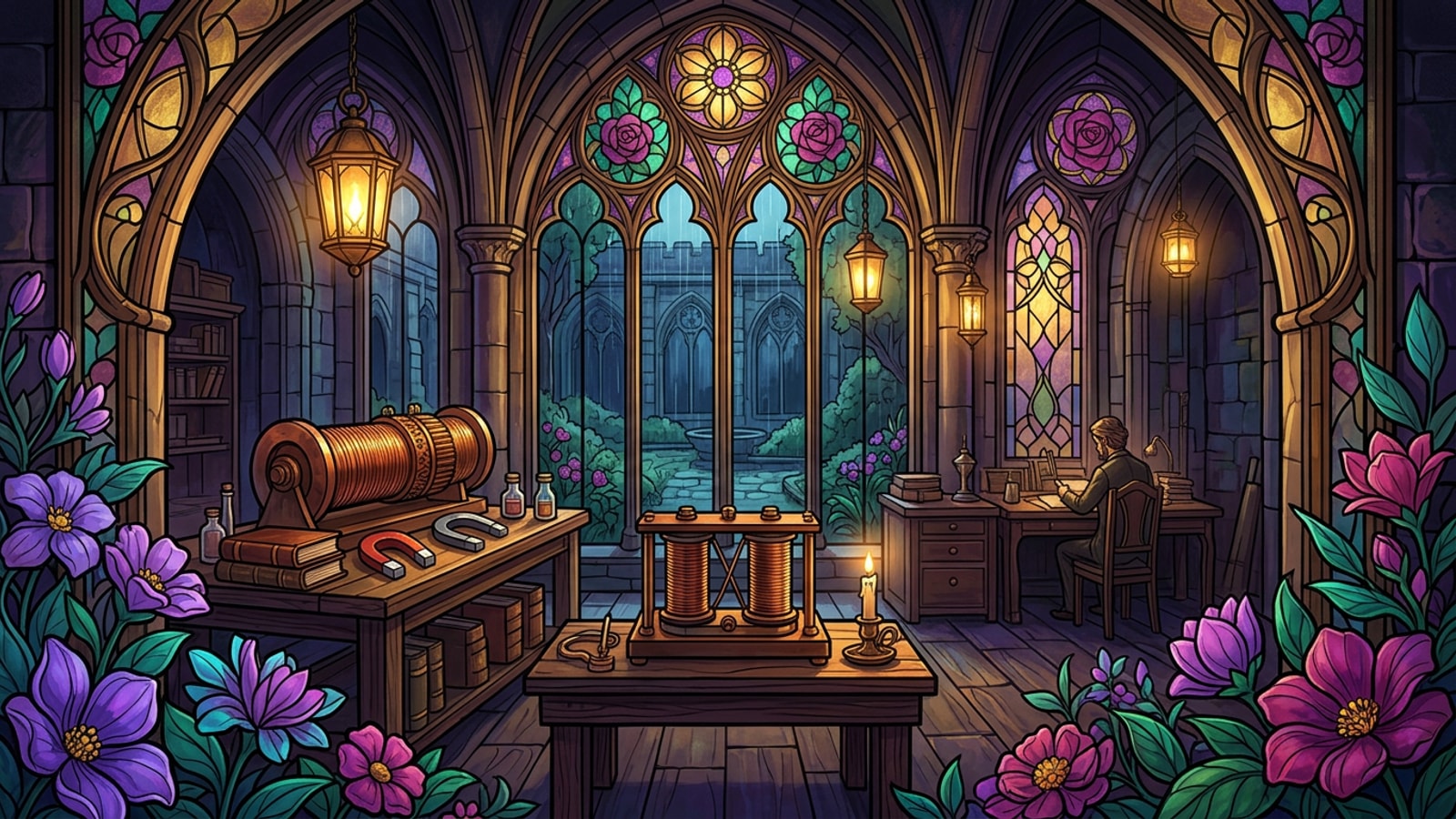
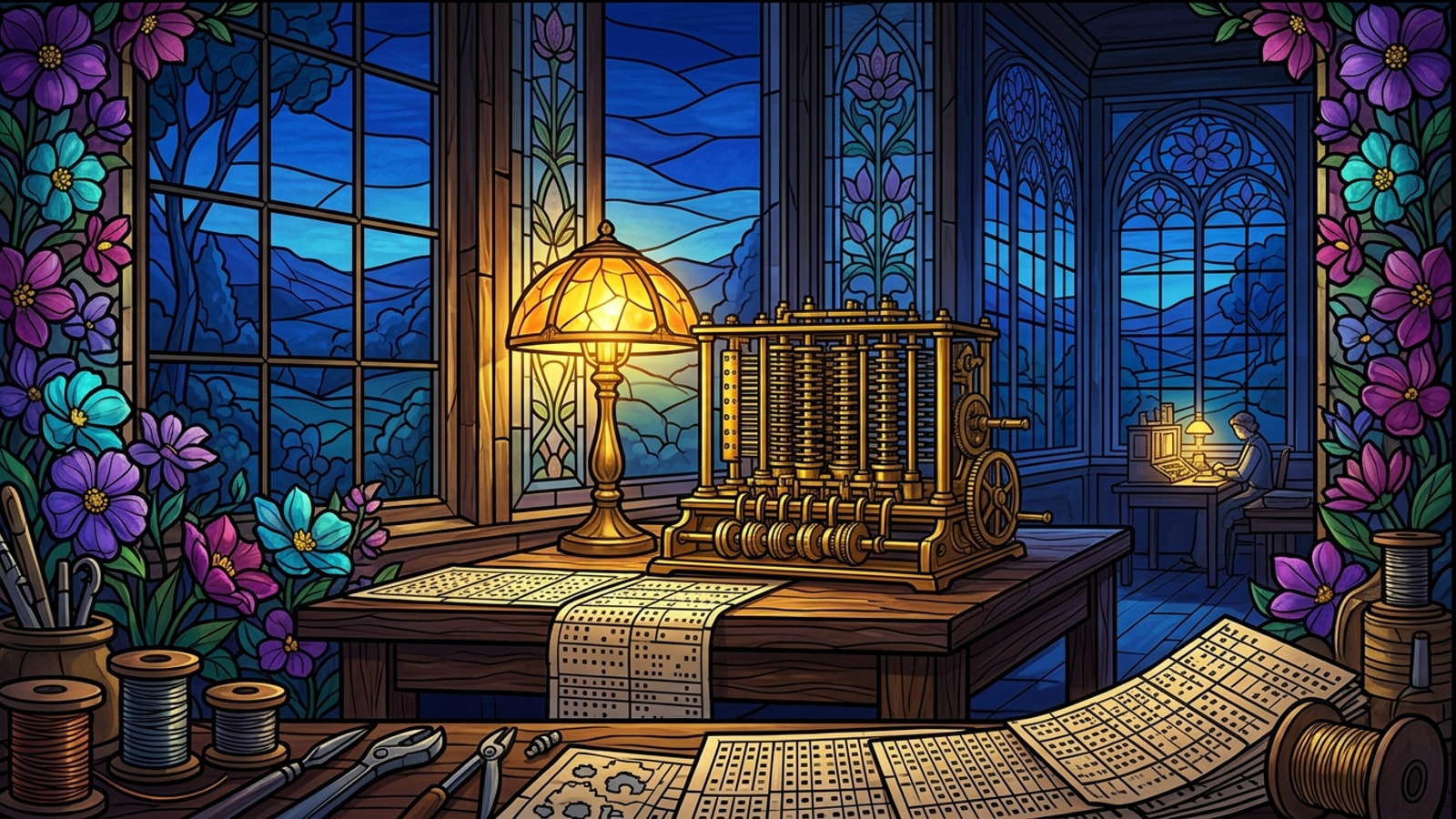
What Newton found in the plague years of 1665 and 1666, in his own words, with diagrams of the Moon test, the prism experiments and his telescope
By Eternal Gardens
8 min read
In this article
- What did Isaac Newton discover? The short list
- What did Newton do in the plague years?
- How did Newton discover gravity?
- Did an apple really hit Newton on the head?
- What are Newton's three laws of motion?
- What did Newton discover about light?
- Did Newton invent calculus?
- Why did Newton build a reflecting telescope?
- Which Newton stories are myths?
- Ask Newton about the plague years
Isaac Newton discovered that one law of gravity pulls on an apple and holds the Moon in orbit. He also found that white light is a mix of colours, and he worked out calculus, which he called fluxions. He stated three laws of motion that still bear his name. Most of this began in 1665 and 1666, when plague closed Cambridge.
Newton was 22 when the plague struck. He went home to his family's house at Woolsthorpe, in Lincolnshire, and spent most of the next two years thinking. This guide takes each discovery in turn, using his own words where they survive.
What did Isaac Newton discover? The short list
Newton's main discoveries were calculus, the nature of white light, the laws of motion and the law of universal gravitation. He also built the first working telescope that used a mirror instead of a lens. Here is when he found each one, and when the world heard about it.
| Discovery | When he found it | When he published |
|---|---|---|
| Binomial series (a way to expand powers into endless sums) | Early 1665 | Shared in letters, 1676 |
| Calculus ("fluxions") | November 1665 to May 1666 | 1704, and in full in 1736 |
| White light is a mixture of colours | January 1666 | 1672, in the Royal Society's journal |
| Gravity reaches the Moon | 1666 | 1687, in the Principia |
| Three laws of motion | Early versions by 1666 | 1687, in the Principia |
| Reflecting telescope | Built by 1671 | 1672 |
The gap between those two columns is the surprise. Newton was slow to publish and feared criticism. Some of his best work sat in a drawer for decades.
What did Newton do in the plague years?
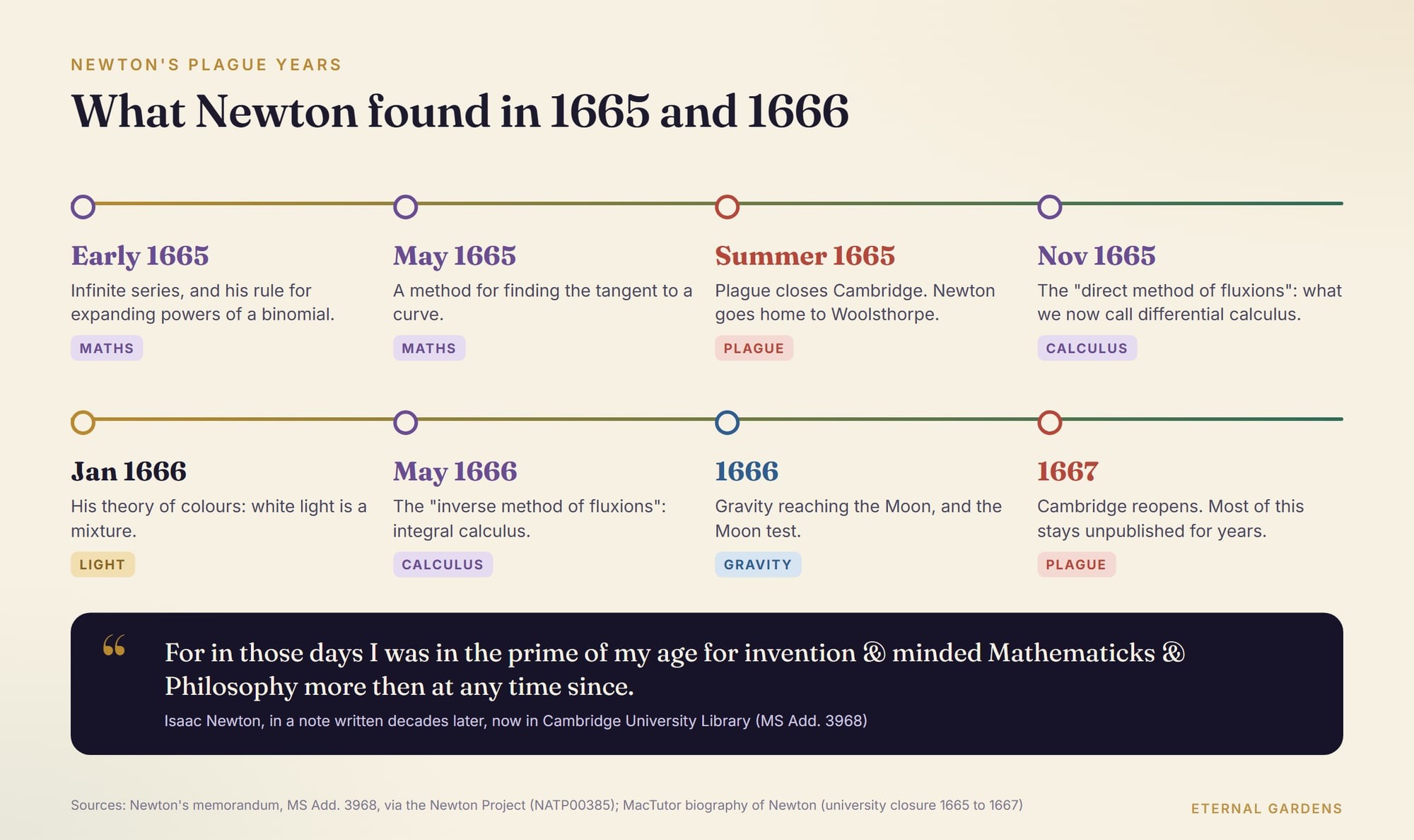
Plague closed the University of Cambridge in the summer of 1665, and it did not reopen until 1667. Newton had just taken his degree at Trinity College, and he went home. The MacTutor biography notes that he was still under 25. Away from his teachers, he did his most important work.
We know the order of events because Newton wrote it down. Decades later, he listed the steps in a note now kept at Cambridge University Library. The Newton Project has the full text:
All this was in the two plague years of 1665 & 1666. For in those days I was in the prime of my age for invention & minded Mathematicks & Philosophy more then at any time since.
The note sits among his papers about the fight with Leibniz over calculus, so he had a reason to stress how early he started. Still, his 1672 paper on light, written long before that quarrel, also dates his prism work to 1666.
How did Newton discover gravity?
Newton did not discover that things fall. His discovery was that the force pulling an apple down is the same force that keeps the Moon in its orbit, and that it weakens with distance in a fixed way. Double the distance, and the pull drops to a quarter.
The famous apple is real, in the sense that Newton told the story himself. On 15 April 1726, a year before he died, his friend William Stukeley came to visit. In Stukeley's memoir, they took tea "under the shade of some appletrees", and Newton said he was in the same spot as "when formerly, the notion of gravitation came into his mind". The idea was "occasion'd by the fall of an apple, as he sat in a comtemplative mood".
Then came the hard part. In 1666, Newton says, he "compared the force requisite to keep the Moon in her Orb with the force of gravity at the surface of the earth, & found them answer pretty nearly."
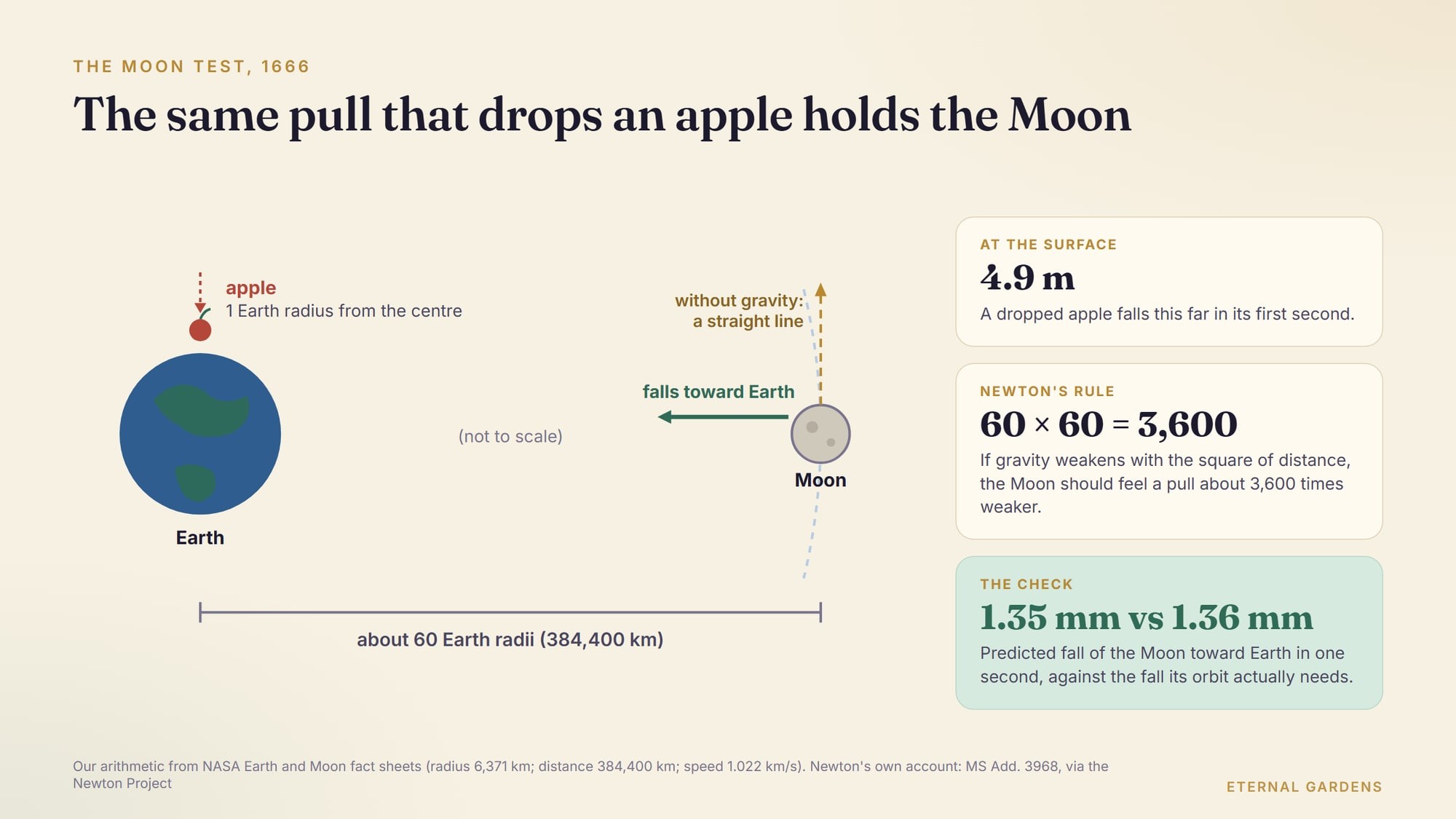
The Moon is about 60 times farther from Earth's centre than an apple is. If gravity weakens with the square of distance, the pull at the Moon should be 60 × 60, or 3,600, times weaker. Run the sums with modern NASA figures and the answer is almost exactly the pull needed to bend the Moon's path into its orbit.
Did an apple really hit Newton on the head?
Not in Newton's own telling. Stukeley's account has the apple fall while Newton sat thinking in the garden. Nothing in it hits him.
What are Newton's three laws of motion?
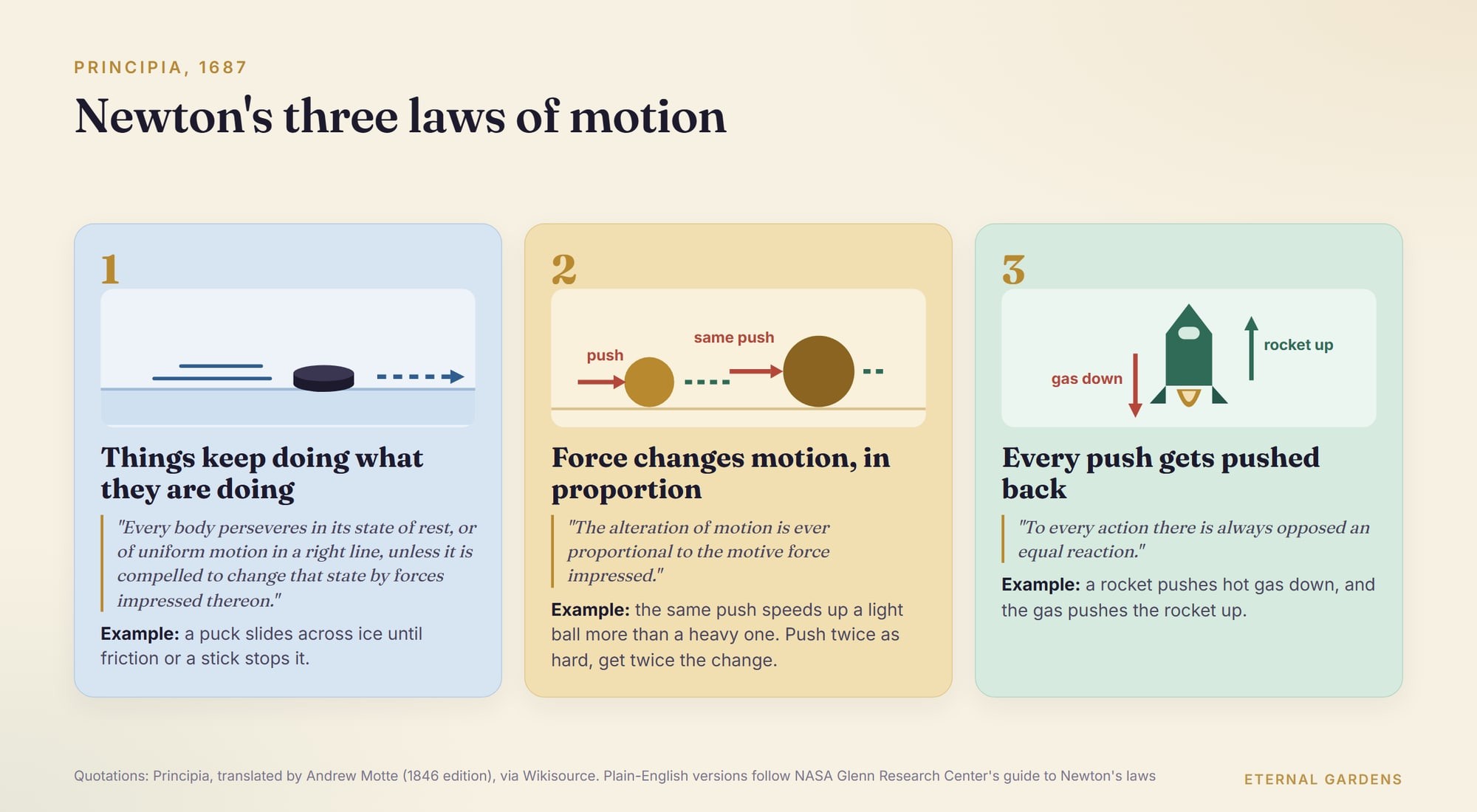
Newton's three laws say that objects keep doing what they are doing unless a force acts, that force changes motion in proportion to its size, and that every action has an equal and opposite reaction. He published them in 1687 in the Principia, after the astronomer Edmond Halley pushed him to write the book.
In the English translation of the Principia, the laws read like this:
- "Every body perseveres in its state of rest, or of uniform motion in a right line, unless it is compelled to change that state by forces impressed thereon."
- "The alteration of motion is ever proportional to the motive force impressed".
- "To every action there is always opposed an equal reaction".
With these laws and his law of gravity, Newton explained the long, stretched orbits of comets. The same sums explained the tides and the slow wobble of Earth's axis. One set of rules now covered both the sky and the ground.
He did not claim to know what gravity is. In the essay that closes the book, he wrote: "I have not been able to discover the cause of those properties of gravity from phænomena, and I frame no hypotheses".
What did Newton discover about light?
Newton showed that white light is a mixture of all the colours, and that a prism splits them apart rather than adding colour. Before him, most people thought glass coloured the light.
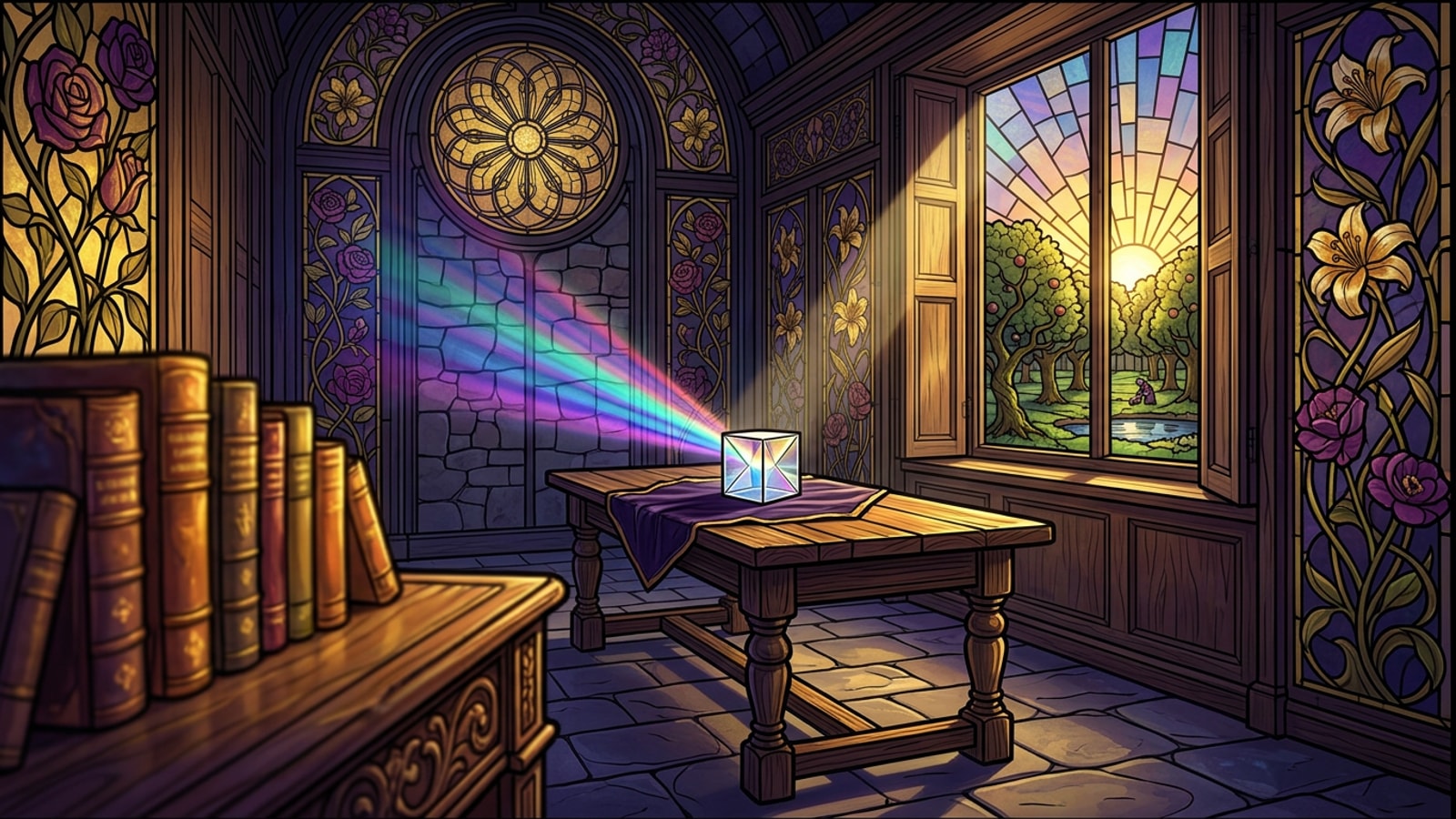
His 1672 letter to the Royal Society tells the story. "In the beginning of the Year 1666," he wrote, he got hold of a glass prism. He darkened his room, made a small hole in the shutters and let a beam of sunlight through the prism onto the far wall.
He expected a round spot of colour. Instead the band of colours was about five times longer than it was wide. That puzzled him.
So he set up what he called the experimentum crucis, the deciding test. He let just one colour through holes in two boards and sent it through a second prism. The second prism bent that colour again but did not change it. Green light stayed green. In another test he used a lens to bring all the colours back together, and they made white light again.
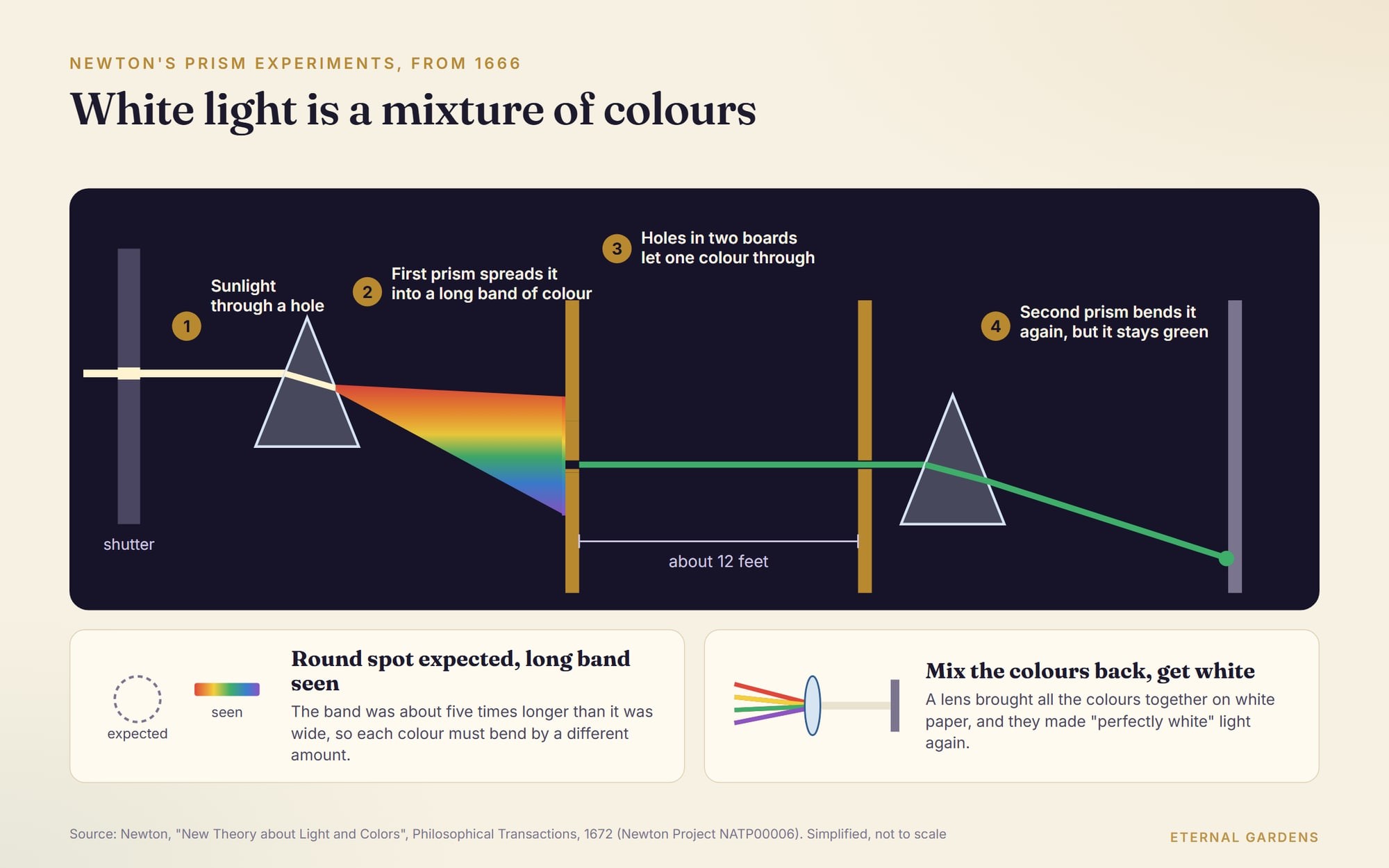
His conclusion: "Light it self is a Heterogeneous mixture of differently refrangible Rays." In plain words, each colour bends by its own amount.
Did Newton invent calculus?
Newton and Gottfried Leibniz both invented calculus, separately. Newton got there first, in 1665 and 1666, but kept it private. Leibniz worked it out in Paris in the mid-1670s and published first, in 1684.
The maths we learn in school uses Leibniz's symbols, like dx and the long S for integrals. Newton wrote about "fluxions", or rates of flow. His main book on the method, written in 1671, did not appear in print until 1736, nine years after his death.
The fight over credit turned ugly. In 1711 a supporter of Newton accused Leibniz of copying. The Royal Society, with Newton as its president, set up a committee to judge. Newton wrote its report himself. The MacTutor history of mathematics archive calls the committee "totally biased", since it never asked Leibniz for his side.
Why did Newton build a reflecting telescope?
Newton built a reflecting telescope because his prism work showed why lens telescopes made blurry, coloured images. A lens bends each colour differently, so they never meet at one point. A mirror reflects all colours the same way. So Newton built a telescope with a curved metal mirror instead of a lens.
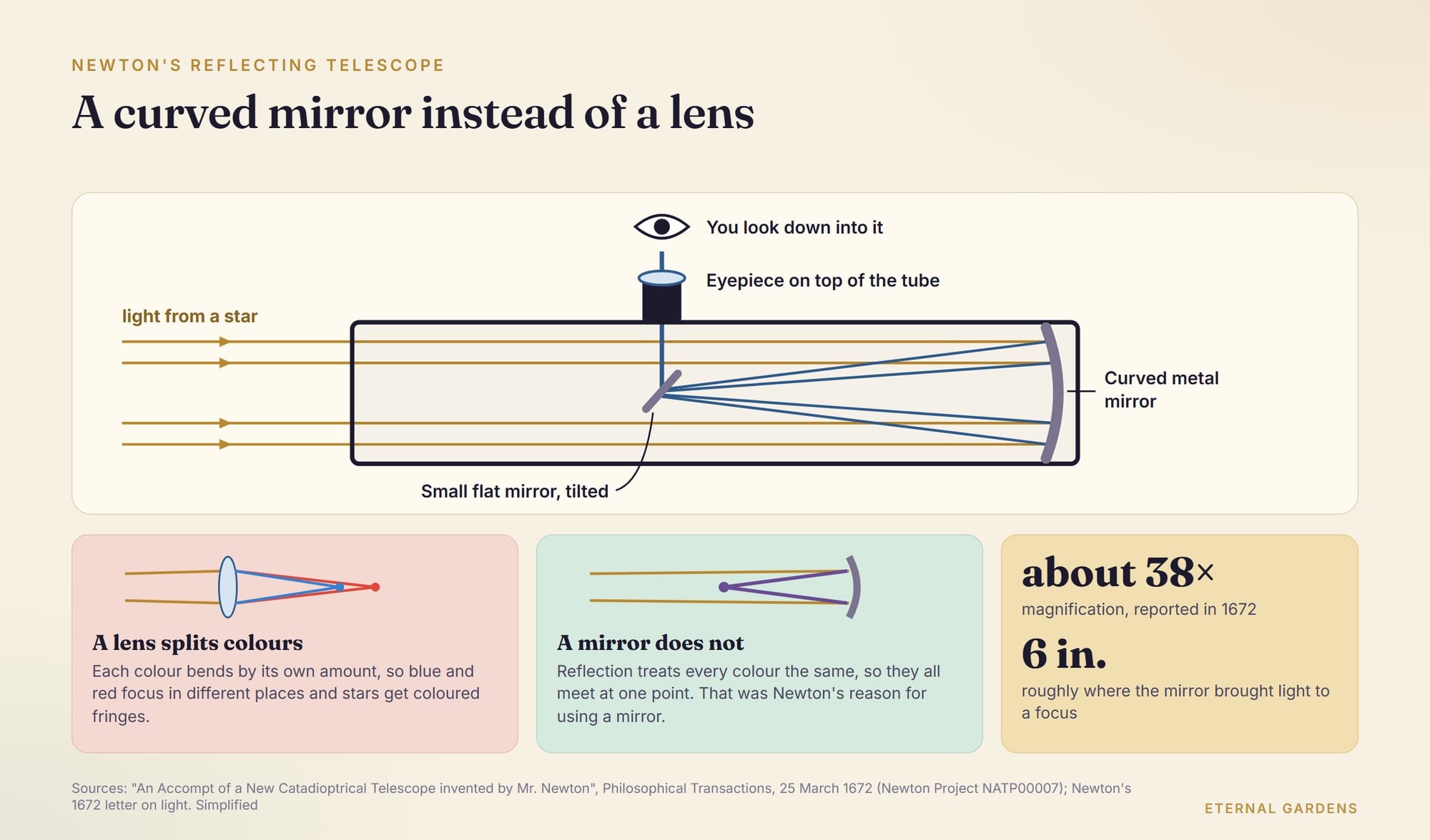
Its mirror brought light to a focus just over six inches away. The Royal Society's journal reported in 1672 that it magnified objects "about 38 times", and that such tubes "may be considerably shortned without prejudice to their magnifying effect". The Society elected Newton a Fellow that year. The Scottish mathematician James Gregory had described a reflecting telescope in a book, but it had not been built. Newton's was the first that worked.
Which Newton stories are myths?
Some of the best-known Newton stories mix fact and fiction. Here is how they compare with the record.
| The story | What the sources show |
|---|---|
| An apple hit him on the head | Newton told Stukeley he saw an apple fall. Stukeley says nothing about his head. |
| Newton discovered gravity | People always knew things fall. He showed one law covers the Earth and the sky. |
| Newton invented calculus alone | Leibniz found it independently and published first. |
| Newton found that prisms make colours | Prism colours were well known. He showed the colours were already in the light. |
| Newton invented the reflecting telescope | James Gregory described one first. Newton built the first working one. |
| Newton only did science | He also ran alchemy experiments, and from 1696 he worked at the Royal Mint and hunted forgers. |
That last row is worth a word. Newton moved to London in 1696 as Warden of the Mint and became Master in 1699. To catch counterfeiters, he paid informers to listen in pubs and prison cells. He was President of the Royal Society from 1703 and was knighted in 1705. He died on 31 March 1727 and is buried in Westminster Abbey.
Ask Newton about the plague years
Eternal Gardens has a Sir Isaac Newton character you can talk with. Its page calls him the "Lucasian Professor, author of the Principia, and the man who took white light apart with a prism". It is an Eternal Gardens interpretation of Isaac Newton, grounded in published and public-domain sources. It is not the historical figure and does not speak for him. You can start a conversation free, without an account.
Good questions to try:
- What did you do at Woolsthorpe when Cambridge closed?
- How did you compare the Moon's orbit with a falling apple?
- What did the second prism show you that the first one could not?
- Why did you wait so long to publish your fluxions?
- How would you settle a question by experiment?
Ask it where its answers come from, and check them against the dates above. If you like this kind of science history, read about what Michael Faraday is famous for or try our guide on how to talk to historical figures with AI.
Frequently asked questions
When did Isaac Newton discover gravity?
Newton began thinking about gravity reaching the Moon in 1666, while plague kept Cambridge closed. He compared the pull needed to hold the Moon in orbit with gravity at Earth's surface and found they matched pretty nearly. He did not publish the full law of universal gravitation until 1687, in the Principia, after Edmond Halley urged him to write the book.
Did an apple really fall on Newton's head?
Not in the account Newton himself gave. He told his friend William Stukeley in April 1726 that the idea of gravitation came to him when he saw an apple fall as he sat thinking in a garden. Stukeley wrote the story down in his memoir of Newton. Nothing in it says the apple hit him.
What are Newton's three laws of motion?
The first law says an object stays at rest or keeps moving in a straight line unless a force acts on it. The second says the change in motion is proportional to the force. The third says every action has an equal and opposite reaction. Newton published all three in the Principia in 1687.
Did Newton or Leibniz invent calculus?
Both did, separately. Newton worked out his method of fluxions in 1665 and 1666 but did not publish it for decades. Gottfried Leibniz developed his own version in the mid-1670s and published first, in 1684. The symbols used in schools today, such as dx and the integral sign, come from Leibniz.
What did Newton discover about light?
Newton showed that white light is a mixture of colours, and that each colour bends by its own fixed amount in glass. A prism separates colours that are already in the light. He also used a lens to mix the colours back into white. He reported these experiments to the Royal Society in 1672.
Sources
- MacTutor History of Mathematics: Isaac Newtonmathshistory.st-andrews.ac.uk
- Newton Project: Newton's fragments on the Leibniz dispute, incl. the plague-years memorandum (MS Add. 3968, Cambridge University Library)newtonproject.ox.ac.uk
- Newton Project: Newton, A Letter containing his New Theory about Light and Colors (Philosophical Transactions, 1672)newtonproject.ox.ac.uk
- Newton Project: An Accompt of a New Catadioptrical Telescope invented by Mr. Newton (Philosophical Transactions, 1672)newtonproject.ox.ac.uk
- Newton Project: William Stukeley, Memoirs of Sir Isaac Newton's Lifenewtonproject.ox.ac.uk
- Principia, Motte translation (1846), Axioms, or Laws of Motion, Wikisourceen.wikisource.org
- Principia, Motte translation (1846), General Scholium, Wikisourceen.wikisource.org
- MacTutor History of Mathematics: Gottfried Wilhelm Leibnizmathshistory.st-andrews.ac.uk
- MacTutor History of Mathematics: James Gregorymathshistory.st-andrews.ac.uk
- NASA Glenn Research Center: Newton's Laws of Motionwww1.grc.nasa.gov
- NASA: Moon Fact Sheetnssdc.gsfc.nasa.gov
- NASA: Earth Fact Sheetnssdc.gsfc.nasa.gov
- Scientific American: What's the real story with Newton and the apple? (2010)scientificamerican.com
- Westminster Abbey: Sir Isaac Newtonwestminster-abbey.org
- Physics World: The giant and the thief (2010)physicsworld.com
About the author
Eternal Gardens
Eternal Gardens is an AI character platform where you can talk with characters drawn from the writings of historical and literary figures, and build worlds and stories with them.