Tesla vs Edison: AC vs DC and the war of the currents
What the two inventors really fought about, how alternating current won, and which famous stories are myths
By Eternal Gardens
8 min read

In this article
Tesla vs Edison was a fight over how to send electricity. Thomas Edison sold direct current (DC), which could only reach a mile or two from a power station. Alternating current (AC), built on Nikola Tesla's 1888 motor patents and sold by George Westinghouse, could travel hundreds of miles. AC won by 1896, and it still runs the grid.
The two men also had a short, awkward history as boss and employee. Many stories about them are true. Several famous ones are not, and this guide sorts them out.
Tesla vs Edison at a glance
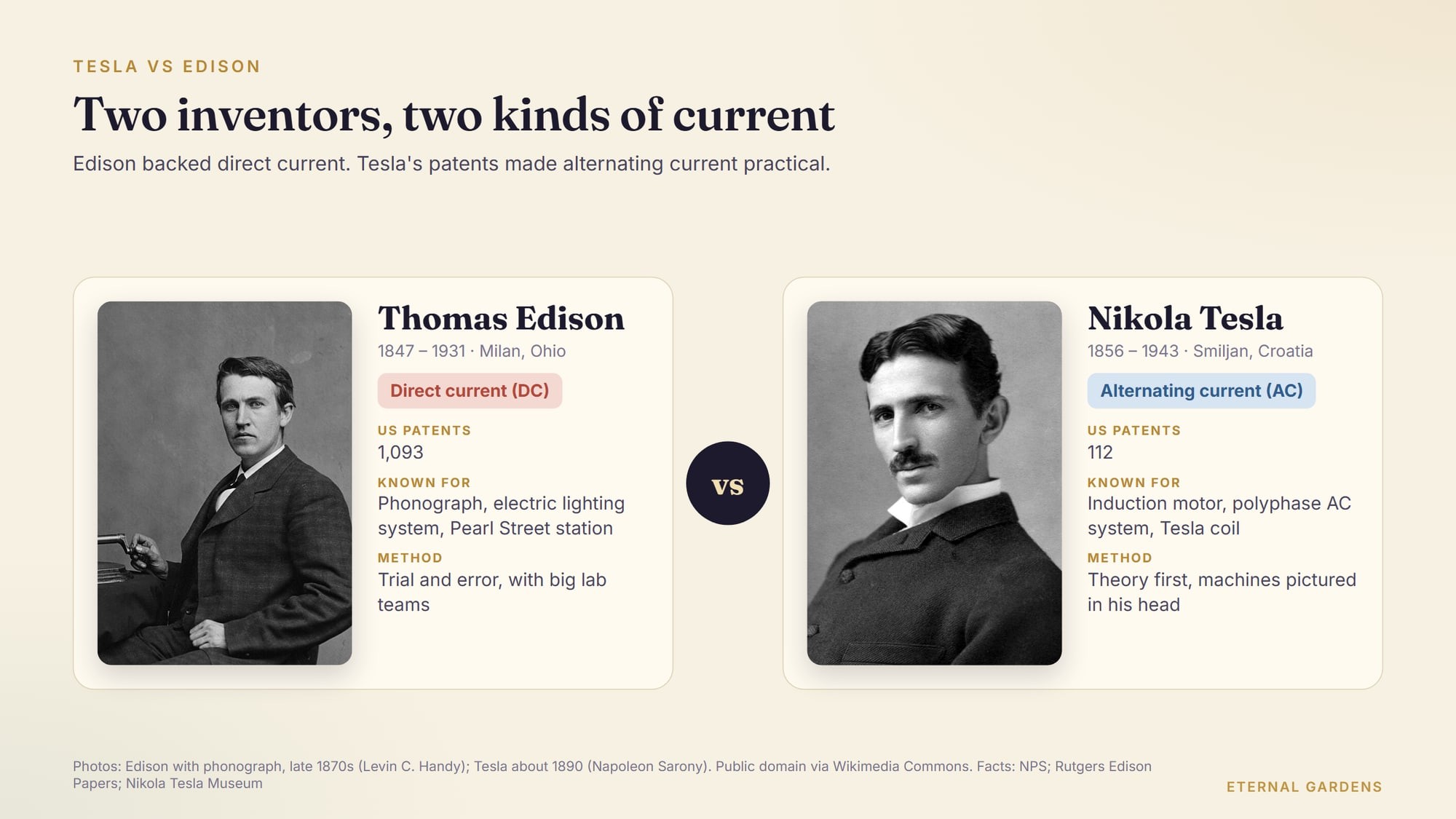
Edison was a businessman-inventor who worked by trial and error and held 1,093 US patents. Tesla was a trained engineer who worked from theory and held 112 US patents. They clashed over which current should power America, though Westinghouse did most of the fighting on Tesla's side.
| Thomas Edison | Nikola Tesla | |
|---|---|---|
| Born | 11 February 1847, Milan, Ohio | 1856, Smiljan, in today's Croatia |
| Died | 18 October 1931 | 7 January 1943 |
| US patents | 1,093 | 112 |
| Best known for | Light bulb system, phonograph, Pearl Street power station | Induction motor, polyphase AC system, Tesla coil |
| Current he backed | Direct current (DC) | Alternating current (AC) |
| How he worked | Trial and error, with a large lab team | Theory first, pictured machines in his head |
Did Tesla really work for Edison?
Yes, for about six months. Tesla arrived in New York on 6 June 1884, aged 28, with a letter of introduction from Edison's office in Paris. PBS reports that Edison hired him the same day.
Tesla redesigned Edison's generators and worked very long hours. In his 1919 memoir My Inventions, he recalled Edison's praise: "I have had many hard-working assistants but you take the cake."
The two men saw the world differently. Historian Jill Jonnes told PBS that Edison called Tesla a "poet of science", and did not mean it kindly. When Tesla described his AC motor, PBS says, Edison told him he was wasting his time.
Then came the money dispute. In the popular version, Edison promised Tesla $50,000 to improve the dynamos, then laughed it off. One PBS page quotes Edison saying, "When you become a full-fledged American you will appreciate an American joke."
Tesla's own memoir tells it a little differently. He wrote that "the Manager" made the promise, and that "it turned out to be a practical joke." Tesla felt cheated and quit. PBS says he spent the next winter digging ditches for $2 a day.
His luck turned in 1888. George Westinghouse bought Tesla's AC patents for $60,000 in cash and shares, plus a royalty of $2.50 for every horsepower of AC capacity sold.
AC vs DC: what is the difference?
Direct current flows one way, like water in a pipe. Alternating current flips direction back and forth, 60 times a second in the US. The big difference in 1890 was that AC voltage could be changed with a transformer, and DC voltage could not.
That mattered because power lines lose energy along the way, and the loss is lower at high voltage. With AC, a plant could step the voltage up for a long line, then step it down again for homes. Edison's 110-volt DC had no easy way to do that. So it needed a power station every mile or so.
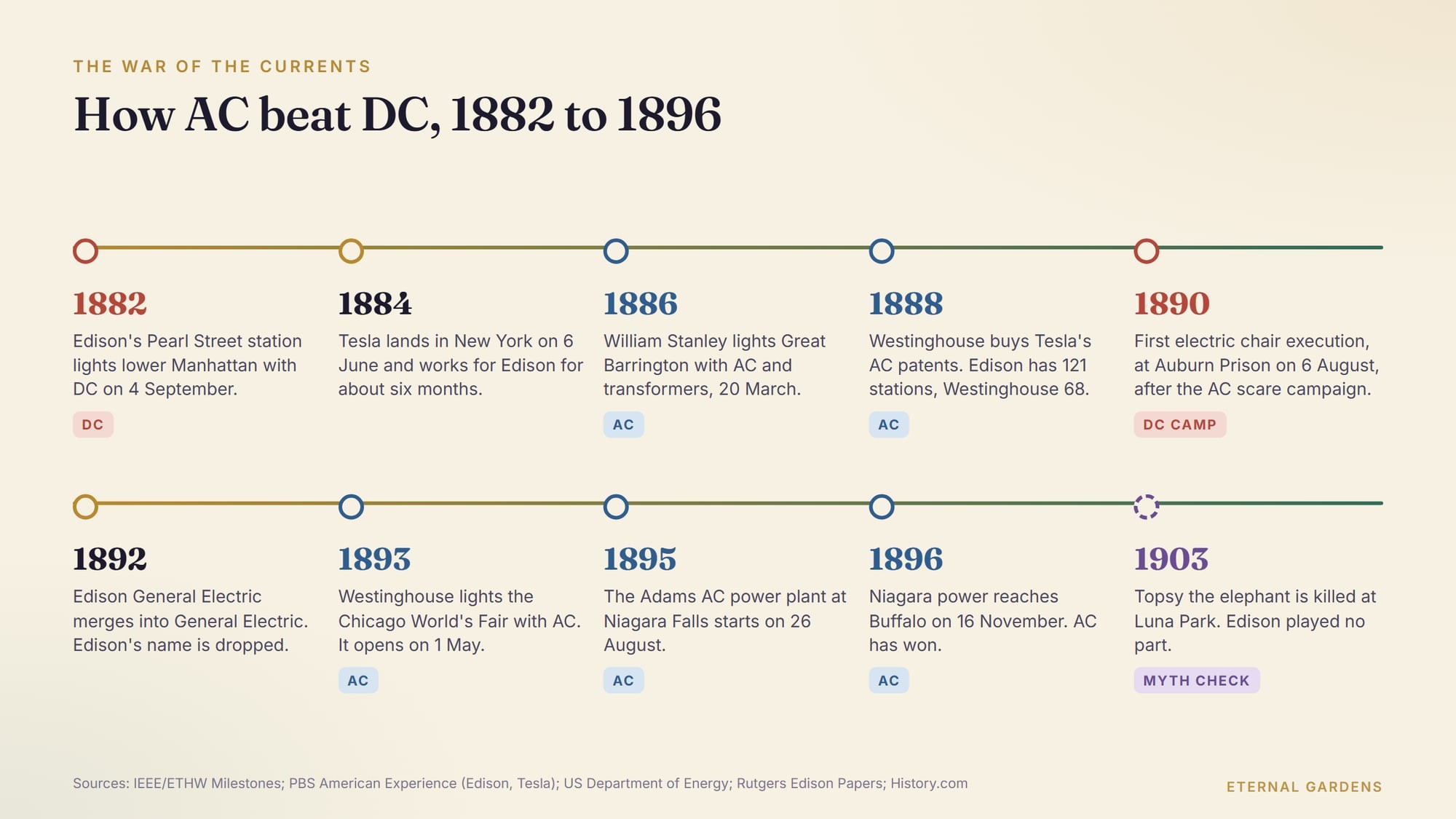
Edison's first station shows the limit. Pearl Street in lower Manhattan started on 4 September 1882 with six steam-driven dynamos. It served about 85 customers on its first day, all inside a district of one-quarter square mile. To light a whole city that way, you would need a great many stations.
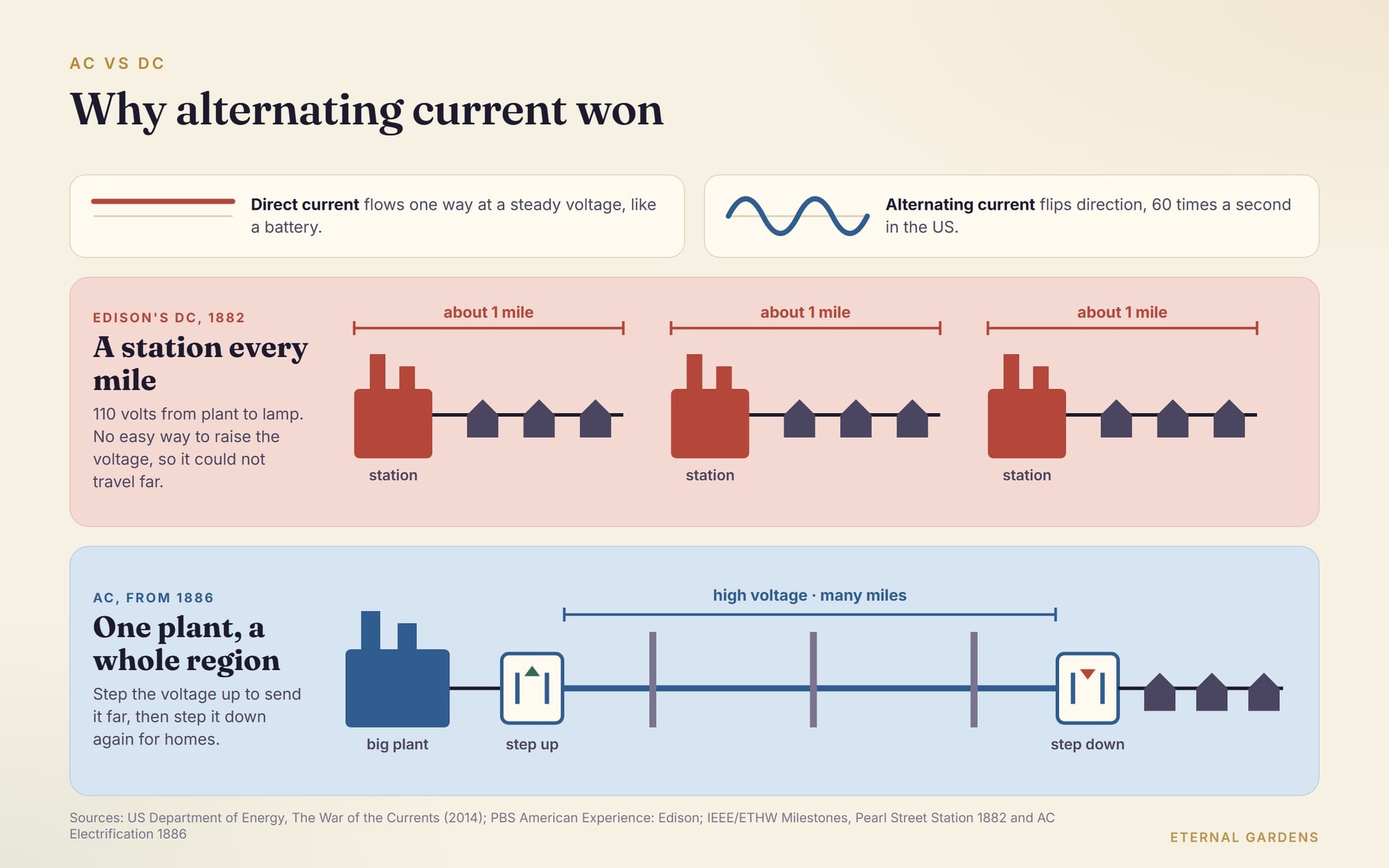
The first practical AC lighting system with transformers ran on Main Street in Great Barrington, Massachusetts, on 20 March 1886. William Stanley built it, and the IEEE now marks it as a Milestone. What AC still lacked was a good motor. Tesla supplied one with his 1888 induction motor patents, which you can read about in our guide to what Nikola Tesla invented.
What was the war of the currents?
The war of the currents was the commercial fight between Edison's DC companies and the AC companies, mainly Westinghouse, in the late 1880s and early 1890s. It was fought with sales pitches and newspaper stories, and with some grim public stunts.
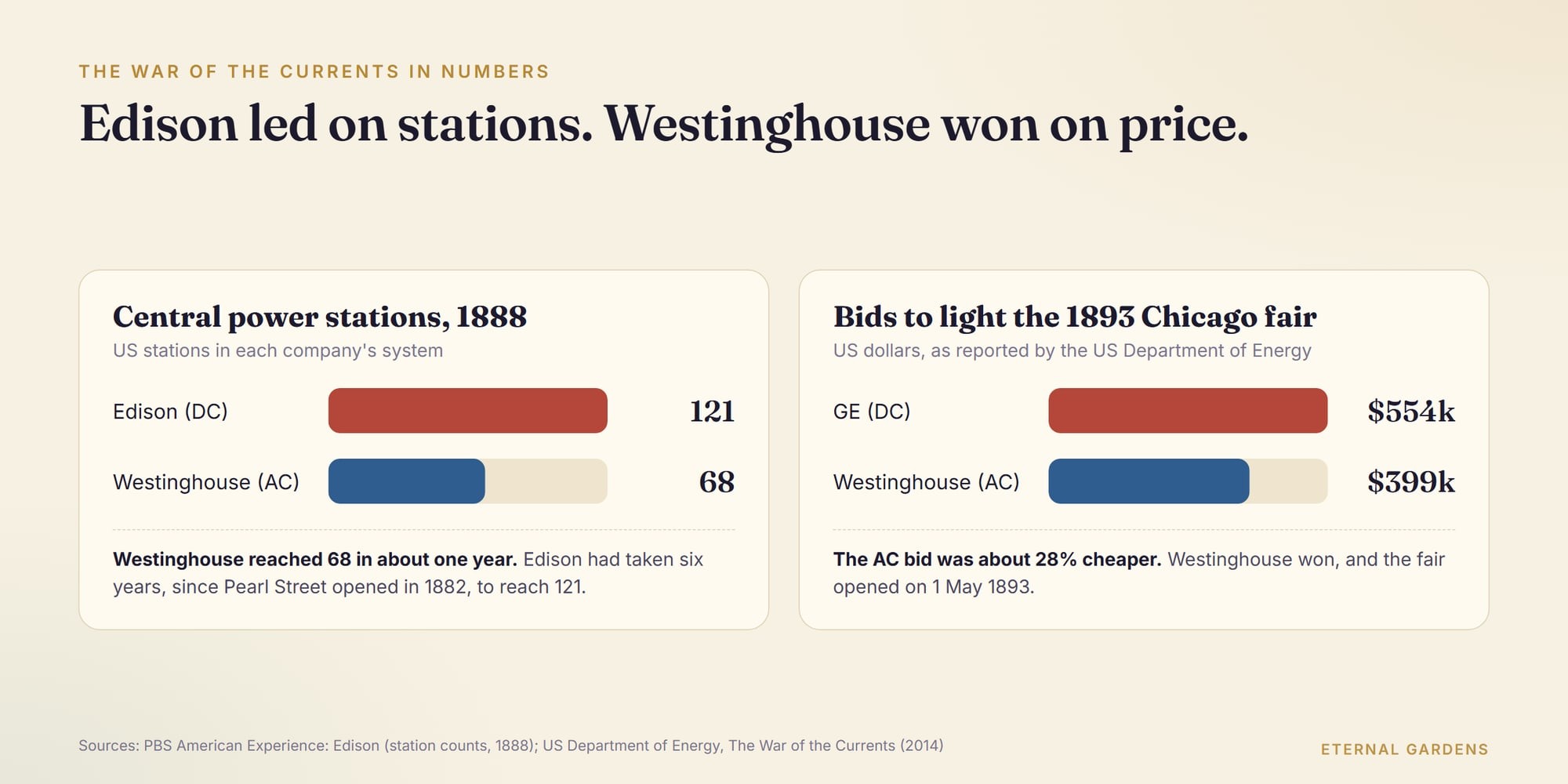
By 1888, PBS reports, Edison had 121 central stations. Westinghouse already had 68 after one year in the business. Edison answered with a safety campaign. In a widely read pamphlet he wrote:
"It is a matter of fact that any system employing high voltage jeopardizes life." (Thomas Edison, in a pamphlet quoted by PBS American Experience: Edison)
Was Edison sincere? Paul Israel of the Edison Papers told PBS: "I think he had real concerns about danger, but this was his system."
Edison's lab in West Orange, New Jersey, electrocuted animals with AC to make the point. The Edison Papers at Rutgers say most were dogs supplied by the local animal welfare society. An engineer named Harold Brown went further and electrocuted animals in public.
The same work fed into New York's search for a "humane" way to execute prisoners. On 6 August 1890, William Kemmler became the first person put to death in the electric chair, at Auburn Prison. The first shock, about 700 volts for 17 seconds, did not kill him. A second shock of 1,030 volts was needed.
Where was Tesla in all this? Mostly in his lab. Westinghouse had bought his patents in 1888. The fighting was largely done by the companies, not by Tesla himself.
How did AC win the war of the currents?
AC won on price. It needed less copper and fewer power stations, so it was cheaper to build. Two contracts sealed it: the 1893 Chicago World's Fair and the Niagara Falls power plant.
According to the US Department of Energy, General Electric bid $554,000 to light the Chicago fair with DC. Westinghouse won with an AC bid of $399,000. The fair opened on 1 May 1893.
Niagara came next. The Adams power plant started up on 26 August 1895, and its AC power reached Buffalo on 16 November 1896.
Edison lost even inside his own company. In 1892, Edison General Electric merged with its rival Thomson-Houston to form General Electric, and Edison's name was dropped. The new firm moved to AC. Edison had warned the money men:
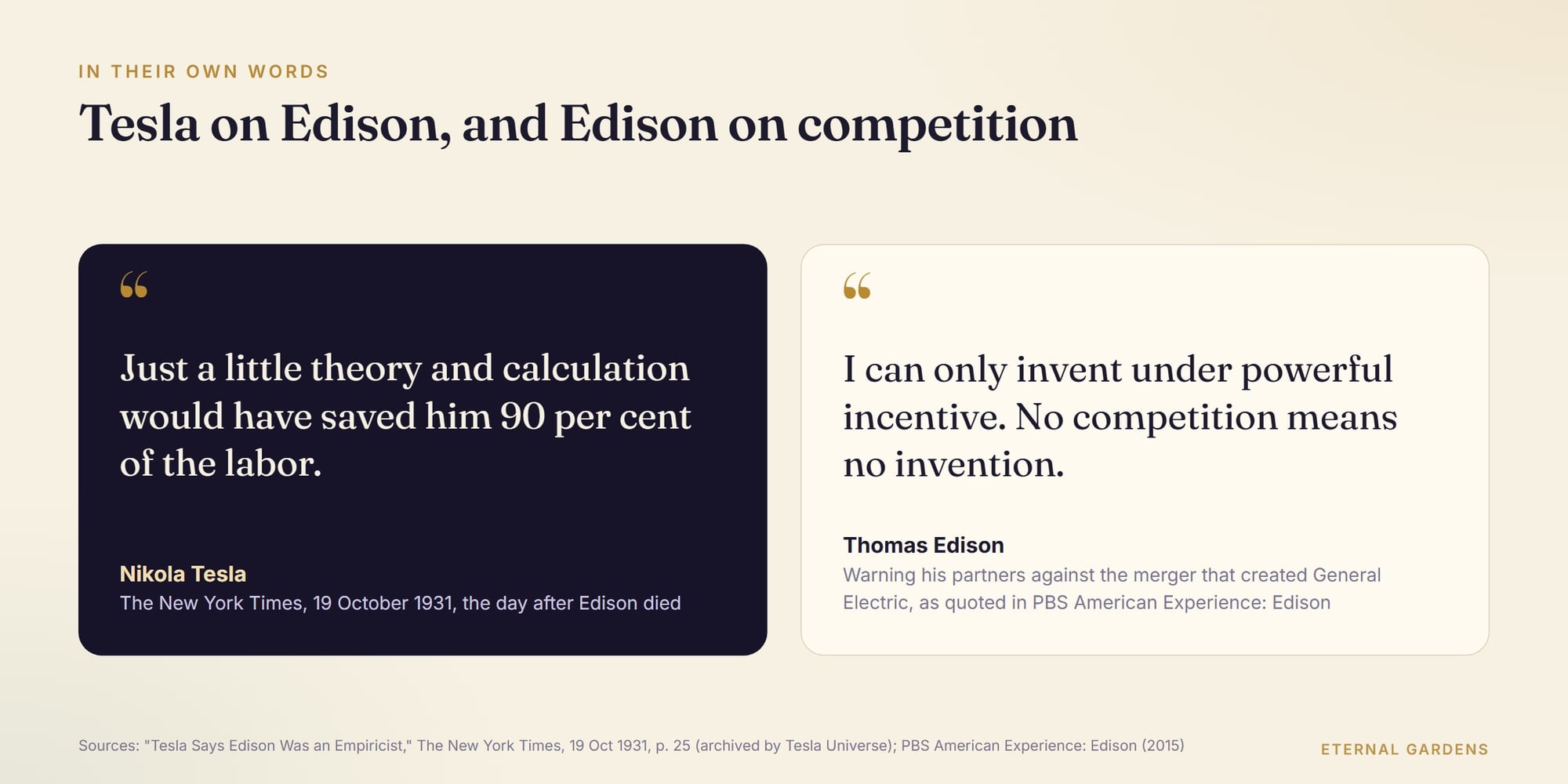
"If you make the coalition my usefulness as an inventor is gone. I can only invent under powerful incentive. No competition means no invention." (Thomas Edison, as quoted in PBS American Experience: Edison)
Is DC making a comeback?
In a way, yes. Inside, your laptop and your LED bulbs run on DC. So do solar panels and electric cars. The Department of Energy also notes that high-voltage DC lines now carry power over long distances with less loss. Modern electronics can change DC voltage, which was impossible in Edison's day.
Which Tesla vs Edison stories are myths?
Some of the best-known stories fall apart when you check them. Here are the main ones.
| Story | What the record shows |
|---|---|
| Edison electrocuted Topsy the elephant to attack Tesla | No. Topsy was killed at Coney Island's Luna Park on 4 January 1903, more than a decade after the fight ended. The Edison Papers find no sign Edison took part. His film company did shoot it |
| Edison personally cheated Tesla out of $50,000 | Unclear. Tesla's own 1919 account blames "the Manager," not Edison |
| Edison and Tesla turned down a shared Nobel Prize | No. In November 1915 the trade paper Electrical World passed on an unconfirmed report that they would share it. The 1915 physics prize went to William Henry Bragg and his son Lawrence |
| Tesla vs Edison was a personal feud | Partly. The commercial war was mostly Edison vs Westinghouse |
| Tesla tore up a fortune for Westinghouse | Partly true. PBS says Westinghouse asked him to give up his $2.50-per-horsepower royalty, and Tesla agreed |
Who was the better inventor?
They were good at different things, so the honest answer is that it depends what you count. Edison built systems and companies. Tesla had deeper theory and bolder ideas, but he struggled to turn them into businesses.
Edison's labs at Menlo Park and later West Orange were factories for invention, where teams tested idea after idea. From them came the phonograph in 1877, a complete electric lighting system shown in December 1879, and motion pictures in 1891. Tesla worked from theory. He said the motors he built in his new lab in 1887 were exactly as he had pictured them, and that he "merely reproduced the pictures as they appeared to my vision."
Edison was the better businessman, with more than 300 companies to his name. Tesla's big ideas, like wireless power from his Wardenclyffe tower, often ran out of money before they worked.
When Edison died in 1931, Tesla gave The New York Times a mixed tribute. He called Edison "the last exponent of the purely empirical method of investigation" and added:
"Just a little theory and calculation would have saved him 90 per cent of the labor." (Nikola Tesla, The New York Times, 19 October 1931)
There is a nice twist, too. Tesla won the Edison Medal of the American Institute of Electrical Engineers, listed for 1916, for his early work on polyphase and high-frequency currents.
Ask Tesla about Edison yourself
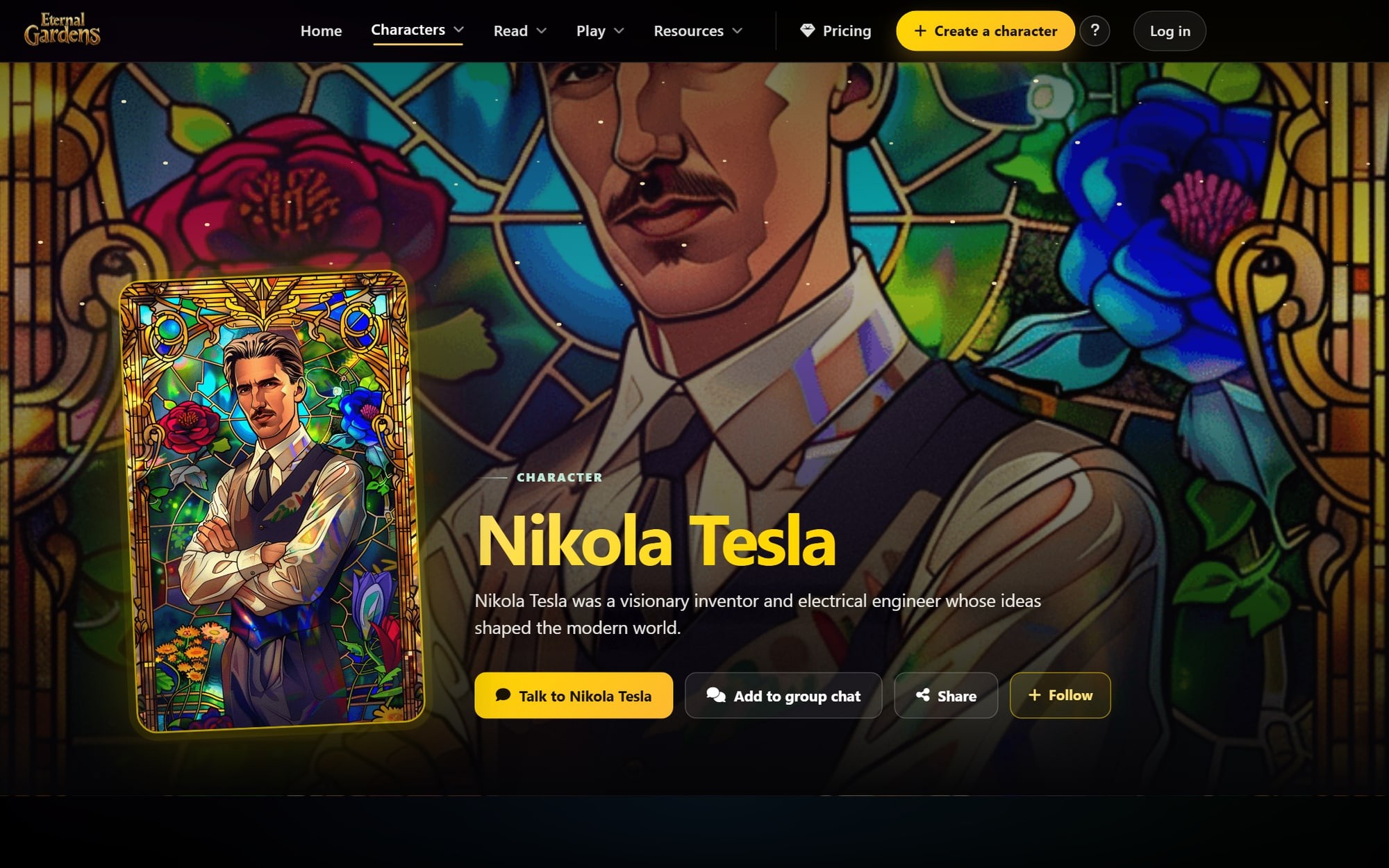
Eternal Gardens has no Edison character, but you can talk with the Nikola Tesla character on Eternal Gardens. It is an Eternal Gardens interpretation of Nikola Tesla, grounded in published and public-domain sources such as his memoir. It is not the historical figure and does not speak for him. You can try it free, without an account.
Questions worth asking:
- What was it like to work for Edison in 1884?
- Who promised you the $50,000, and what happened?
- Why did you agree to give up your Westinghouse royalties?
- What did you think of Edison's safety campaign against AC?
- Was your rivalry with Edison personal, or just business?
Compare its answers with the dates above, and ask where a claim comes from. For more on getting good answers, see our guide on how to talk to historical figures with AI.
Frequently asked questions
What was the main difference between Tesla and Edison?
Edison backed direct current, which flows one way and could only reach a mile or two from a power station. Tesla's patents made alternating current practical, and a transformer can raise AC voltage for long lines. Edison worked by trial and error with big lab teams and built many companies. Tesla worked from theory and struggled with business.
Did Tesla work for Edison?
Yes, for about six months. Tesla reached New York on 6 June 1884 with a letter of introduction from Edison's Paris office, and Edison hired him on the spot. He quit after a dispute over a promised $50,000. In his own 1919 account, Tesla says the promise came from the Manager, not from Edison himself.
Who won the war of the currents?
Alternating current won. Westinghouse, using Tesla's patents, beat General Electric's DC bid to light the 1893 Chicago World's Fair. It then built the AC plant at Niagara Falls, which sent power to Buffalo on 16 November 1896. By then General Electric, formed partly from Edison's company in 1892, had also switched to AC.
Did Edison electrocute an elephant to discredit Tesla?
No. Topsy the elephant was killed at Luna Park on Coney Island on 4 January 1903, more than a decade after the war of the currents ended. The Thomas Edison Papers at Rutgers answer the question with an emphatic no. Edison's film company did record the event, which is why his name is tied to it.
Is DC still used today?
Yes. The US Department of Energy notes that computers, LEDs, solar cells and electric cars all run on direct current. High-voltage DC lines now carry power over long distances with less loss. Modern electronics can convert DC to higher and lower voltages, which Edison could not do, so today's grid uses both kinds of current.
Sources
- US Department of Energy, The War of the Currents: AC vs. DC Power (2014)energy.gov
- PBS American Experience: Edison (film page and transcript)pbs.org
- PBS American Experience: Tesla (film page and transcript)pbs.org
- PBS American Experience: AC/DC, What's the Difference?pbs.org
- PBS, Tesla: Master of Lightning, Coming to Americapbs.org
- PBS, Tesla: Master of Lightning, War of the Currentspbs.org
- Nikola Tesla, My Inventions (1919), Wikisourceen.wikisource.org
- Thomas A. Edison Papers, Rutgers: Did Edison really electrocute Topsy the Elephant?edison.rutgers.edu
- Thomas A. Edison Papers, Rutgers: Biographyedison.rutgers.edu
- Thomas A. Edison Papers, Rutgers: General Electric Companyedison.rutgers.edu
- National Park Service: Edison Biographynps.gov
- IEEE/ETHW Milestone: Pearl Street Station, 1882ethw.org
- IEEE/ETHW Milestone: Alternating Current Electrification, 1886ethw.org
- IEEE/ETHW Milestone: Adams Hydroelectric Generating Plant, 1895ethw.org
- ETHW: Nikola Teslaethw.org
- Library of Congress: George Westinghouse research guideguides.loc.gov
- History.com: First execution by electric chairhistory.com
- Tesla Says Edison Was an Empiricist, The New York Times, 19 Oct 1931 (archived by Tesla Universe)teslauniverse.com
- Edison and Tesla Win Nobel Prize, Electrical World, 13 Nov 1915 (archived by Tesla Universe)teslauniverse.com
- Nobel Prize in Physics 1915nobelprize.org
- Nikola Tesla Museum, Belgrade: Patentstesla-museum.org
About the author
Eternal Gardens
Eternal Gardens is an AI character platform where you can talk with characters drawn from the writings of historical and literary figures, and build worlds and stories with them.