What is Michael Faraday famous for? Induction, the motor and more
How a bookbinder's apprentice found electromagnetic induction, made the first electric motion and gave the Christmas Lectures, with diagrams and his own words
By Eternal Gardens
7 min read
In this article
- What is Michael Faraday famous for? The short list
- Who was Michael Faraday?
- How did Faraday make the first electric motor?
- What is electromagnetic induction?
- Why does induction still matter?
- What else did Faraday discover?
- What were Faraday's Christmas Lectures?
- Which Faraday stories are myths?
- Talk to Faraday about the night the compass moved
Michael Faraday is famous for discovering electromagnetic induction in 1831, the effect that makes electricity in almost every power station. Ten years earlier he built the first device that turned electric current into steady motion, the ancestor of the electric motor. He is also known for the Royal Institution's Christmas Lectures for children.
Faraday did all this without higher maths. He was a blacksmith's son who learned science by reading the books he bound. This guide goes through his main discoveries in order. Where his own words survive, we quote them.
What is Michael Faraday famous for? The short list
Faraday is best known for electromagnetic induction, the first electric motor, and his lectures. But he made discoveries in chemistry too, and he gave us several words that every science student learns.
| Year | Discovery | In plain words |
|---|---|---|
| 1821 | Electromagnetic rotation | A wire carrying current circles a magnet |
| 1823 | Liquid chlorine | He turned chlorine gas into a liquid |
| 1825 | Benzene | He isolated a new compound, benzene |
| 1831 | Electromagnetic induction | A changing magnet makes current flow |
| 1834 | Electrolysis words | He named the anode, the cathode and the ion |
| 1837 | The shielded cube | A charged wire-and-foil room has no charge inside |
| 1845 | Magnetism and light | A strong magnet can twist polarised light |
Who was Michael Faraday?
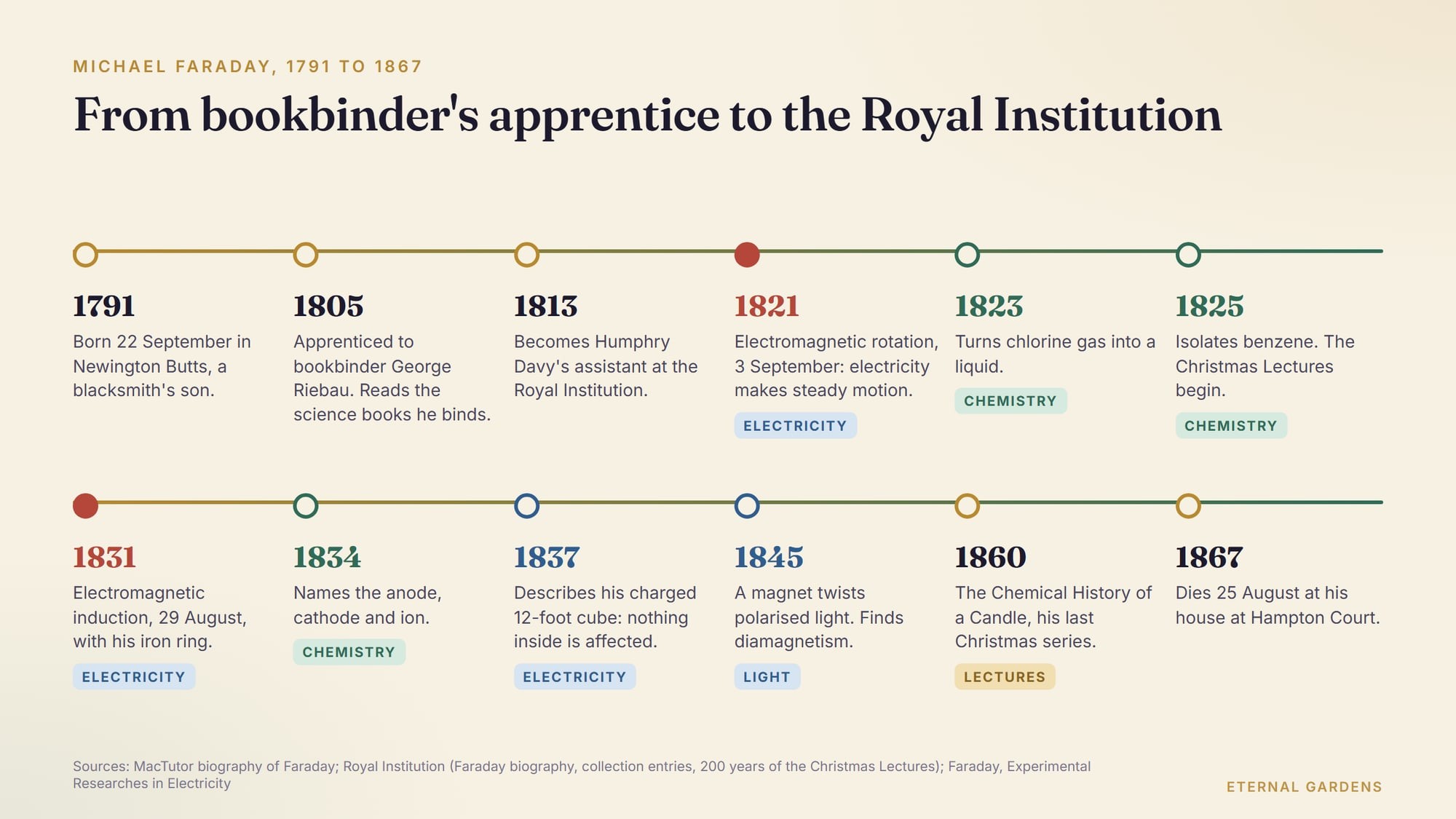
Faraday was born on 22 September 1791 in Newington Butts, in Surrey, now part of London. His father was a blacksmith. In 1805 he became an apprentice to a London bookbinder, George Riebau. He read the books that came through the shop. "Whilst an apprentice, I loved to read the scientific books which were under my hands," he later wrote.
In 1812 he went to hear the chemist Humphry Davy lecture at the Royal Institution in London. Faraday wrote up careful notes and sent them to Davy. The next year Davy took him on as an assistant. In October 1813 the two set off on an 18-month tour of Europe, where Faraday met the scientists André-Marie Ampère in Paris and Alessandro Volta in Milan. Back in London, Faraday stayed at the Royal Institution for the rest of his working life. He became a Fellow of the Royal Society in 1824 and the Institution's first Fullerian Professor of Chemistry in 1833.
He never learned much mathematics. The MacTutor biography says he "did not directly contribute to mathematics". His ideas came from experiments, and from pictures such as his "lines of force" around a magnet.
How did Faraday make the first electric motor?
In 1820 the Danish scientist Hans Christian Ørsted showed that an electric current makes a compass needle move. The news startled scientists, who had thought of electricity and magnetism as separate things.
On 3 September 1821, in the Royal Institution's basement laboratory, Faraday found that a wire carrying current would circle around a magnet without stopping. He fixed a magnet upright so that one end poked above a pool of mercury. Mercury is a metal that conducts electricity. A loose wire hung down into it. When the current flowed, the wire swept round and round the magnet. He called the effect "electromagnetic rotations".
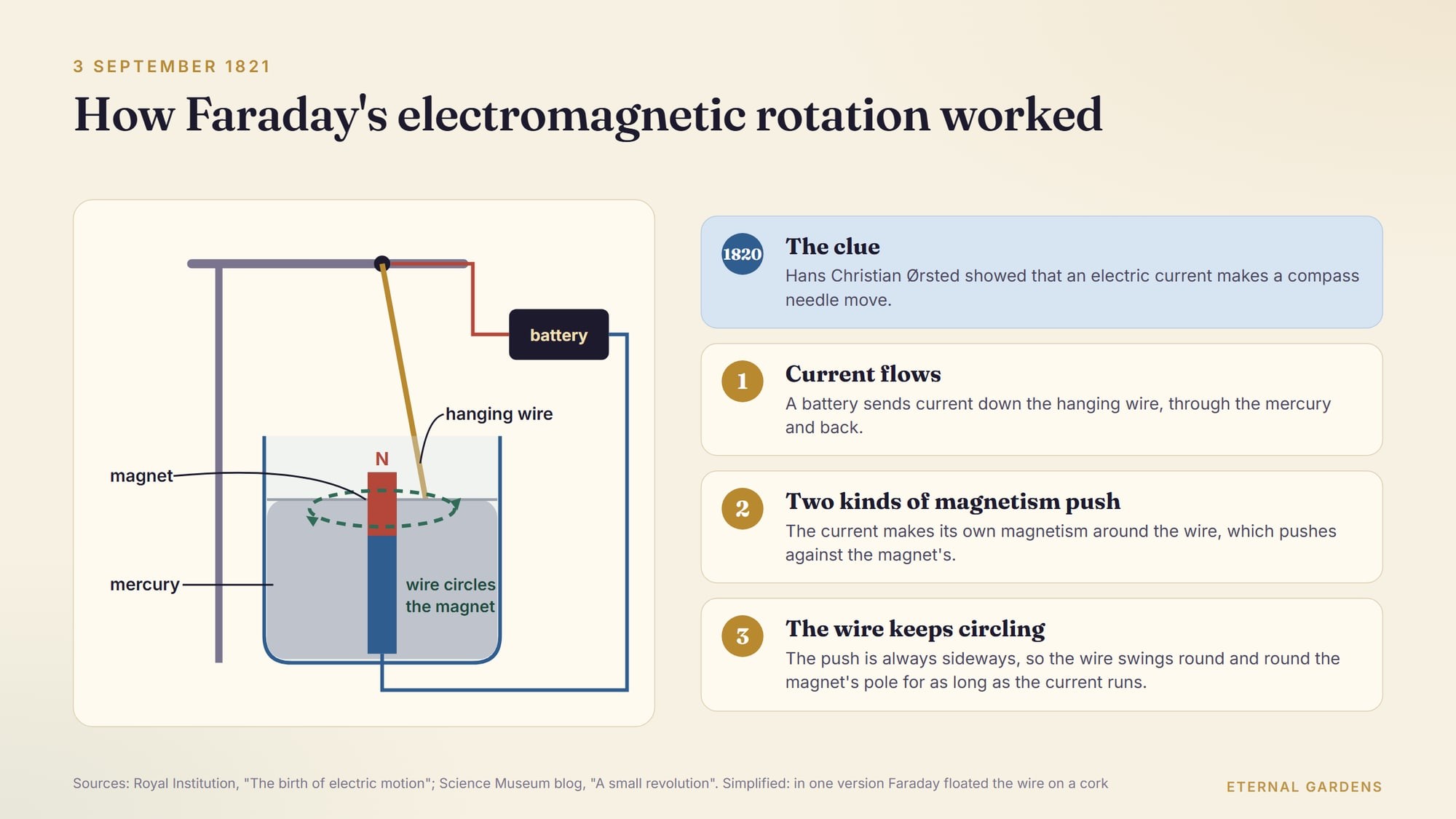
It was the first time electricity had made something move steadily. The device did no useful work, and practical electric motors came decades later. But it showed that electricity and magnetism could make motion.
The discovery also caused a row. Davy accused Faraday of failing to credit William Wollaston, who had been working on similar motions. Wollaston dropped the matter after Faraday apologised, but the episode strained his friendship with Davy.
What is electromagnetic induction?
Electromagnetic induction is the making of an electric current by a changing magnetic field. Move a magnet near a coil of wire, or switch a current on and off in a nearby coil, and a current flows. Faraday discovered it in 1831.
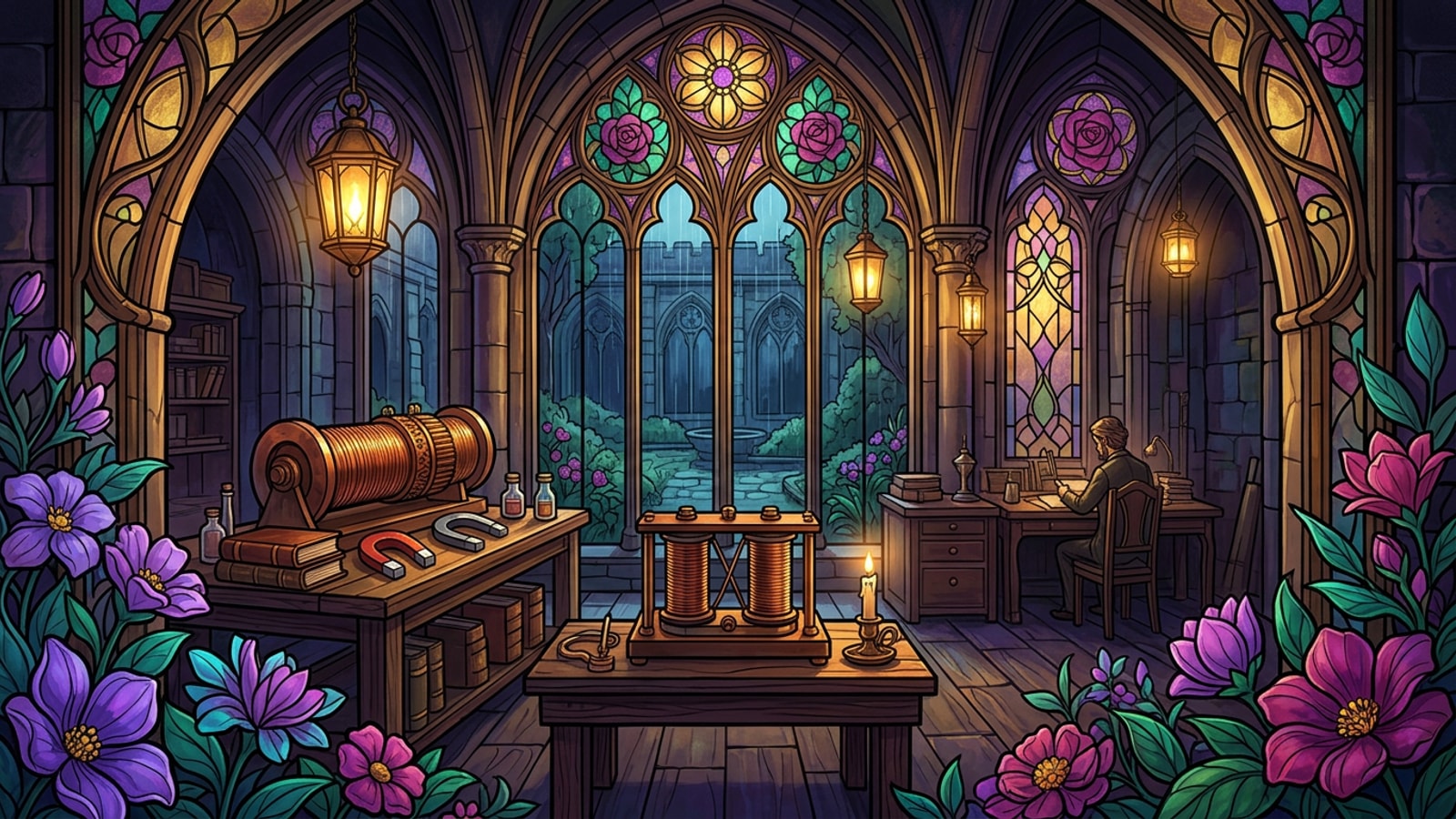
His first success came on 29 August 1831, according to the Royal Institution, which still has the ring. (Some sources give 31 August.) He wound two separate coils of copper wire onto an iron ring, six inches across. One coil went to a battery. The other went to a galvanometer, a needle that shows current.
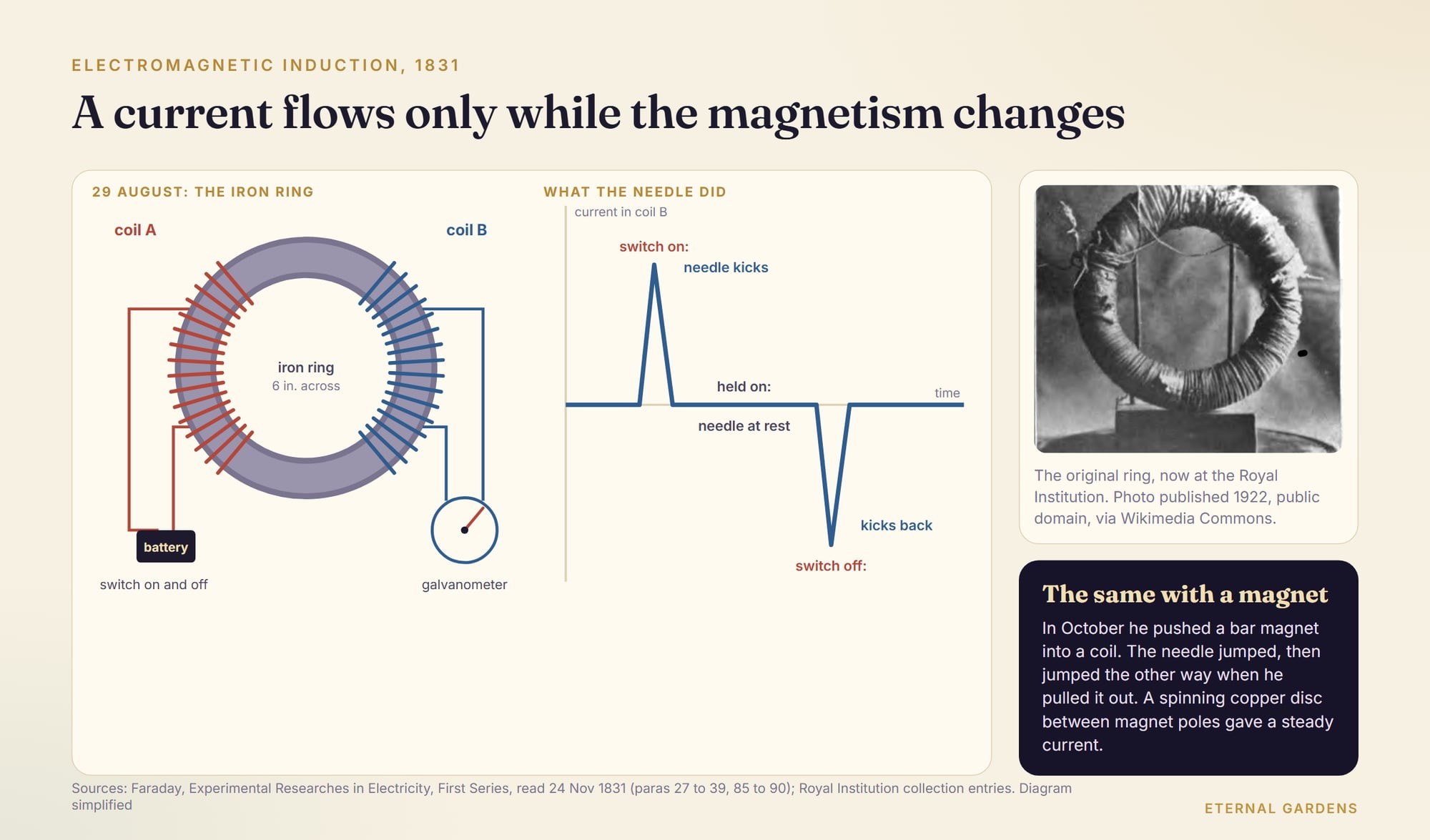
In his Experimental Researches in Electricity he describes what happened when he connected the battery:
The galvanometer was immediately affected ... but though the contact was continued, the effect was not permanent, for the needle soon came to rest in its natural position
When he broke the contact, the needle kicked the other way. That was the key. A steady current did nothing. Only a change made current flow in the second coil.
That autumn he pushed a bar magnet into a coil and watched the needle jump, then jump the other way when he pulled it out. He also spun a copper disc between the poles of a large magnet and got a steady current. In his words, "Here therefore was demonstrated the production of a permanent current of electricity by ordinary magnets." He read his results to the Royal Society on 24 November 1831.
Why does induction still matter?
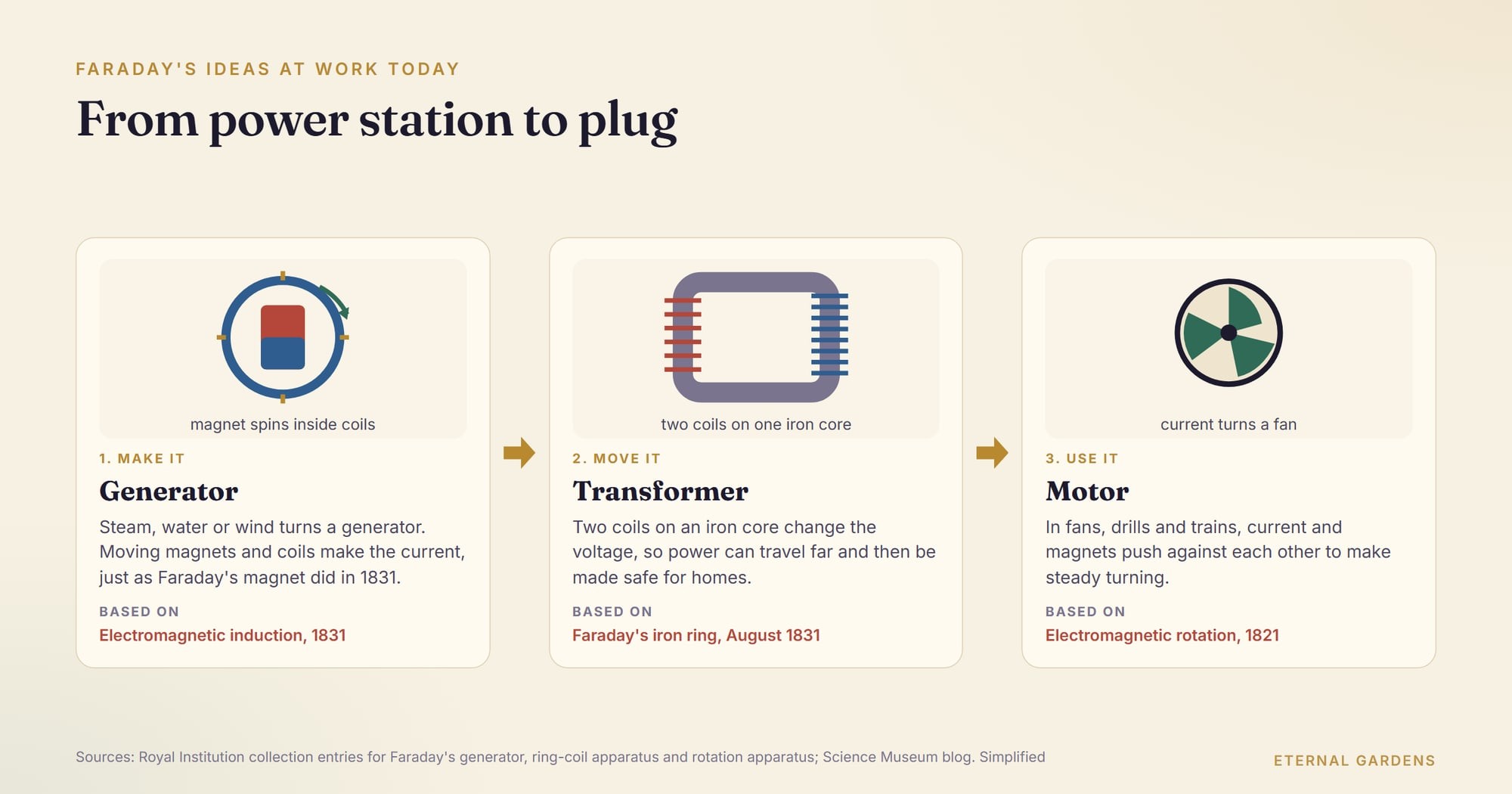
Induction is how we make most of our electricity. The rule that a changing magnetic field drives a current is still called Faraday's law. In a power station, a turbine turns a generator, where magnets and coils of wire move past each other. The Royal Institution calls Faraday's ring "the first ever electric transformer", and transformers on poles and at substations work the same way.
What else did Faraday discover?
Faraday was a chemist first. In 1823 he turned chlorine into a liquid, and in 1825 he isolated benzene.
In 1834 he studied how electric current splits chemicals apart, which is called electrolysis. He needed new words for it. He named the two metal surfaces the anode and the cathode, and the particles that travel between them ions. "When I have occasion to speak of these together, I shall call them ions," he wrote.
In 1837 he described a room he had built at the Royal Institution: a 12-foot cube covered in wire and tin foil. He charged the outside until sparks flew from it, then went inside with his instruments. "I went into the cube and lived in it," he wrote. His candles and instruments showed no electrical effect inside. That is the principle behind what we now call a Faraday cage.
In 1845 he showed that a strong magnet can twist the direction in which polarised light vibrates. It was a sign that light and magnetism are linked. The same year he found diamagnetism, a weak push away from a magnet that many materials show. He also pictured invisible "lines of force" around magnets. James Clerk Maxwell later turned these ideas into the equations of the electromagnetic field.
What were Faraday's Christmas Lectures?
The Christmas Lectures are talks on science for young people, given at the Royal Institution every winter since 1825, with a short break during the Blitz. Faraday gave 19 series of them between 1827 and 1860.
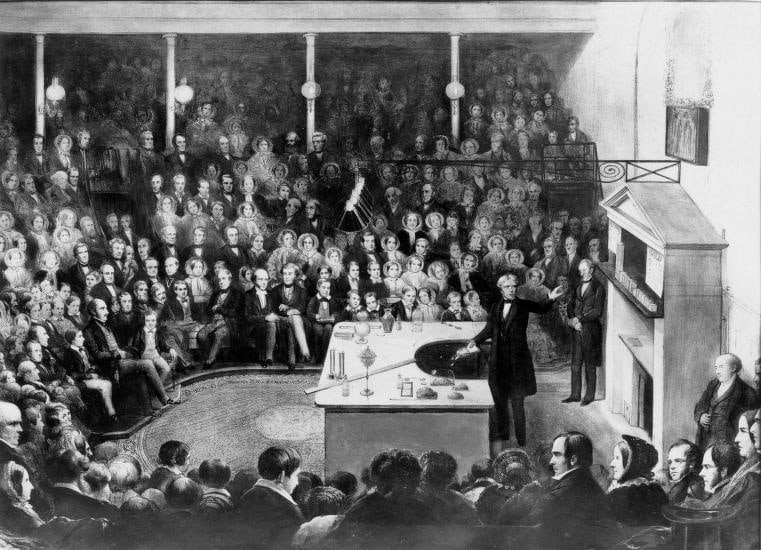
His most famous series was The Chemical History of a Candle, given over Christmas 1860 to 1861. In six talks, he used a single candle to explain how things burn. By the last talk he had linked a candle flame to the way we breathe. He told his young audience: "There is not a law under which any part of this universe is governed which does not come into play, and is touched upon in these phenomena."
The talks were published as a book in 1861. The Royal Institution says it has never gone out of print. The lectures still run today, and they have been part of British television's Christmas schedule since 1966.
Which Faraday stories are myths?
Some of the most repeated Faraday facts need care. Here is what the records show.
| The story | What the sources show |
|---|---|
| Faraday founded the Christmas Lectures | The Royal Institution began them in 1825. Faraday gave his first series in 1827. |
| Faraday invented the electric motor | He made the first electromagnetic rotation. It did no work, and practical motors came later. |
| Faraday turned down a knighthood | He said he would not accept one. The Royal Institution has found no evidence one was offered. |
| Faraday was a great mathematician | He never learned higher maths. Maxwell put his ideas into equations. |
| Faraday discovered electricity | Electricity was studied long before him. He found how to make it from magnetism. |
He did turn down one great honour. He declined the presidency of the Royal Society, twice according to the Royal Institution. Queen Victoria gave him a house at Hampton Court in 1858, and he died there on 25 August 1867.
Talk to Faraday about the night the compass moved
Eternal Gardens has a Michael Faraday character you can chat with. It is an Eternal Gardens interpretation of Michael Faraday, grounded in published and public-domain sources. It is not the historical figure and does not speak for him. You can start a conversation free, without an account. The chat page also offers a scene called The Night the Compass Moved, set in a reconstruction of his 1831 laboratory.
Good questions to try:
- What did you see on the galvanometer when you closed the circuit on the iron ring?
- Why did a steady current do nothing?
- How did you choose the words anode and cathode?
- What was it like to sit inside the charged cube?
- Why did you use a candle to teach children chemistry?
Check what it says against the dates above, and ask where its answers come from. Later inventors put induction to work in new machines, such as Nikola Tesla's AC induction motor of 1888. For an earlier giant of physics, read what Isaac Newton discovered, or see our guide to talking with historical figures using AI.
Frequently asked questions
What is Michael Faraday best known for?
Faraday is best known for discovering electromagnetic induction in 1831: a changing magnetic field makes an electric current flow. Nearly all the electricity we use comes from generators that work on this principle. He is also known for making the first electromagnetic rotation in 1821, an early ancestor of the electric motor, and for his Christmas Lectures.
When did Faraday discover electromagnetic induction?
The Royal Institution, which holds his iron ring, dates his first success to 29 August 1831. Some sources give 31 August. That autumn he showed the same effect by moving a magnet in and out of a coil, and by spinning a copper disc between magnet poles. He read his results to the Royal Society on 24 November 1831.
Did Faraday invent the electric motor?
He made the first device that turned electric current into continuous motion. On 3 September 1821 he got a wire carrying current to circle around a magnet in a pool of mercury. It did no useful work, and practical electric motors came decades later, but the Royal Institution calls it the world's first electric motor.
Did Faraday start the Christmas Lectures?
Not quite. The Royal Institution's history of the series says its managers began the lectures in 1825, with John Millington giving the first course. Faraday gave his first series in 1827 and went on to give 19 series by 1860. His best known, The Chemical History of a Candle, was published in 1861 and is still in print.
What words did Faraday invent?
In his 1834 research on electrolysis, Faraday introduced the words anode, cathode, electrolyte, anion, cation and ion. He wanted plain names for what he saw. Older terms such as "electro-positive", he wrote, were only hypothetical and might be wrong, and he feared they would narrow how scientists thought. Chemists still use his new words today.
Sources
- Royal Institution: Michael Faraday (1791-1867)rigb.org
- Royal Institution collection: Michael Faraday's ring-coil apparatusrigb.org
- Royal Institution collection: Michael Faraday's generatorrigb.org
- Royal Institution: The birth of electric motionrigb.org
- Royal Institution: 200 years of the Christmas Lecturesrigb.org
- Science Museum blog: A small revolution, Michael Faraday and the origins of the electric motorblog.sciencemuseum.org.uk
- MacTutor History of Mathematics: Michael Faradaymathshistory.st-andrews.ac.uk
- MacTutor: Times obituary and letters on Faradaymathshistory.st-andrews.ac.uk
- IEEE Milestone proposal: Faraday's Discovery of Inductionieeemilestones.ethw.org
- Faraday, Experimental Researches in Electricity, vol. 1 (Project Gutenberg)gutenberg.org
- Faraday, The Chemical History of a Candle (Project Gutenberg)gutenberg.org
- Wikimedia Commons: Faraday Michael Christmas lecture.jpgcommons.wikimedia.org
- Wikimedia Commons: Faraday ring transformer.jpgcommons.wikimedia.org
About the author
Eternal Gardens
Eternal Gardens is an AI character platform where you can talk with characters drawn from the writings of historical and literary figures, and build worlds and stories with them.