Leonardo da Vinci's inventions: what he designed, and what was built
The flying machine, the parachute, the 'tank' and more, with the notebook page each comes from and who finally built it
By Eternal Gardens
8 min read

In this article
- Leonardo da Vinci's inventions: the full list
- The everyday machines
- Did Leonardo da Vinci's flying machine work?
- The aerial screw
- The parachute
- Which of Leonardo's inventions were built in his lifetime?
- Why did Leonardo design war machines?
- How do we know about his inventions at all?
- Ask Leonardo about his machines yourself
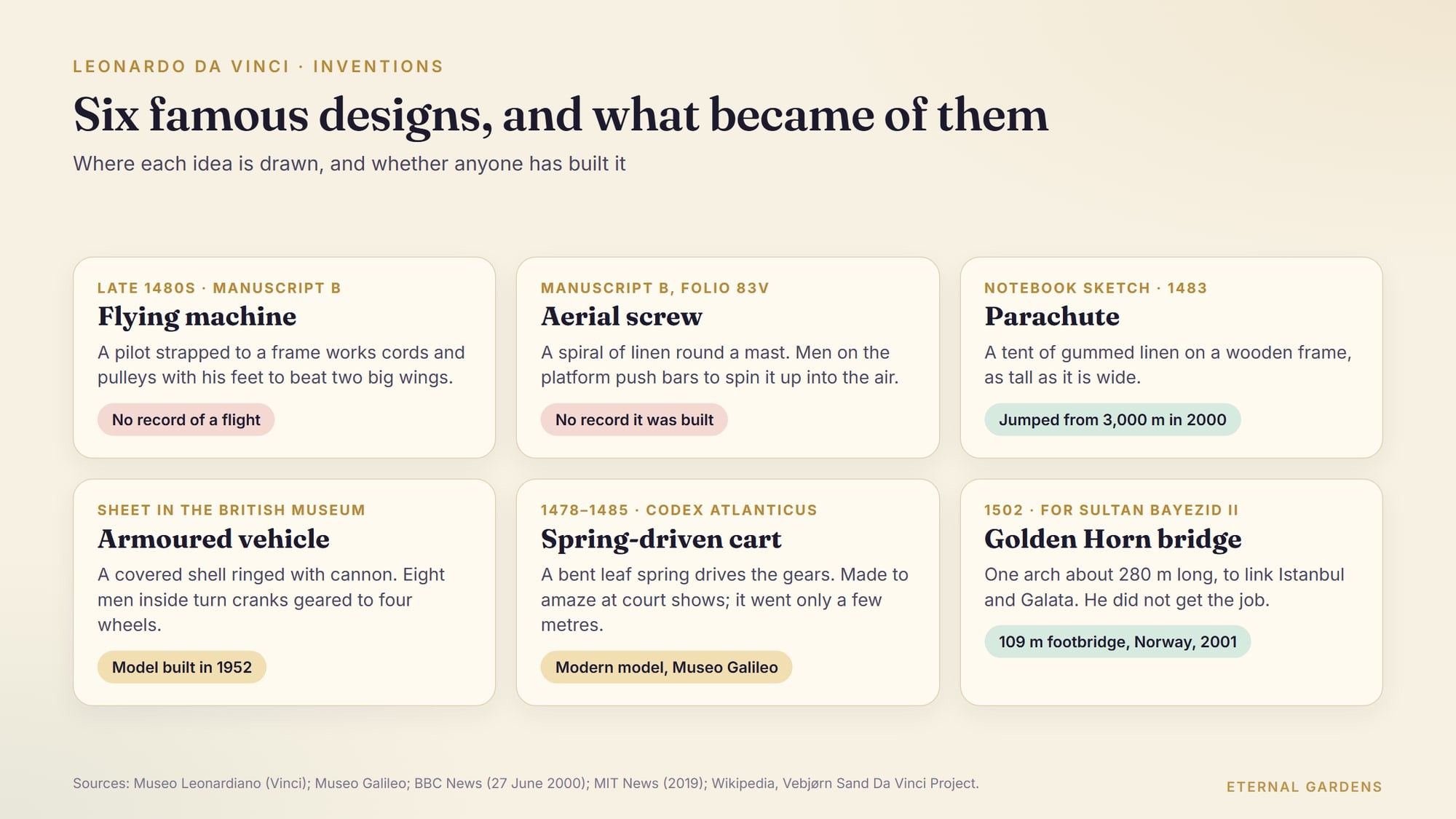
Leonardo da Vinci's inventions are mostly drawings in his notebooks. The famous ones are a flapping-wing flying machine, an "aerial screw", a parachute, an armoured fighting vehicle, a spring-driven cart, a 280-metre bridge and a robot knight. Almost none were built while he lived. A working parachute and a version of the bridge were finally built about 500 years later.
So any honest list has two columns: what Leonardo designed, and what anyone actually made. Here are both, with the drawing each idea comes from.
Leonardo da Vinci's inventions: the full list
Leonardo (1452–1519) filled notebooks for most of his working life, and the British Library says over 7,000 pages survive. The machines below are the best known. The table shows where each comes from and whether it was built.
| Invention | Where it is drawn | Built in his lifetime? | Built since |
|---|---|---|---|
| Flapping-wing flying machine | Manuscript B, late 1480s | No record | Museum models, such as one made in 1938 for Vinci |
| Aerial screw | Manuscript B, folio 83v | No record | Museum models |
| Parachute | A notebook page, 1483 | No record | Tested in a real jump in 2000 |
| Armoured fighting vehicle | A sheet now in the British Museum | No record | A 1952 model by IBM Italia |
| Spring-driven cart | Codex Atlanticus, folio 812r, 1478–1485 | No record | A model shown by the Museo Galileo |
| Bridge over the Golden Horn | Proposed to Sultan Bayezid II, 1502 | No | A smaller timber version in Norway, 2001 |
| Swing bridge | Codex Atlanticus, folio 855r | No record | A 1952 model |
| Mechanical knight | Scattered notes, about 1495 | Perhaps a prototype | Reconstructions by Mark Rosheim and others |
| Mechanical lion | Described by Giorgio Vasari | Yes | Modern reconstructions |
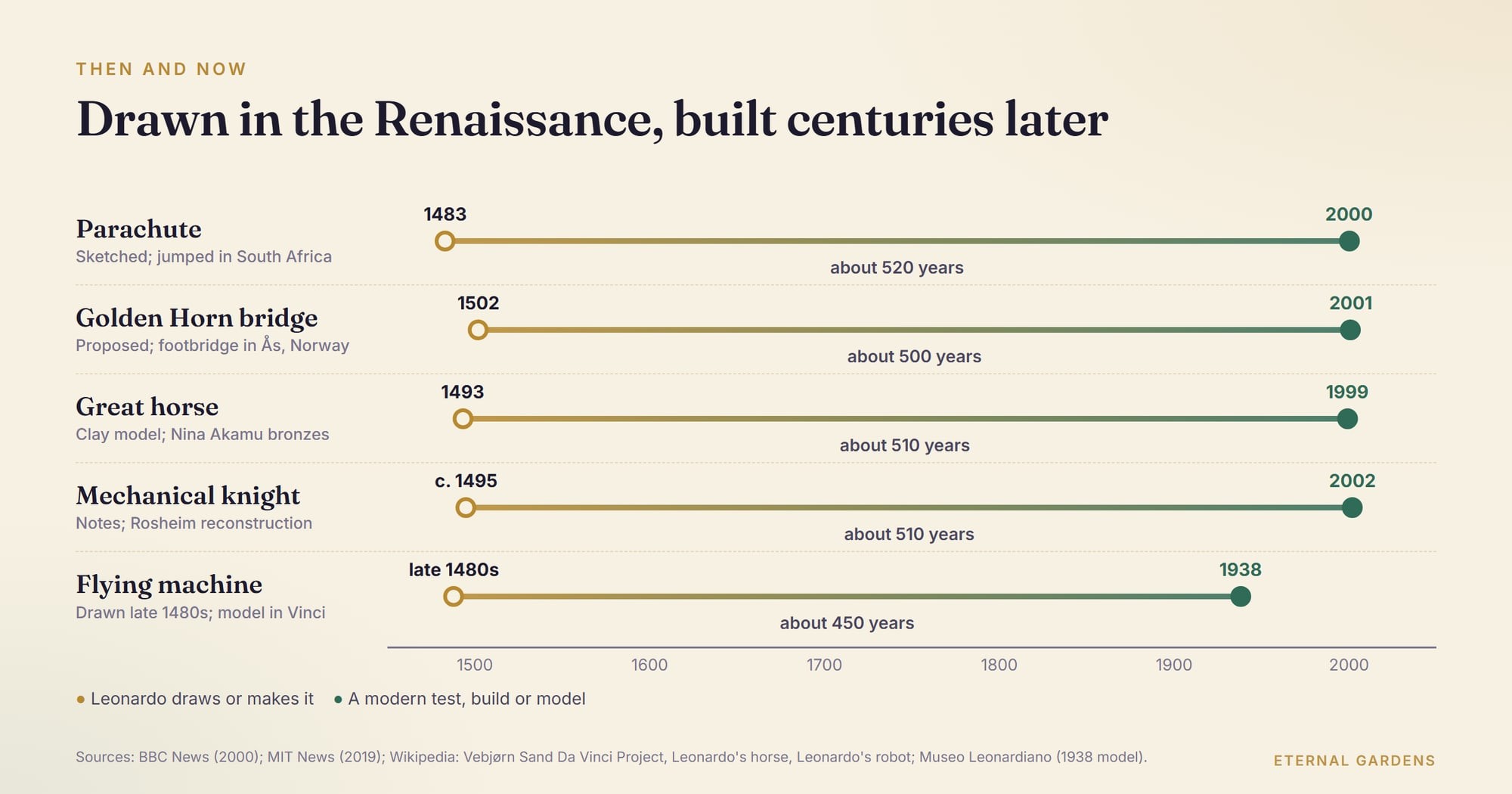
| Giant bronze horse | Commissioned 1482 | Clay model only | Two new bronze horses, 1999 |
"No record" means no surviving source says it was built. That is not quite the same as proof it never was.
The everyday machines
The list above is the famous part. Most of his engineering pages are humbler. Vasari says Leonardo designed "flour-mills, fulling-mills, and engines, which might be driven by the force of water." The Museo Leonardiano in Vinci has models of his cranes and winches. It also shows his spinning machines, including one with four spindles for making thread. There are also canal and river schemes. Vasari credits a young Leonardo with the first plan to turn the river Arno into a canal from Pisa to Florence.
These never made headlines, but they show what he was hired to do. Patrons wanted water moved and heavy loads lifted.
Did Leonardo da Vinci's flying machine work?
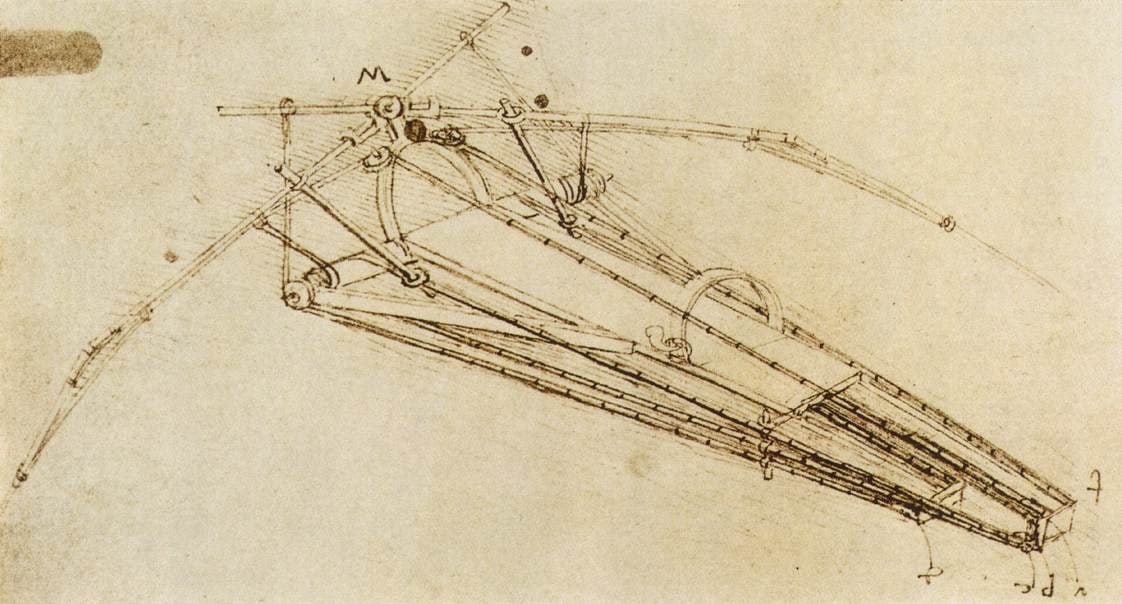
No version of Leonardo's flying machine is known to have flown, and there is no record that he built a full-size one. His main design needed a person to flap the wings by muscle power alone, which asks far more of the body than it can give.
Leonardo began studying how birds fly in about 1485. In the late 1480s he drew a machine in which the pilot is strapped to a platform. Pushing the feet into stirrups works a set of cords and pulleys that beat two large wings. The Museo Leonardiano in Vinci shows a model of it, built from his drawing in Manuscript B.
He thought hard about the details. In one note he told himself to copy bats, not birds:
"Remember that your flying machine must imitate no other than the bat, because the web is what by its union gives the armour, or strength to the wings." Leonardo da Vinci, Notebooks, No. 1123, trans. Jean Paul Richter (1888)
He also dreamed big. One cryptic note in his papers predicts that "The great bird will take its first flight," and goes on about "filling the universe with wonders." Richter, who translated it, took it to be about the flying machine.
He came to see the problem. Humans are too heavy, and not strong enough, to fly with wings worked by their own arms and legs. His later work on flight was close study of birds and air. In 1505 and 1506 he wrote a whole notebook on it, the Codex on the Flight of Birds. The Smithsonian's National Air and Space Museum counts more than 35,000 words and 500 sketches in his writing on flight.
For a sense of how hard it is: in 2010 a University of Toronto team flew a human-powered flapping aircraft called Snowbird. A car had to tow it into the air first. Then it flew for about 20 seconds.
The aerial screw
The aerial screw is a spiral of linen wound around a mast, standing on a round platform. Men walking around the platform would push bars to turn it. Leonardo's idea was that, spun fast enough, it would screw itself up into the air. It is often called a forerunner of the helicopter. Like the flying machine, it had no engine, and there is no record of it being built.
The parachute
Leonardo's parachute is a tent of gummed linen on a wooden frame, as tall as it is wide, sketched in a notebook margin in 1483. On 26 June 2000, a British man named Adrian Nicholas tried one. The team used only materials and tools that Leonardo's Milan would have had, so it weighed 85 kilograms. He dropped from a hot-air balloon 3,000 metres above Mpumalanga, South Africa.
It worked. Nicholas said the ride was smoother than a modern parachute, BBC News reported. He cut himself free at 600 metres and landed on a modern chute, so the heavy frame would not fall on him.
Which of Leonardo's inventions were built in his lifetime?
Only a few, and mostly for show. The pieces we know were made are court marvels and sculpture, not war machines.
The best-known is a mechanical lion. Giorgio Vasari wrote a life of Leonardo in the 1500s. He says Leonardo was asked to make something strange for the King of France, and "made a lion which walked several steps and then opened its breast, and showed it full of lilies." The lion itself is lost.
The giant horse came close. Duke Ludovico Sforza of Milan commissioned a bronze horse in 1482. By November 1493 a full-size clay model was on show. Then in 1494 the bronze set aside for it went to make cannon instead. When French troops took Milan in 1499, soldiers used the clay horse for archery practice. In 1999 two bronze horses by the sculptor Nina Akamu, inspired by his project, went up in Milan and in Grand Rapids, Michigan.
He may also have built a mechanical knight. It was a suit of armour worked by pulleys, able to sit up and move its arms and jaw. His notes suggest a prototype around 1495, but no complete drawing survives. Mark Rosheim later pieced the design together from scattered sketches.
Why did Leonardo design war machines?
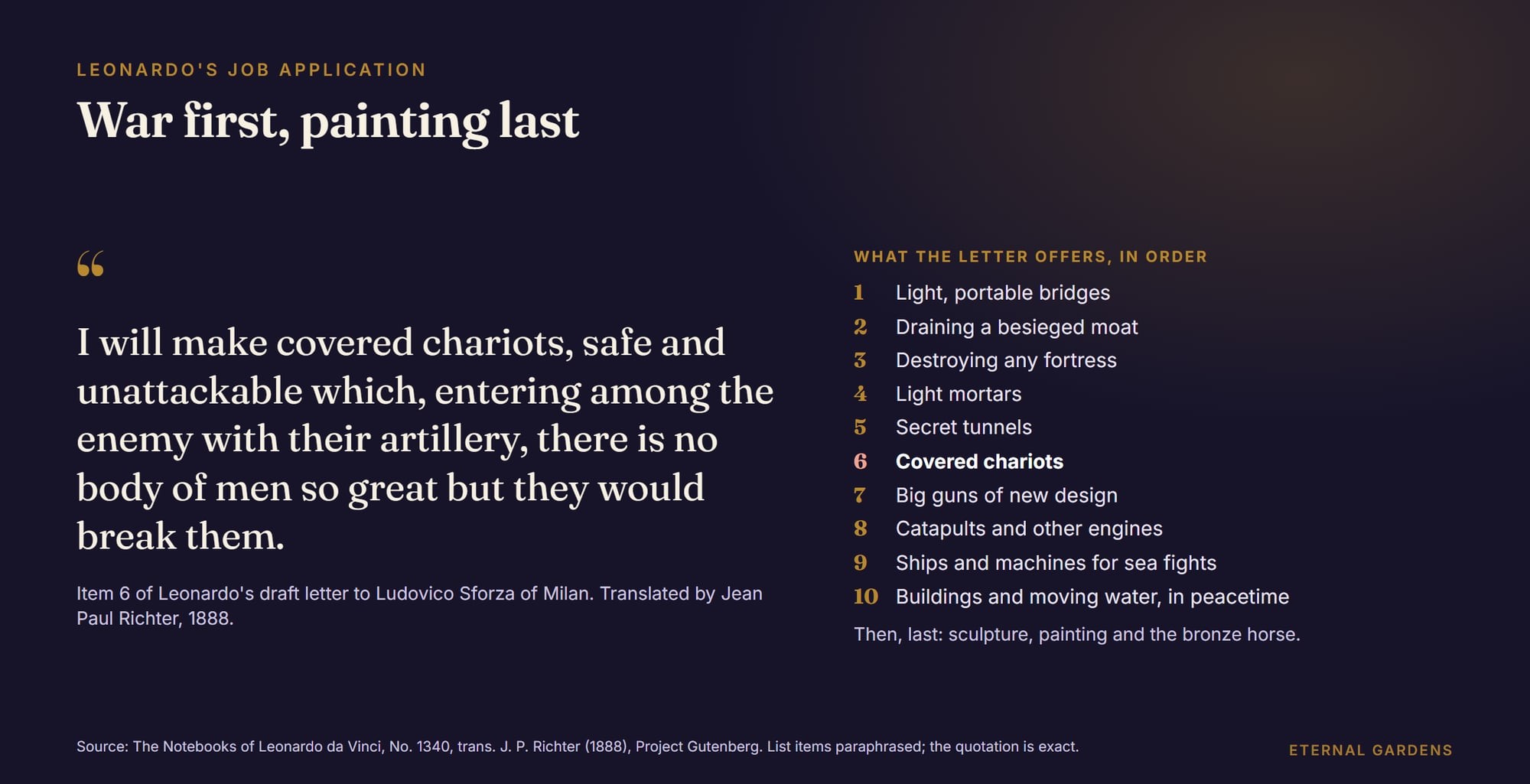
Leonardo designed weapons to win work. When he wrote to Ludovico Sforza of Milan asking for a post, his draft letter led with war machines and mentioned painting only near the end.
The letter lists ten skills. He offered portable bridges, ways to drain a moat, and new kinds of cannon. Item six is the one that sounds like a tank:
"I will make covered chariots, safe and unattackable which, entering among the enemy with their artillery, there is no body of men so great but they would break them." Leonardo da Vinci, draft letter to Ludovico Sforza, trans. Jean Paul Richter (1888), Project Gutenberg
His armoured vehicle drawing, now in the British Museum, shows what he meant. It is a covered shell with cannon all round it and a slotted turret on top for looking out. Inside, eight men would turn cranks geared to four wheels. Only in item ten does he mention peacetime work: buildings and "guiding water from one place to another." He closed with a confident offer. If any of it seemed impossible, he was "most ready to make the experiment in your park."
How do we know about his inventions at all?
Almost everything comes from his notebooks. Today the pages are spread across many libraries. The British Library in London, the Institut de France in Paris and the Biblioteca Reale in Turin all hold some. He usually wrote from right to left in mirror writing. Richter, his Victorian translator, noted the draft letter to Sforza as one of the very few pages written the normal way.
The notebooks are full of ideas in progress. The spring-driven cart is a good example. It is often called the first car. But the Museo Galileo says Leonardo meant it to amaze guests at court parties and in the theatre. A bent leaf spring drove its gears, and it could travel only "a few meters."
The Golden Horn bridge is another. In 1502 Sultan Bayezid II wanted a bridge between Istanbul and Galata. Leonardo proposed a single arch about 280 metres long. He did not get the job. In 2019 two MIT students tested the design with a 3D-printed model of 126 blocks, and MIT News reported that it held up well. A 109-metre timber footbridge based on the drawing opened in Ås, Norway, in 2001.
If you like ideas that stayed on paper, Ada Lovelace's first program for Babbage's engine had the same fate. For an inventor whose ideas did leave the page, see what Nikola Tesla invented.
Ask Leonardo about his machines yourself
You can talk with the Leonardo da Vinci character on Eternal Gardens. It is an Eternal Gardens interpretation of Leonardo da Vinci, grounded in published and public-domain sources. It is not the historical Leonardo and does not speak for him. You can try it free, without an account.
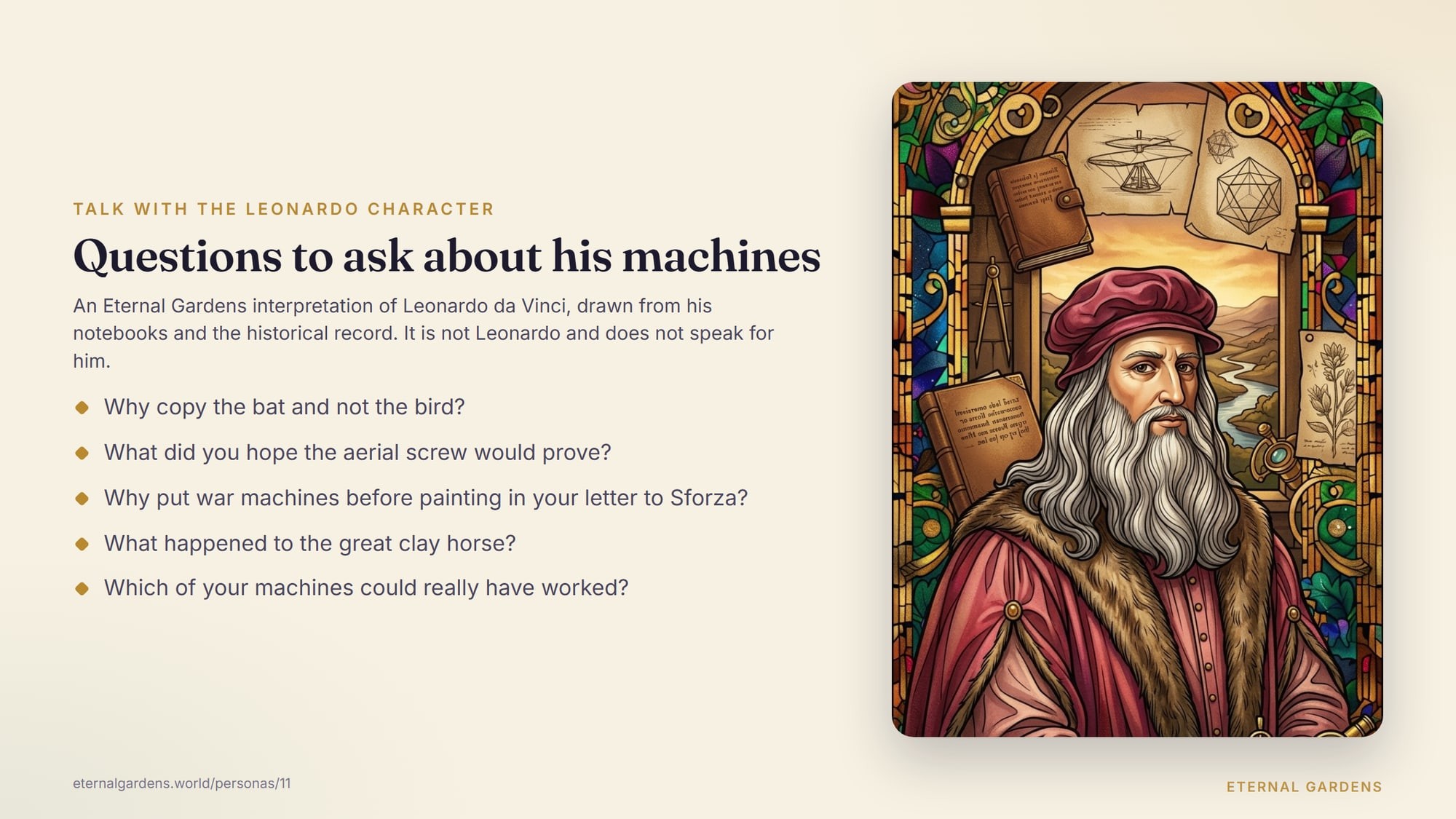
A few questions to start with:
- Why did you tell yourself to copy the bat and not the bird?
- What did you hope the aerial screw would prove?
- Why does your letter to Sforza put war machines before painting?
- What happened to the great horse after the French arrived?
- Which of your machines do you think could have worked?
Treat its answers as a starting point and check them against the notebooks. Our guide to getting reliable answers from historical AI characters explains how.
Frequently asked questions
What did Leonardo da Vinci invent?
Leonardo designed far more than he built. His notebooks include a flapping-wing flying machine, an aerial screw often compared to a helicopter, a parachute, an armoured fighting vehicle, a spring-driven cart, a mechanical knight and a single-arch bridge for Istanbul. He also drew cranes, winches, spinning machines and water mills. Most stayed on paper during his lifetime.
Did any of Leonardo da Vinci's inventions work?
Some have been tested since. In June 2000 Adrian Nicholas jumped from 3,000 metres over South Africa with a parachute built to Leonardo's design and said the ride was smoother than a modern one. In 2019 MIT students showed with a 3D-printed model that his 1502 bridge design would stand. His flapping flying machine is not known to have flown.
Did Leonardo da Vinci's flying machine fly?
There is no record that it ever flew, or that Leonardo built a full-size one. His design needed a pilot to beat the wings by muscle power, and humans are too heavy and too weak for that. He later wrote a whole notebook on bird flight in 1505 and 1506, the Codex on the Flight of Birds.
Did Leonardo da Vinci invent the tank?
He designed an armoured fighting vehicle, but no record says it was built. In his draft letter to Ludovico Sforza he promised 'covered chariots, safe and unattackable.' His drawing, now in the British Museum, shows a covered shell ringed with cannon, moved by eight men turning cranks geared to four wheels. Modern models exist, including one from 1952.
Sources
- The Notebooks of Leonardo da Vinci, trans. Jean Paul Richter (1888), Project Gutenberggutenberg.org
- Giorgio Vasari, Lives of the Most Eminent Painters, Sculptors and Architects, vol. 4, trans. Gaston du C. de Vere, Project Gutenberggutenberg.org
- Smithsonian National Air and Space Museum, Codex on the Flight of Birdsairandspace.si.edu
- Museo Leonardiano, Flying machinemuseoleonardiano.it
- Museo Leonardiano, Aerial screwmuseoleonardiano.it
- Museo Leonardiano, Tankmuseoleonardiano.it
- Museo Galileo, Motus: the self-propelled cartmostre.museogalileo.it
- BBC News, Da Vinci's parachute flies (27 June 2000)news.bbc.co.uk
- MIT News, Engineers put Leonardo da Vinci's bridge design to the test (2019)news.mit.edu
- British Library, Treasures gallerybl.uk
- Wikipedia, Leonardo's horseen.wikipedia.org
- Wikipedia, Leonardo's roboten.wikipedia.org
- Wikipedia, Vebjørn Sand Da Vinci Projecten.wikipedia.org
- Wikipedia, Ornithopteren.wikipedia.org
- History.com, Da Vinci's robotic lion (2025)history.com
About the author
Eternal Gardens
Eternal Gardens is an AI character platform where you can talk with characters drawn from the writings of historical and literary figures, and build worlds and stories with them.