What did Nikola Tesla invent? His real inventions, and the myths
The induction motor, the Tesla coil and a radio-controlled boat, checked against the patents, plus what he didn't invent
By Eternal Gardens
8 min read
In this article
- What did Nikola Tesla invent? The short list
- How did Tesla's induction motor work?
- The walk in the park: fact or legend?
- Did Tesla invent alternating current?
- What is a Tesla coil, and what was it for?
- Did Tesla invent radio?
- The boat that seemed to read minds
- Which Tesla stories are legends?
- What about Tesla's pigeon?
- Which Tesla inventions do we still use today?
- Put your questions to Tesla
Nikola Tesla invented the AC induction motor and a way to send power using several alternating currents at once. He patented both in 1888, and George Westinghouse built them into the AC power systems that won out over direct current. He also invented the Tesla coil and one of the first radio-controlled boats. He did not invent alternating current itself, and X-rays and neon signs belong to other people.
That last line surprises people. Few names in science carry as many myths as Tesla's. So this guide gives each claim a verdict, and the dates come from the patents themselves and from court and museum records.
What did Nikola Tesla invent? The short list
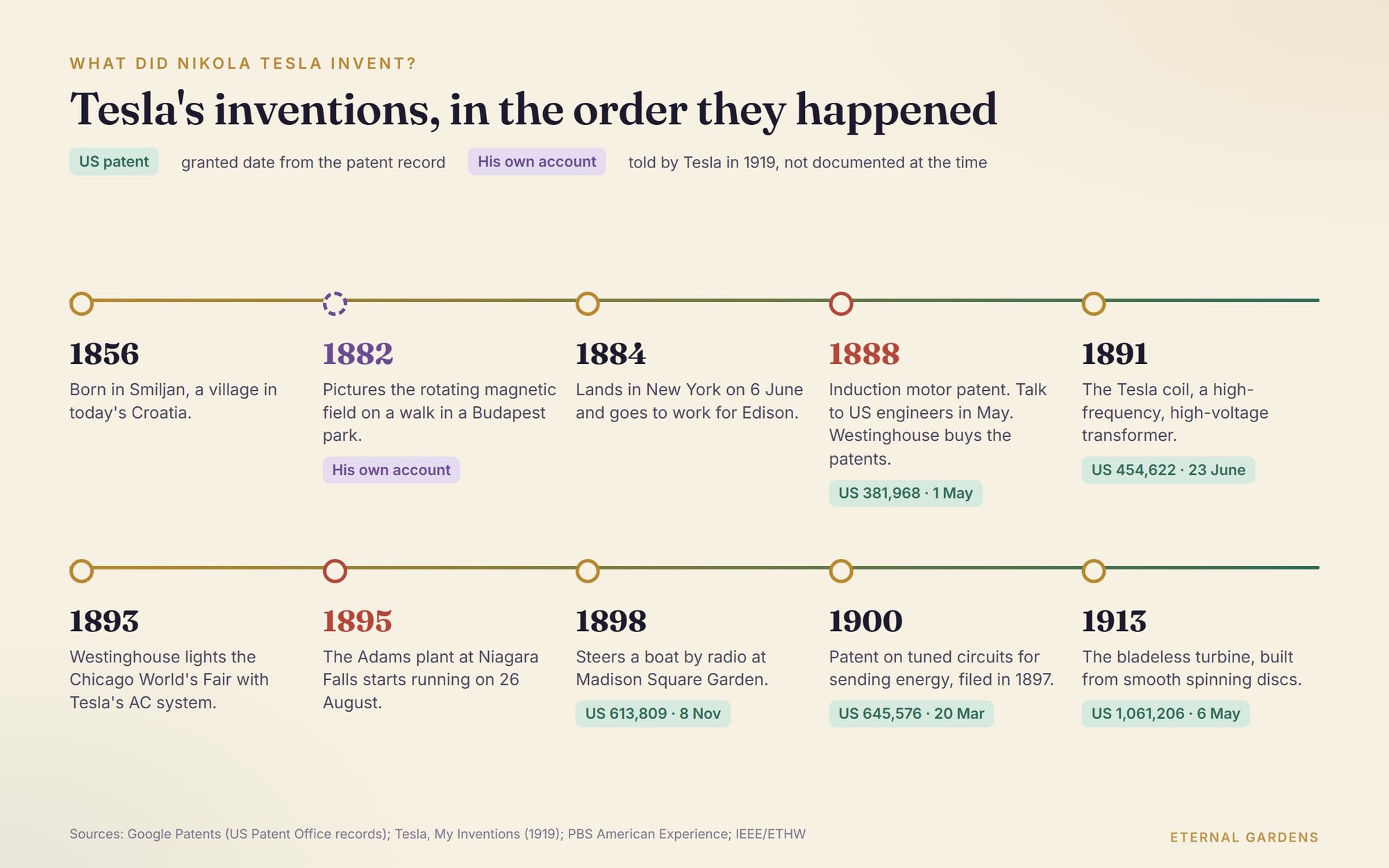
Tesla's best-known inventions are the induction motor (1888), the polyphase AC system (1888), the Tesla coil (1891), the radio-controlled boat (1898) and the bladeless turbine (1913). The Nikola Tesla Museum in Belgrade counts at least 311 patents in 27 countries, 112 of them in the United States.
Many of those patents cover the same idea filed in different countries. Here are the ones that matter most.
| Invention | Patent and date | Verdict |
|---|---|---|
| Induction motor | US 381,968, granted 1 May 1888 | His invention. Galileo Ferraris reached the same idea in Italy |
| Polyphase AC power system | US 382,280 and others, 1888 | His invention, licensed to Westinghouse |
| Tesla coil | US 454,622, granted 23 June 1891 | His invention |
| Radio-controlled boat | US 613,809, granted 8 November 1898 | His invention, an early remote control |
| Radio tuning circuits | US 645,576, filed 1897, granted 1900 | Shared credit with Marconi, Lodge and Stone |
| Bladeless turbine | US 1,061,206, granted 6 May 1913 | His invention, never widely used |
| Alternating current itself | none | Not his. AC was known decades earlier |
| X-rays and neon signs | none | Not his. Röntgen and Georges Claude |
How did Tesla's induction motor work?
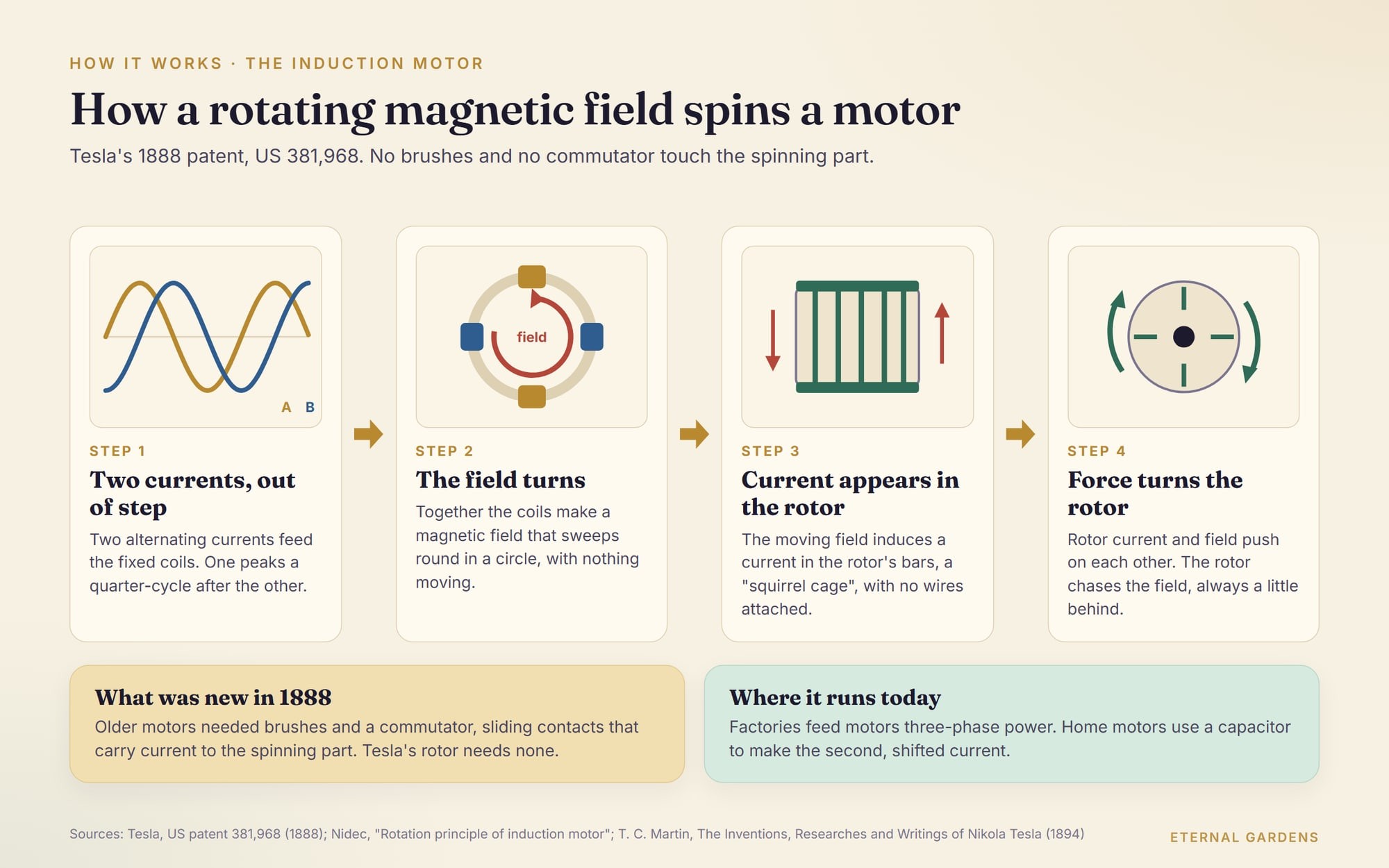
Tesla's motor spins because of a rotating magnetic field. Two or more alternating currents, timed slightly apart, flow through fixed coils. Together they make a magnetic field that turns in a circle, and the rotor is dragged along behind it.
Most motors of his day used brushes and a commutator, a set of sliding contacts. Tesla wanted to get rid of them, and his rotor needs no wired connection at all. The moving field induces a current in the rotor, and that current reacts with the field to make a force. The Japanese motor maker Nidec lists the four steps: the field rotates, it induces a current, the current makes a force, and the rotor turns.
The idea grows straight out of Michael Faraday's 1831 discovery that a changing magnetic field makes a current. You can read about that in our guide to what Michael Faraday is famous for.
The walk in the park: fact or legend?
Tesla said the idea came to him in 1882, on a walk in the City Park in Budapest. He was reciting Goethe's Faust at sunset. In his 1919 memoir My Inventions, he wrote:
"As I uttered these inspiring words the idea came like a flash of lightning and in an instant the truth was revealed." (Nikola Tesla, My Inventions, 1919)
He said he drew the diagrams in the sand with a stick. This is a lovely story, but it is his own memory, written 37 years later. The documented record starts with his patent, filed on 12 October 1887, and his talk to the American Institute of Electrical Engineers in May 1888.
The Italian physicist Galileo Ferraris built rotating-field motors in Turin between 1885 and 1888. He never patented them. The IEEE marked his work with a Milestone plaque in 2021. Fairly put, two men found the same principle at about the same time, and Tesla turned it into patents and products.
Did Tesla invent alternating current?
No. Alternating current was known decades before Tesla. Even the Tesla Science Center at Wardenclyffe says so plainly. What Tesla added was a practical AC motor and a full system for sending AC power and putting it to work.
That system mattered because AC voltage can be raised with a transformer for long lines and lowered again for homes. George Westinghouse bought Tesla's patents in 1888. PBS reports that the contract paid Tesla $2.50 for every horsepower of AC sold, a deal Westinghouse later said he could not afford.
Westinghouse lit the Chicago World's Fair with Tesla's system in 1893. Then came Niagara Falls. The Adams power plant started running on 26 August 1895, and its power reached Buffalo at midnight on 16 November 1896.
Tesla had dreamed of this as a boy. He wrote that he read about Niagara and "pictured in my imagination a big wheel run by the Falls." The full story of how AC beat Edison's direct current is in our piece on Tesla vs Edison and the war of the currents.
What is a Tesla coil, and what was it for?
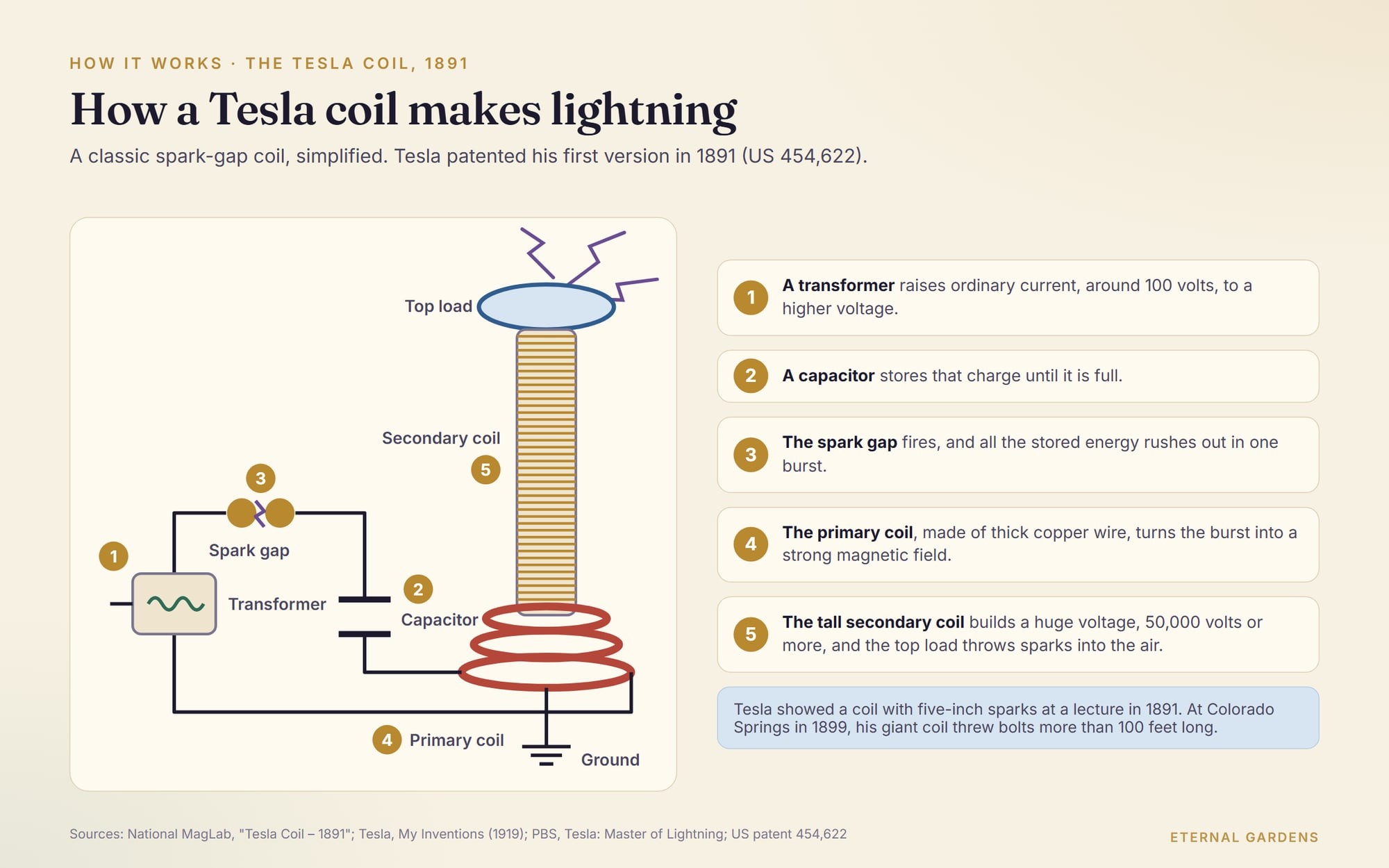
A Tesla coil is a transformer that turns ordinary electricity into very high voltage at very high frequency. Tesla patented it in 1891 for lighting and later used it in his wireless experiments.
Here is how the classic version works. A capacitor fills with charge until a spark jumps across a small gap. That spark dumps the energy into a primary coil of thick copper wire. The burst of current makes a strong magnetic field, which builds a huge voltage in a tall secondary coil. At the top, the charge escapes as sparks.
At a lecture in 1891, Tesla showed a coil "giving sparks of five inches." By 1899, in Colorado Springs, PBS says his giant coil threw bolts more than 100 feet long.
The National MagLab notes that circuits built on the coil went into the first wireless telegraph transmitters. Newer electronics have since replaced it in most jobs. One coil even made the lighting effects for the 1979 film Star Trek: The Motion Picture.
Did Tesla invent radio?
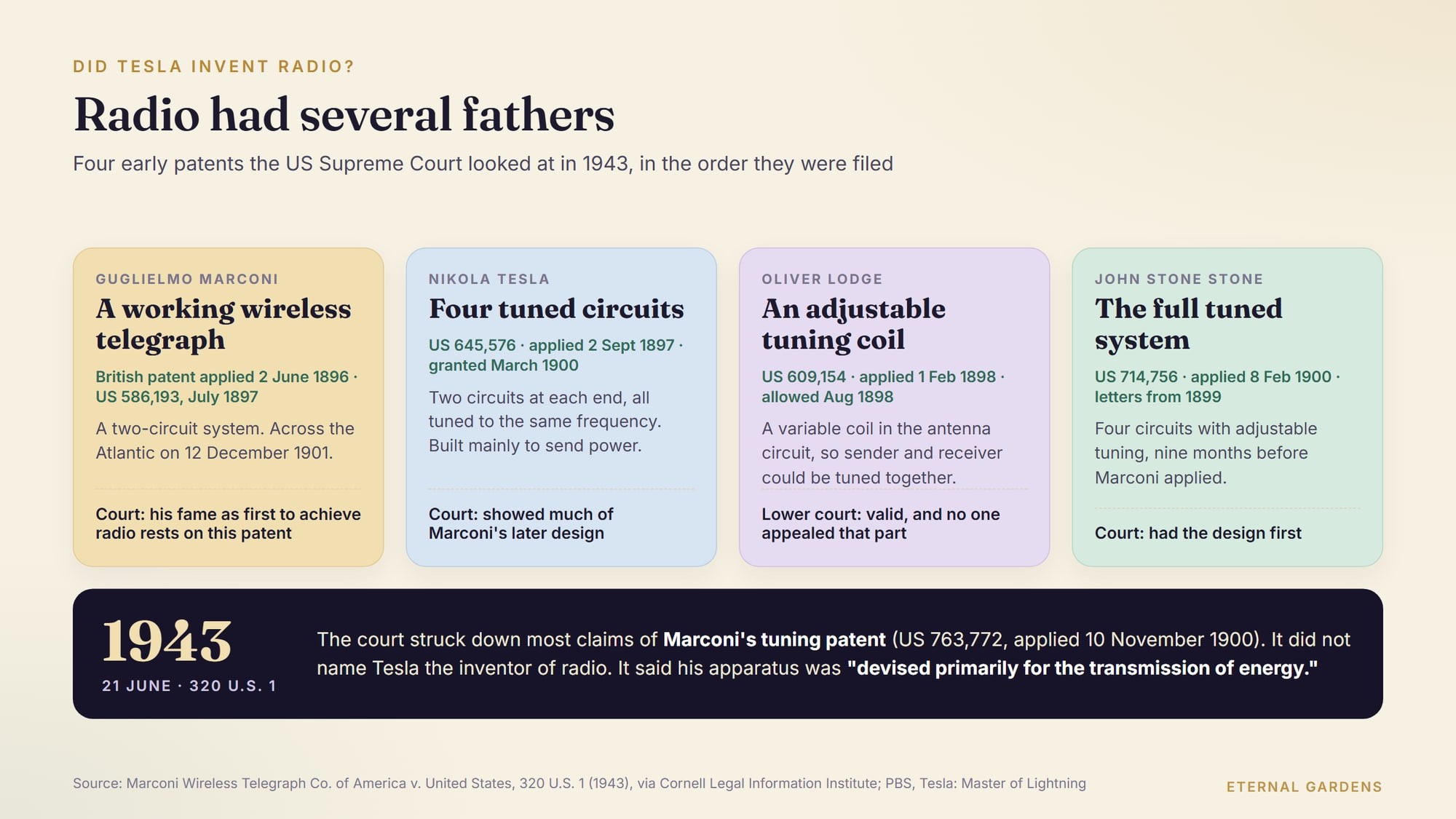
Tesla made real contributions to radio, but no single person invented it. Tesla filed a key patent on tuned circuits in 1897. Guglielmo Marconi applied for his first British patent in June 1896 and sent signals across the Atlantic on 12 December 1901.
A popular claim says the US Supreme Court handed radio to Tesla in 1943. Even the PBS film on Tesla says the court ruled the radio patents belonged to him. The court's opinion, issued on 21 June 1943, is more careful than that. It struck down the main claims of Marconi's patent on tuning. It found that John Stone Stone had the four-circuit design first. Tesla's 1897 patent showed most of it too, but not the adjustable tuning coil, which came from a patent by Oliver Lodge.
The court also said Tesla's apparatus was "devised primarily for the transmission of energy." And it said Marconi's fame as the first to achieve radio rests on his original 1897 patent, which was not in question. So the fair answer is that radio had several fathers, and Tesla was one of them.
The boat that seemed to read minds
In 1898, at an electrical show in Madison Square Garden, Tesla steered a small iron boat around an indoor pond by radio. He called it a "teleautomaton." His patent, US 613,809, is one of the earliest for wireless remote control, and PBS calls it the first. Tesla wrote that it "created a sensation such as no other invention of mine has ever produced."
Which Tesla stories are legends?
Tesla made big promises, especially after 1899, and fans have added more since. Here is how the most common claims hold up.
| Claim | What the record shows |
|---|---|
| Tesla invented X-rays | Wilhelm Röntgen discovered them on 8 November 1895. Tesla experimented with X-ray pictures he called "shadowgraphs" |
| Tesla invented neon lights | Tesla lit gas tubes with high-frequency current in the 1890s. Georges Claude showed the first neon tubes in Paris in December 1910 |
| Tesla sent free power through the air | His Wardenclyffe tower on Long Island was tested only once, in July 1903, and was dynamited in 1917 |
| Tesla built a death ray | He described "teleforce" in the 1930s. It was never built |
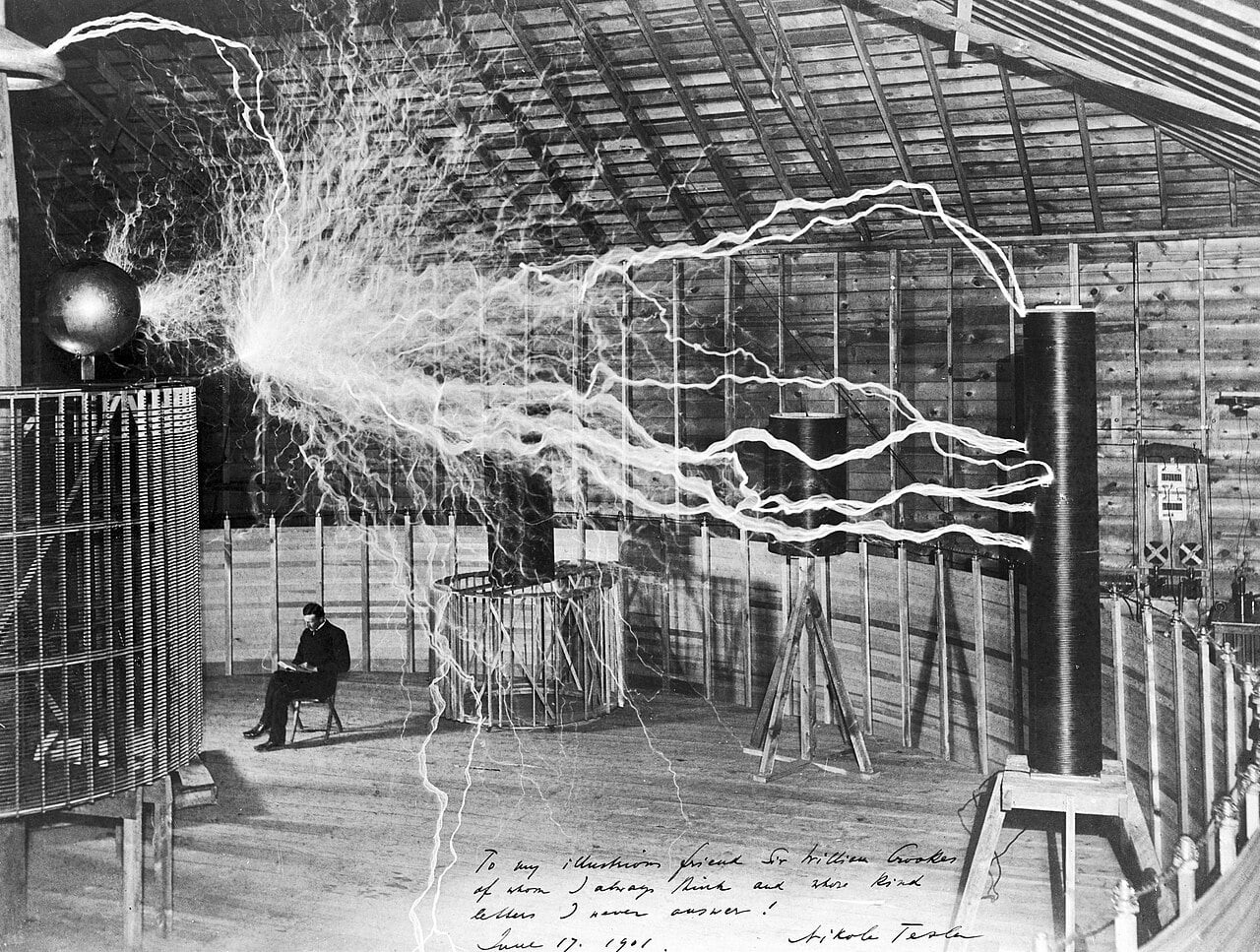
| The famous lightning photo is real | It is a double exposure, staged for a magazine in 1900 |
That photo is worth a closer look. It shows Tesla calmly reading while huge sparks fill his lab. The Public Domain Review explains that it is a double exposure, staged for a 1900 article in Century Magazine. Two exposures were combined on one plate.
What about Tesla's pigeon?
Tesla did not invent anything to do with pigeons. People search for it because of a famous story. He grew up with pigeons on the family farm in Smiljan, and in New York he fed them for years. He told his biographer John O'Neill about one white bird he loved. He said that when she died, he knew his life's work was finished. The story appears in O'Neill's 1944 biography, Prodigal Genius. Amanda Gefter retells it well in a 2023 Nautilus essay.
Which Tesla inventions do we still use today?
The induction motor is the big one. It still works on the rotating-field idea Tesla patented in 1888. Factory motors run on three-phase power, and smaller motors on household current use a capacitor to make the shifted second phase, as Nidec explains.
The AC grid itself, with power plants far from the cities they serve, follows the system Westinghouse built on Tesla's patents. Tuned circuits, which let a radio pick one station out of many, trace back partly to his 1897 work. Radio-controlled toys and drones use the trick his 1898 boat showed off: a radio signal telling a machine what to do.
His name is in your hospital too. In 1960 the General Conference on Weights and Measures named the unit of magnetic flux density the tesla. A typical MRI scanner, NIST notes, runs at 1.5 to 3 teslas.
Put your questions to Tesla
If you want to go further, you can talk with the Nikola Tesla character on Eternal Gardens. It is an Eternal Gardens interpretation of Nikola Tesla, grounded in published and public-domain sources such as My Inventions. It is not the historical figure and does not speak for him. You can try a conversation free, without an account.
Good questions to try:
- How did you picture the induction motor before you built it?
- Why did the 133-cycle current at Westinghouse give your motor so much trouble?
- What did you hope Wardenclyffe would do, and why did it stop?
- Who do you think deserves credit for radio?
A useful habit is to ask it where an answer comes from, and to check the dates against a list like the one above. Our guide on how to talk to historical figures with AI has more tips.
!The Nikola Tesla character chat page on Eternal Gardens with suggested opening questions
Frequently asked questions
What did Nikola Tesla invent that we still use today?
The induction motor is the biggest one. Tesla patented it in 1888, and factory and household motors still work on his rotating magnetic field. The AC power systems Westinghouse built on his patents shaped the modern grid. His 1897 tuned circuits fed into radio, and his name lives on in the tesla, the unit used to rate MRI scanners.
Did Nikola Tesla invent alternating current?
No. Alternating current was known decades before Tesla was born, and even the Tesla Science Center at Wardenclyffe says so. Tesla's contribution was a practical AC induction motor and a full polyphase system for sending and using AC power. He patented these in 1888 and licensed them to George Westinghouse.
Did Tesla invent the radio?
Not alone. Tesla filed a key patent on tuned circuits in 1897, while Marconi applied for his first British patent in 1896. In 1943 the US Supreme Court struck down most claims of Marconi's tuning patent, mainly because John Stone Stone had the design first. The court did not name Tesla the inventor of radio.
How many patents did Nikola Tesla have?
The Nikola Tesla Museum in Belgrade counts at least 311 patents in 27 countries. Of these, 112 were US patents. Many foreign patents cover the same inventions as the American ones. His first US patent was for a dynamo commutator, and his last, granted in 1928, was for an apparatus for aerial transport.
What is the story of Tesla's pigeon?
Tesla did not invent anything to do with pigeons. In New York he fed pigeons for years, and he told his biographer John O'Neill about a white pigeon he loved. He said that when she died, he knew his life's work was finished. The story appears in O'Neill's 1944 biography, Prodigal Genius.
Sources
- Nikola Tesla Museum, Belgrade: Patentstesla-museum.org
- Nikola Tesla, My Inventions (1919), Wikisourceen.wikisource.org
- Google Patents: US 381,968, Electro-magnetic motor (1888)patents.google.com
- Google Patents: US 454,622, System of electric lighting (1891)patents.google.com
- Google Patents: US 613,809, controlling moving vessels (1898)patents.google.com
- Google Patents: US 645,576, transmission of electrical energy (1900)patents.google.com
- Google Patents: US 1,061,206, Turbine (1913)patents.google.com
- Marconi Wireless Telegraph Co. v. United States, 320 U.S. 1 (1943), Cornell LIIlaw.cornell.edu
- IEEE/ETHW Milestone: Rotating Fields and Early Induction Motors, 1885-1888ethw.org
- IEEE/ETHW Milestone: Adams Hydroelectric Generating Plant, 1895ethw.org
- ETHW: Nikola Teslaethw.org
- National MagLab: Tesla Coil, 1891nationalmaglab.org
- PBS American Experience: Teslapbs.org
- PBS American Experience: The Contractpbs.org
- PBS Tesla: Master of Lightning, Who Invented Radio?pbs.org
- PBS Tesla: Master of Lightning, Harnessing Niagarapbs.org
- PBS Tesla: Master of Lightning, Race of Robotspbs.org
- PBS Tesla: Master of Lightning, Colorado Springspbs.org
- T. C. Martin, The Inventions, Researches and Writings of Nikola Tesla (1894), Project Gutenberggutenberg.org
- Nidec: Rotation principle of induction motornidec.com
- Tesla Science Center at Wardenclyffe: Nikola Tesla inventionsteslasciencecenter.org
- APS Historic Sites: Wardenclyffeaps.org
- Franklin Institute: Wilhelm Conrad Röntgenfi.edu
- APS News: This Month in Physics History, neon lightsaps.org
- Public Domain Review: Nikola Tesla in his laboratorypublicdomainreview.org
- Amanda Gefter, Tesla's Pigeon, Nautilus (2023)nautil.us
- BIPM: Resolution 12 of the 11th CGPM (1960)bipm.org
- NIST: What's in a name? The teslanist.gov
About the author
Eternal Gardens
Eternal Gardens is an AI character platform where you can talk with characters drawn from the writings of historical and literary figures, and build worlds and stories with them.