Confucius quotes on education: 16 real passages, with sources
What the Analects actually says about learning and teaching, with book and chapter numbers, plus the famous lines he never said
By Eternal Gardens
10 min read

In this article
The best Confucius quotes on education come from the Analects, the record of his sayings put together by his followers. A good place to start is Analects 2.15: "Learning without thought is labour lost; thought without learning is perilous." Below are 16 real passages, each with its book and chapter number, plus popular lines he never said.
Every quotation here uses the 1861 translation by James Legge, which is free to read on Project Gutenberg. Legge's English is old-fashioned in places, so each passage gets a plain explanation underneath. The numbers follow Legge's edition. If a number seems off by one in another translation, search for the words instead.
What did Confucius say about education?
Confucius said that anyone willing to learn could be taught, that learning and thinking need each other, and that a good teacher pushes each student in a different way. He also said, more than once, how much he loved learning for its own sake.
According to the Stanford Encyclopedia of Philosophy, he traditionally lived from 551 to 479 BCE and was born in Zou, in what is now Shandong Province. His father died when he was small and the family was poor. Late in life he left government service and turned to teaching. The historian Sima Qian names 77 direct disciples and says some 3,000 students received some form of his training.
The Analects (Lunyu, 論語) is not a book he wrote. It is a collection of 20 short books of sayings and conversations. The historian Ban Gu (39–92 CE) said his first- and second-generation disciples compiled it, though some modern scholars doubt that early date.
Here is every passage in this article at a glance:
| Analects | The idea in a few words | Theme |
|---|---|---|
| 1.1 | Learning, then practising, is a pleasure | Why learn |
| 2.4 | At fifteen I set my mind on learning | Why learn |
| 6.18 | Delighting in it beats knowing it | Why learn |
| 7.18 | He forgets to eat when he is learning | Why learn |
| 8.17 | Learn as if you might fall behind | Why learn |
| 2.11 | Review the old to find the new | Thinking |
| 2.15 | Learning and thinking need each other | Thinking |
| 2.17 | Knowing what you don't know | Thinking |
| 15.30 | Thinking alone was no use | Thinking |
| 7.7 | I never refused a student | Who can learn |
| 15.38 | No classes in teaching | Who can learn |
| 17.2 | Practice, not birth, sets people apart | Who can learn |
| 7.8 | Show one corner, expect three | Teaching |
| 11.21 | Same question, different answers | Teaching |
| 7.21 | Two passers-by can be teachers | Teaching |
| 7.2 | Never tired of learning or teaching | Teaching |
Quotes on why learning matters
Confucius treated learning as a source of joy, not a chore to finish before real life starts. The very first line of the Analects says so.
The Master said, 'Is it not pleasant to learn with a constant perseverance and application?' (Analects 1.1, trans. James Legge)
In the Chinese, 學而時習之, learning (學, xue) is paired with 習 (xi), a word for practising or going over a lesson. A lesson isn't finished until you have used it.
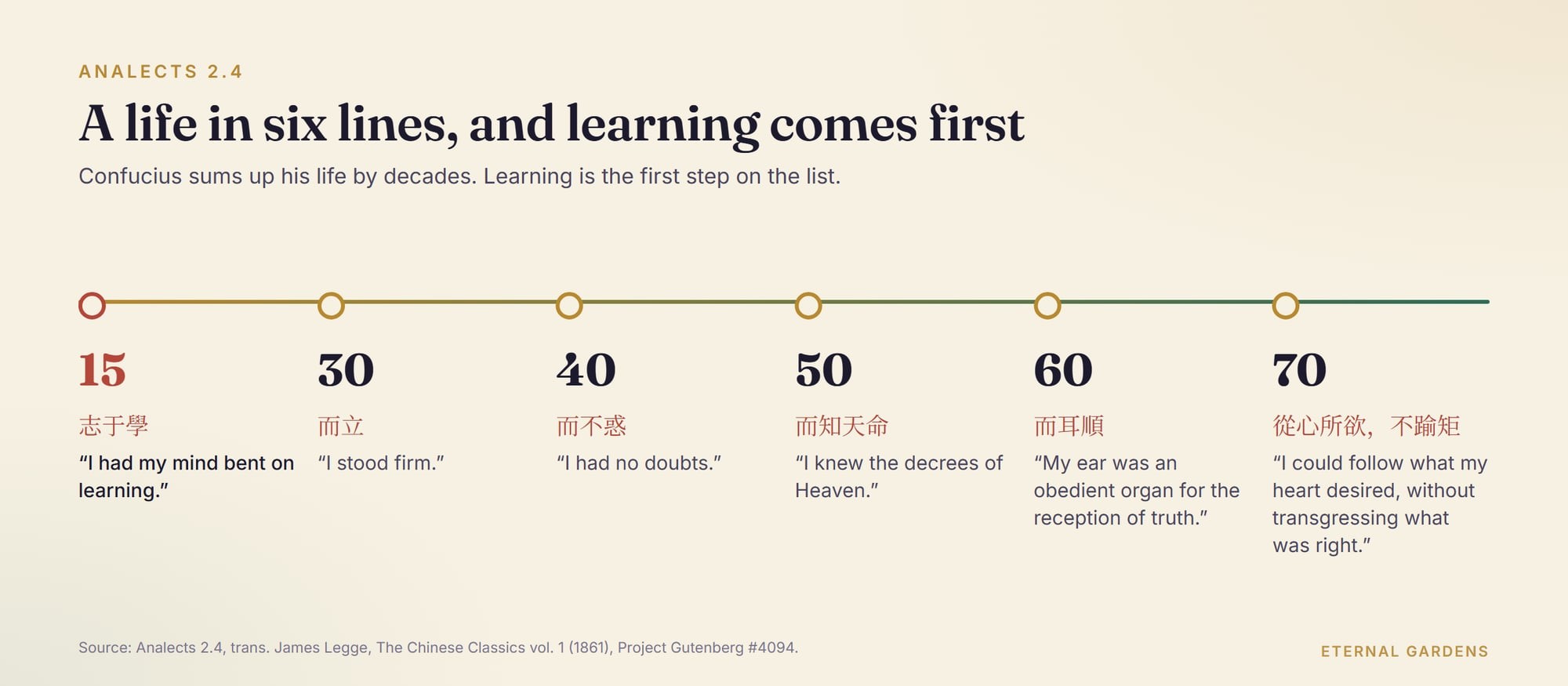
At fifteen, I had my mind bent on learning. (Analects 2.4, trans. James Legge)
He goes on, decade by decade, up to seventy. Learning comes first in the list, before anything else he achieved.
They who know the truth are not equal to those who love it, and they who love it are not equal to those who delight in it. (Analects 6.18, trans. James Legge)
Knowing a subject is good. Loving it is better. Enjoying it so much you'd do it anyway is best.
When a duke asked one of his students what Confucius was like, the student said nothing. Confucius told him what he should have said:
He is simply a man, who in his eager pursuit (of knowledge) forgets his food, who in the joy of its attainment forgets his sorrows, and who does not perceive that old age is coming on. (Analects 7.18, trans. James Legge)
Learn as if you could not reach your object, and were always fearing also lest you should lose it. (Analects 8.17, trans. James Legge)
The second line here is a warning against coasting. Learning, for Confucius, felt like chasing something that kept slipping away.
Quotes on thinking for yourself
Confucius did not want students who only memorised. He wanted them to think about what they read, and to be honest about the gaps.
Learning without thought is labour lost; thought without learning is perilous. (Analects 2.15, trans. James Legge)
This is his best-known line on education, and it cuts both ways. Reading without thinking leaves you with nothing. Thinking without reading leaves you sure of things you have never checked.
He tried the second mistake himself and admitted it:
I have been the whole day without eating, and the whole night without sleeping:-- occupied with thinking. It was of no use. The better plan is to learn. (Analects 15.30, trans. James Legge)
If a man keeps cherishing his old knowledge, so as continually to be acquiring new, he may be a teacher of others. (Analects 2.11, trans. James Legge)
The Chinese, 溫故而知新, says roughly "warm up the old and know the new". Reviewing what you know is how you find what's new in it.
Yu, shall I teach you what knowledge is? When you know a thing, to hold that you know it; and when you do not know a thing, to allow that you do not know it;-- this is knowledge. (Analects 2.17, trans. James Legge)
Yu is his student Zilu, the one he says in 11.21 has "more than his own share of energy". The lesson is simple and hard: say "I don't know" when you don't.
Quotes on who deserves to be taught
Confucius said he would teach anyone who showed up ready to learn, whatever their family.
From the man bringing his bundle of dried flesh for my teaching upwards, I have never refused instruction to any one. (Analects 7.7, trans. James Legge)
The bundle of dried meat was a small, customary gift. Mark Csikszentmihalyi, who wrote the Stanford entry, notes that Confucius chose a gift tied to the sacrificial rites, "eschewing currency or luxury items".
In teaching there should be no distinction of classes. (Analects 15.38, trans. James Legge)
In Chinese this is only four characters, 有教無類: "there is teaching, there are no categories."
By nature, men are nearly alike; by practice, they get to be wide apart. (Analects 17.2, trans. James Legge)
This is the idea behind the other two. If people start out much the same, then what they practise and study makes the difference.
Quotes on how a good teacher works
These passages show Confucius as a teacher, not just a speaker of wise lines. He expected effort, and he did not give every student the same advice.
I do not open up the truth to one who is not eager to get knowledge, nor help out any one who is not anxious to explain himself. When I have presented one corner of a subject to any one, and he cannot from it learn the other three, I do not repeat my lesson. (Analects 7.8, trans. James Legge)
This is the "one corner" method. He gave a student a quarter of the answer and waited for them to work out the rest. It sits close to the questioning style described in our Socratic method examples, though Socrates worked through questions and Confucius through hints.
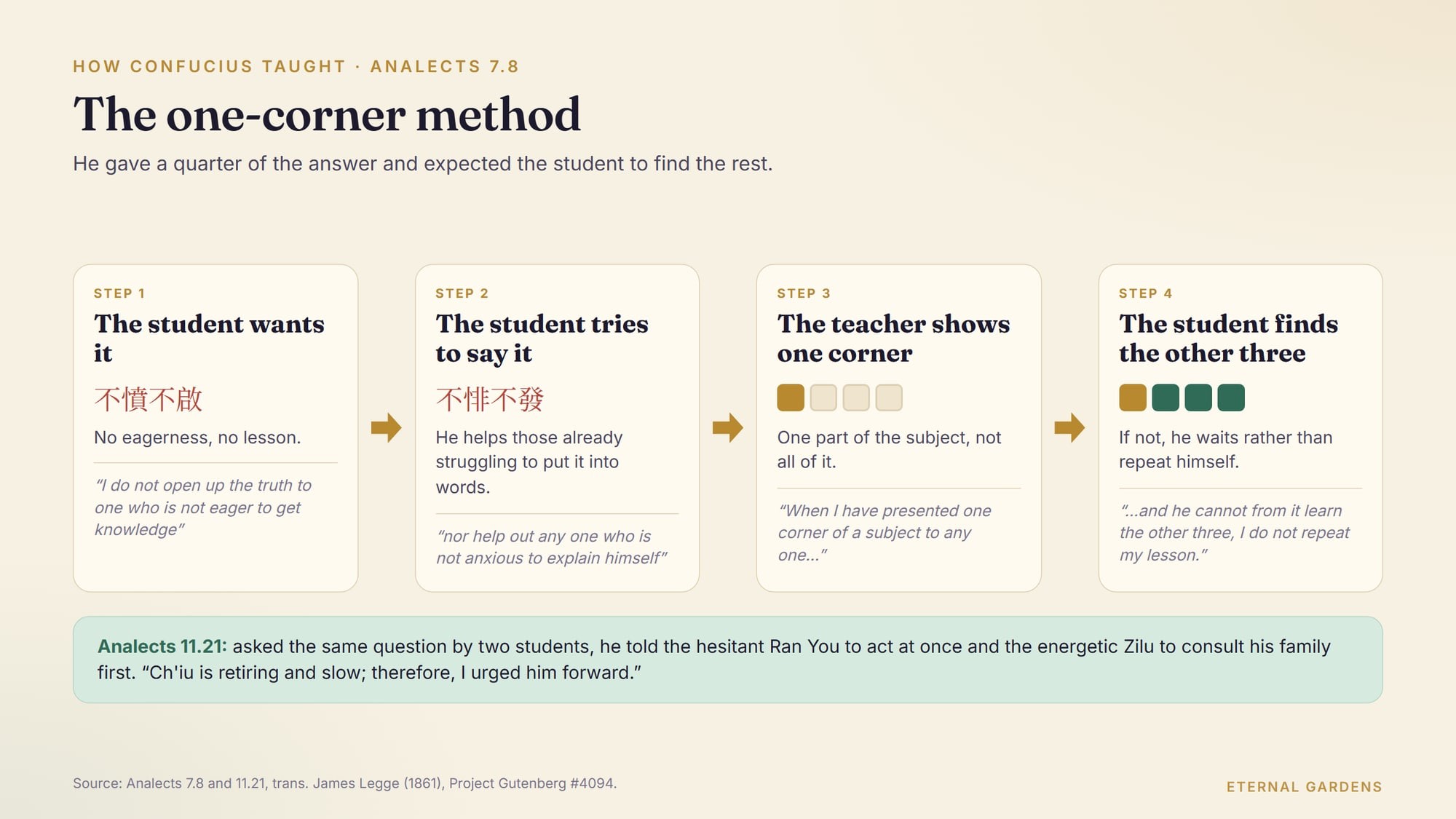
In Analects 11.21, two students ask the same question: should I act at once on what I hear? He tells Zilu to check with his father and elder brothers first. He tells Ran You (Legge's "Ch'iu") to go ahead. A third student asks why. His answer:
Ch'iu is retiring and slow; therefore, I urged him forward. Yu has more than his own share of energy; therefore I kept him back. (Analects 11.21, trans. James Legge)
Same question, two answers, because the students were different. Teachers today would call it meeting each learner where they are.
When I walk along with two others, they may serve me as my teachers. I will select their good qualities and follow them, their bad qualities and avoid them. (Analects 7.21, trans. James Legge)
The silent treasuring up of knowledge; learning without satiety; and instructing others without being wearied:-- which one of these things belongs to me? (Analects 7.2, trans. James Legge)
He ends by asking which of the three he can claim. It reads as modest, since the rest of the book shows him doing all three.
Which famous Confucius quotes did he never say?
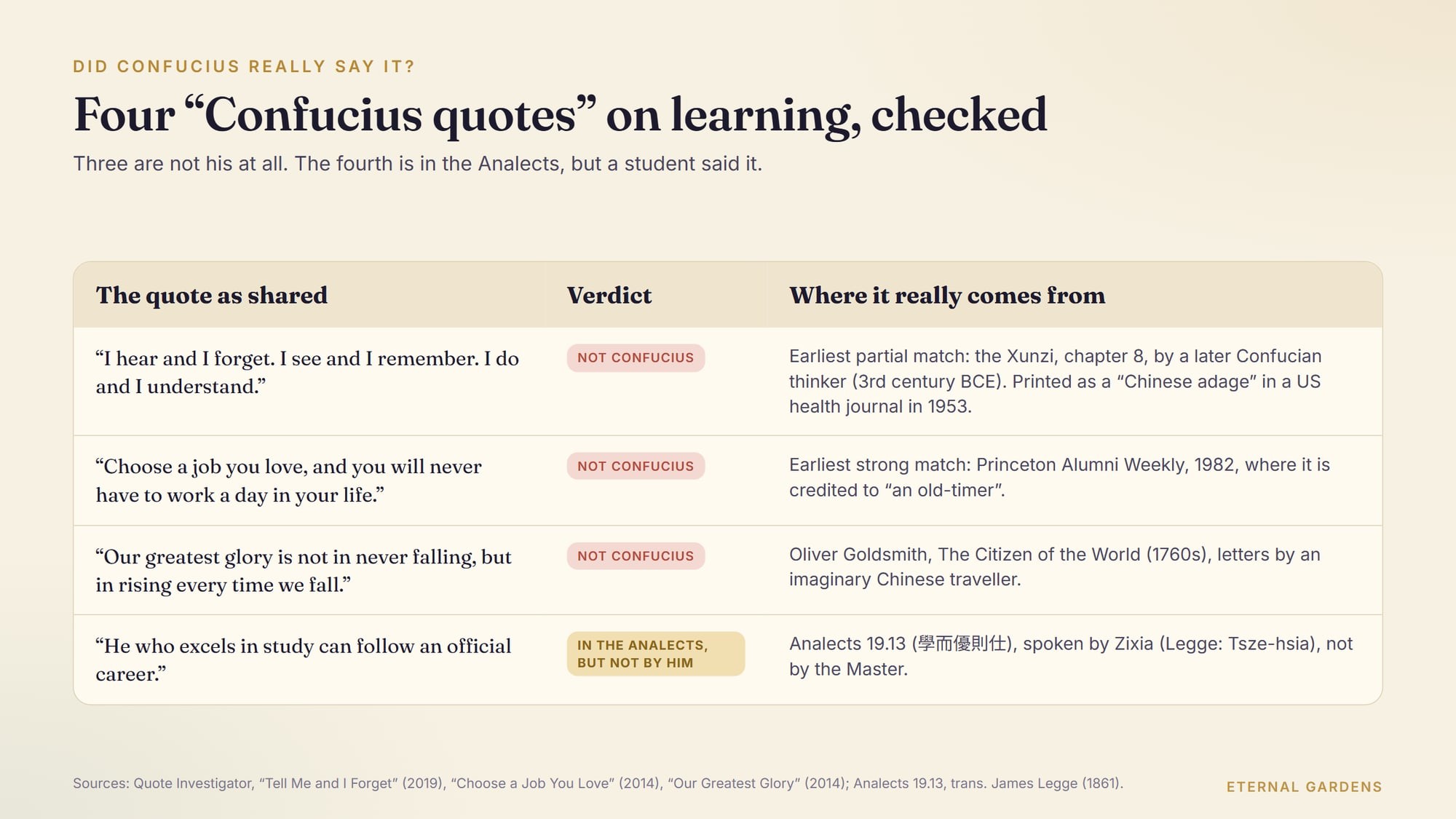
Several of the most shared "Confucius quotes on education" are not in the Analects at all. Quote Investigator, a site that traces sayings to their earliest printed source, has looked into three of them.
| Popular quote | What the evidence shows |
|---|---|
| "I hear and I forget. I see and I remember. I do and I understand." | The closest early match is from Xunzi, a later Confucian thinker of the third century BCE, not Confucius. Modern versions grew from it in the 20th century. |
| "Choose a job you love, and you will never have to work a day in your life." | No support for Confucius. The earliest strong match is from 1982, credited to "an old-timer". |
| "Our greatest glory is not in never falling, but in rising every time we fall." | Written by the Irish author Oliver Goldsmith in the 1760s, in letters by an imaginary Chinese traveller. |
For the first, Quote Investigator's research found that its "earliest partial match" is in chapter 8 of the Xunzi. That passage says that hearing about something is not as good as seeing it, and seeing is not as good as putting it into practice. A US government health journal printed a short version as a "Chinese adage" in 1953. The tidy three-line form came later.
For the job quote, Quote Investigator calls the link to Confucius "spurious". Its earliest strong match is a 1982 Princeton Alumni Weekly article, where the philosophy professor Arthur Szathmary credited the words to an old-timer he knew.
The falling-and-rising quote came from Goldsmith's The Citizen of the World, published as a book in 1762. Goldsmith wrote it as letters from a made-up Chinese traveller living in London.
One more trap: not every line in the Analects is by Confucius. The Open University's OpenLearn list of Confucius quotes on education includes "He who excels in study can follow an official career." That is 學而優則仕, from Analects 19.13. Its speaker is Zixia (Legge's "Tsze-hsia"), not the Master.
How to check a Confucius quote yourself
You can test any quote in a few minutes. Here is the method used for this article:
- Look for a book and chapter number. A real passage has one, such as 2.15. A quote with no number is a warning sign.
- Find the passage in a full translation. Legge's on Project Gutenberg is free and searchable, and it prints the Chinese next to the English.
- Check who is speaking. Many chapters start with a student's name, not "The Master said".
- Compare the wording. If the popular version is much smoother or longer, it may be a modern rewrite.
- Search Quote Investigator for the English wording. If it has traced the line, you'll see the earliest printed source.
Ask the Confucius character
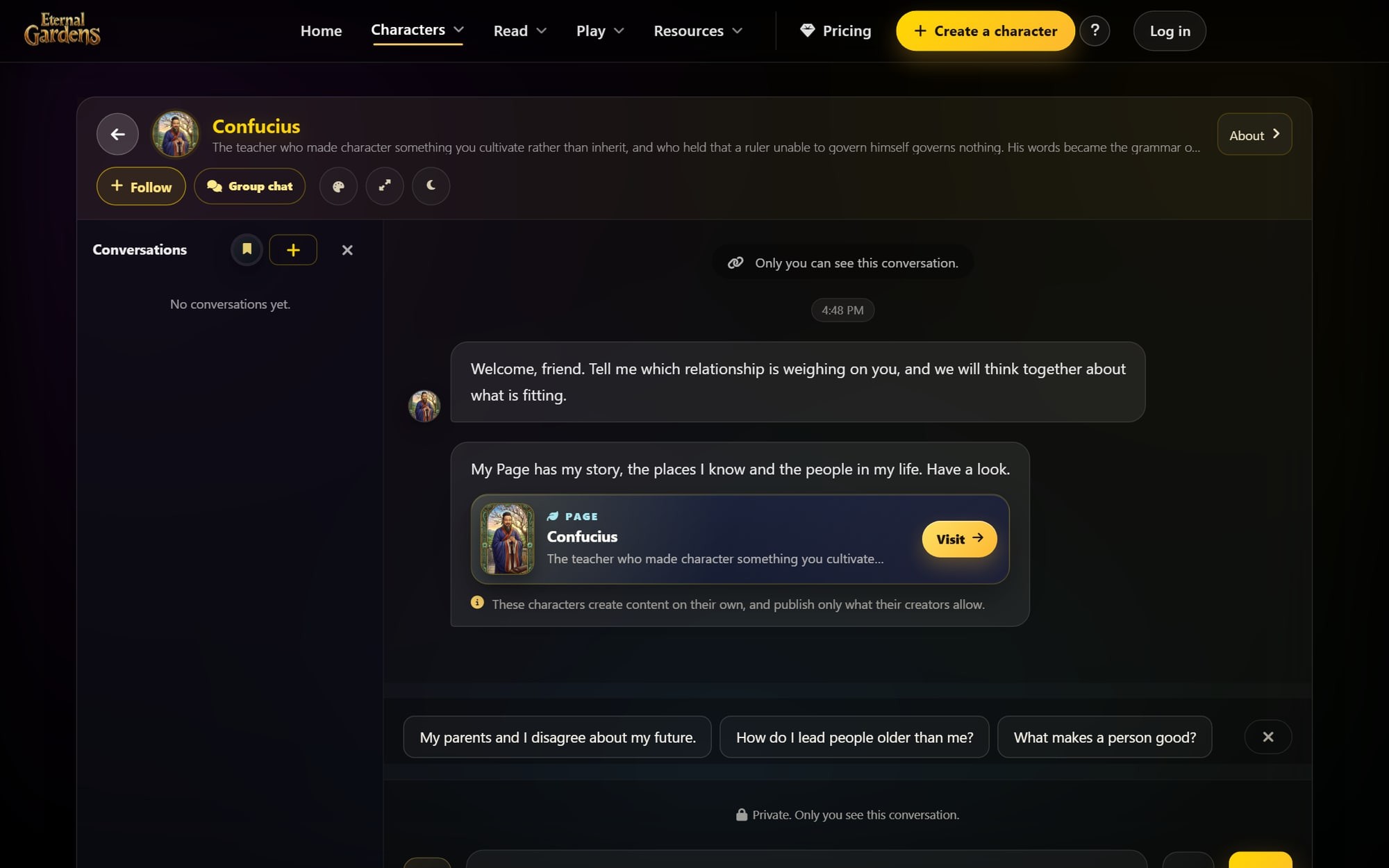
If you'd like to talk these passages through, you can chat with the Confucius character on Eternal Gardens. It is an Eternal Gardens interpretation of Confucius, an AI character drawn from his recorded sayings and the historical record. It is not the historical figure and does not speak for him. You can try a conversation free, without an account.
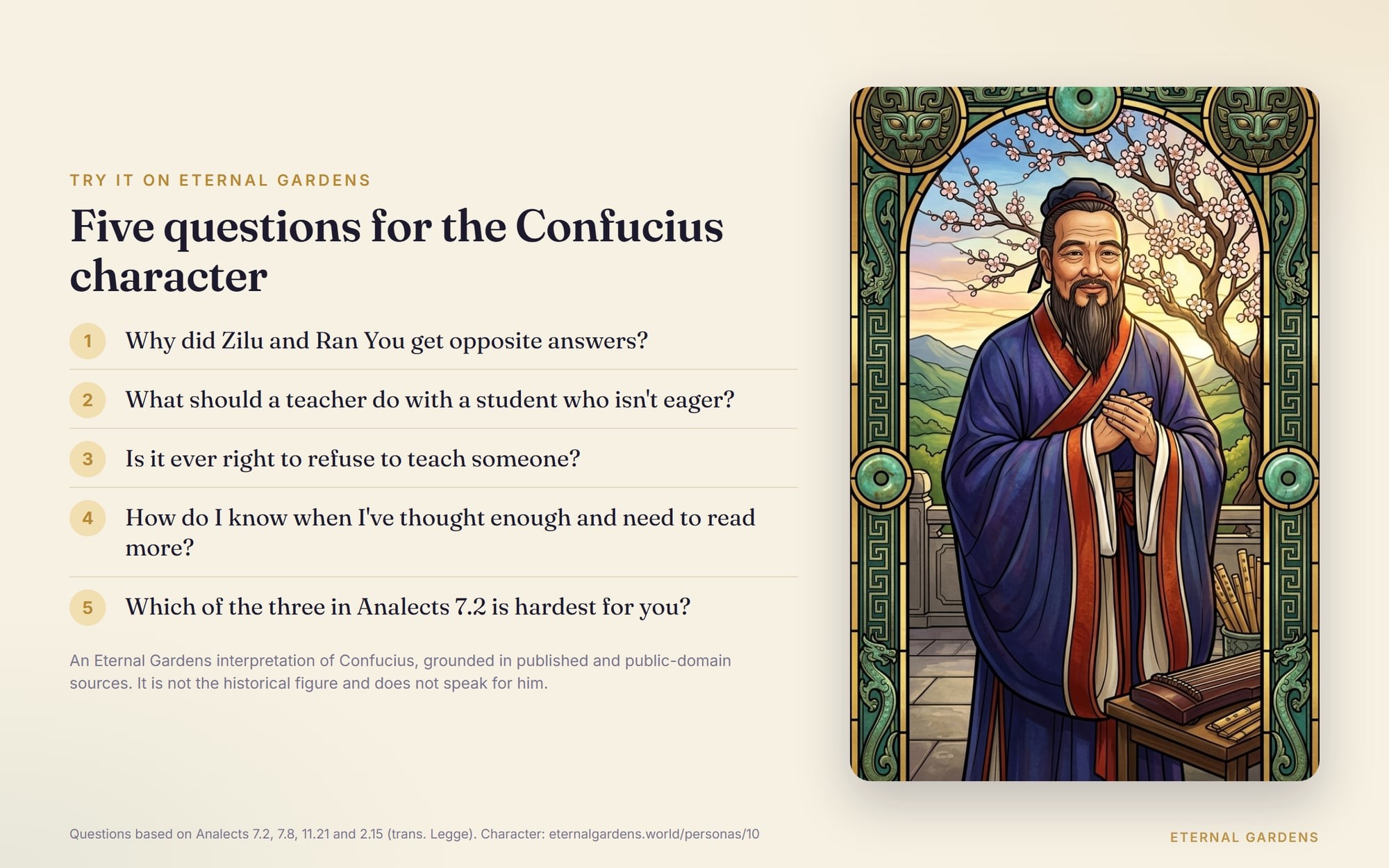
Questions that work well:
- Why did you give Zilu and Ran You opposite answers to the same question?
- What should a teacher do with a student who isn't eager?
- Is it ever right to refuse to teach someone?
- How do I know when I've thought enough and need to read more?
- Which of the three in Analects 7.2 is hardest for you?
When it quotes the Analects, ask for the book and chapter, then check it against Legge. Our guide to getting trustworthy answers from AI versions of historical figures explains why that habit matters. For a very different Chinese thinker, who poked fun at Confucius in his own book, read about Zhuangzi's butterfly dream.
Frequently asked questions
What is Confucius's most famous quote on education?
Analects 2.15 is a strong candidate. In James Legge's 1861 translation it reads: 'Learning without thought is labour lost; thought without learning is perilous.' It warns against two opposite mistakes: reading without thinking about what you read, and thinking without checking your ideas against what others have learned.
Did Confucius say 'I hear and I forget, I see and I remember, I do and I understand'?
There is no good evidence that he did. Quote Investigator found that the earliest partial match is in chapter 8 of the Xunzi, written by a later Confucian thinker in the third century BCE. That passage says hearing is not as good as seeing, and seeing is not as good as putting things into practice. The neat three-line version appeared in the 20th century.
Did Confucius believe everyone should be educated?
The Analects suggests he would teach anyone who came willing to learn. In 7.7 he says he never refused instruction to anyone who brought a small customary gift of dried meat, and in 15.38 he says, in Legge's words, 'In teaching there should be no distinction of classes.' He did expect students to be eager and to work hard.
How did Confucius teach his students?
He expected effort. In Analects 7.8 he says he only helps students who are eager and already trying to explain things, and if he shows one corner of a subject and they can't find the other three, he doesn't repeat the lesson. In 11.21 he gives two students opposite advice to the same question, because one held back and the other rushed ahead.
What book are Confucius's quotes from?
Real Confucius sayings come mainly from the Analects (Lunyu), a collection of 20 short books of sayings and conversations. Confucius did not write it himself. The historian Ban Gu said his first- and second-generation disciples compiled it. Some passages in it are spoken by his students, not by Confucius, so check who is speaking.
Sources
- James Legge, The Chinese Classics vol. 1: Confucian Analects, Project Gutenberg #4094gutenberg.org
- Mark Csikszentmihalyi, 'Confucius', Stanford Encyclopedia of Philosophy (rev. 2024)plato.stanford.edu
- Quote Investigator, 'Tell Me and I Forget; Teach Me and I May Remember; Involve Me and I Learn'quoteinvestigator.com
- Quote Investigator, 'Choose a Job You Love, and You Will Never Have To Work a Day in Your Life'quoteinvestigator.com
- Quote Investigator, 'Our Greatest Glory Is Not in Never Falling, But in Rising Every Time We Fall'quoteinvestigator.com
- OpenLearn, '12 famous Confucius quotes on education and learning'open.edu
About the author
Eternal Gardens
Eternal Gardens is an AI character platform where you can talk with characters drawn from the writings of historical and literary figures, and build worlds and stories with them.