Aristotle's virtues list: every virtue, its two vices, and the golden mean
The full table from the Nicomachean Ethics, what the mean really is, and how Aristotle says you hit it
By Eternal Gardens
8 min read

In this article
- Aristotle's virtues list, with the vices on each side
- What is the golden mean?
- Does the golden mean just mean moderation?
- How do you get a virtue, according to Aristotle?
- What are Aristotle's intellectual virtues?
- How do you hit the mean in real life?
- Where does Aristotle's list of virtues come from?
- Put your questions to Aristotle
Aristotle's virtues list comes from Book II of the Nicomachean Ethics. It names about a dozen traits of character, from courage and temperance to truthfulness and friendliness. Each one sits between two vices, one of too much and one of too little. That middle point is what people now call the golden mean.
Below is the full list as a table, with the vices on each side and the book where Aristotle discusses each one. After that comes what the "mean" really is, and why it is harder than it sounds.
Aristotle's virtues list, with the vices on each side
In Book II, chapter 7, Aristotle walks through the virtues one by one. He admits that many of the states have no name in Greek, so he makes some up. Then in Books III and IV he treats most of them at length.
The names below are from W. D. Ross's 1908 translation, which is free to read online at MIT's Internet Classics Archive. Other translators use other words. Ross's "liberality" is generosity, and his "proper pride" is often called greatness of soul.
| Virtue (the mean) | What it is about | Too little | Too much | Where |
|---|---|---|---|---|
| Courage | Fear and confidence | Cowardice | Rashness | III.6–9 |
| Temperance | Bodily pleasures | Insensibility | Self-indulgence | III.10–12 |
| Liberality | Giving and taking money | Meanness | Prodigality | IV.1 |
| Magnificence | Spending large sums | Niggardliness | Vulgarity | IV.2 |
| Proper pride | Great honours | Undue humility | Empty vanity | IV.3 |
| (No name) | Small honours | Lack of ambition | Ambition | IV.4 |
| Good temper | Anger | Inirascibility | Irascibility | IV.5 |
| Friendliness | Being pleasant to others | Surliness | Obsequiousness | IV.6 |
| Truthfulness | What you claim about yourself | Mock modesty | Boastfulness | IV.7 |
| Ready wit | Joking and fun | Boorishness | Buffoonery | IV.8 |
| Modesty | Shame | Shamelessness | Bashfulness | II.7, IV.9 |
| Righteous indignation | Others' fortunes | Spite | Envy | II.7 |
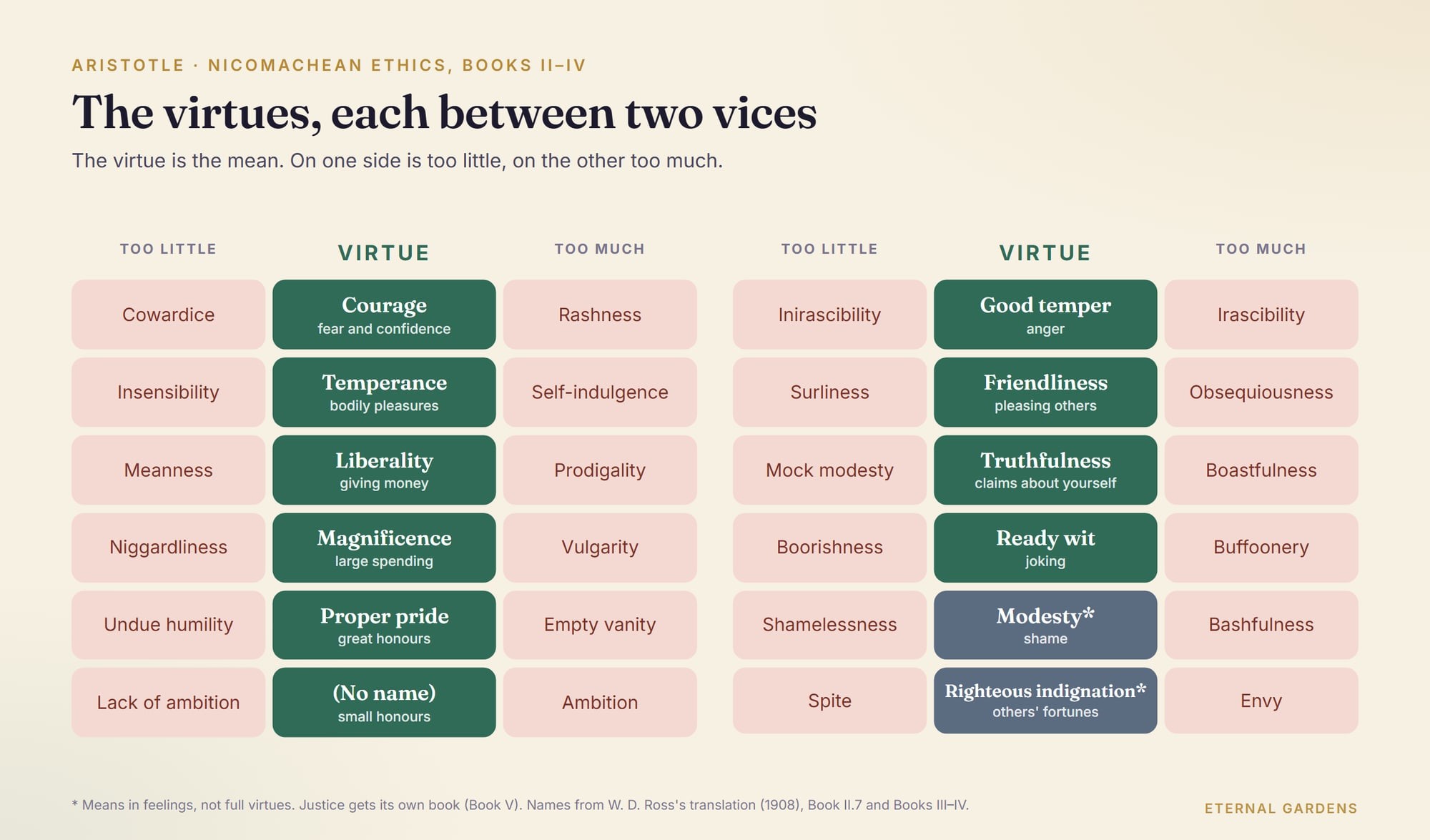
Two items on the list are odd. Aristotle says modesty is not really a virtue at all, because shame "is more like a feeling than a state of character." And justice is missing from the table. He leaves it for the whole of Book V, because it "has not one simple meaning." In one sense, he says, justice is "not part of virtue but virtue entire." It is all the other virtues put to work for other people.
What is the golden mean?
The golden mean is the right amount of a feeling or action for you, in your situation. It is not the average, and Aristotle never called it golden.
Here is his own definition, from Book II, chapter 6:
"Virtue, then, is a state of character concerned with choice, lying in a mean, i.e. the mean relative to us, this being determined by a rational principle, and by that principle by which the man of practical wisdom would determine it." Aristotle, Nicomachean Ethics II.6, trans. W. D. Ross (1908)
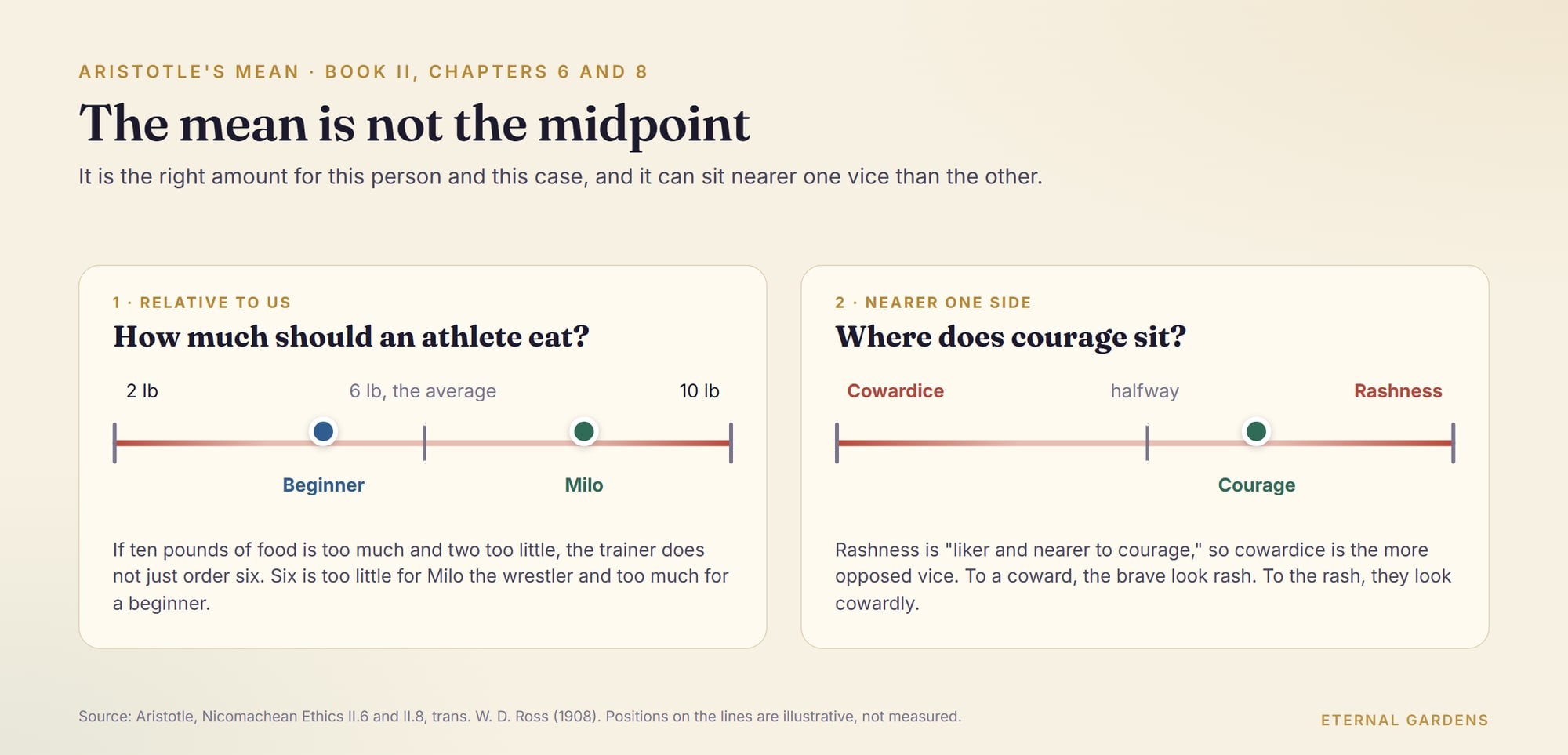
The key words are "relative to us." Aristotle gives a food example. If ten pounds of food is too much and two is too little, a trainer will not simply order six. Six pounds may be too little for Milo, the champion wrestler. It may be too much for a beginner. The mean depends on the person.
The word "golden" comes from somewhere else. The Roman poet Horace praised whoever loves "auream ... mediocritatem," the golden middle, in Odes 2.10. Today the phrase is attached to Aristotle's idea, but it is Horace's. In Ross's translation of the Ethics, the word "golden" never appears.
Does the golden mean just mean moderation?
No. The mean is about getting it right, and sometimes the right amount is a lot.
Aristotle says we can feel anger or pity too much or too little. The virtue is to feel them "at the right times, with reference to the right objects, towards the right people, with the right motive, and in the right way." Sometimes great anger is the fitting response. The Stanford Encyclopedia of Philosophy makes the same point: the right amount "is not some quantity between zero and the highest possible level."
The mean is also not halfway between the two vices. Aristotle says rashness is nearer and more like courage than cowardice is. Self-indulgence, he adds, is the vice most opposed to temperance, because people lean toward pleasure. And the brave person looks rash to a coward and cowardly to a rash one.
Some feelings and acts have no mean at all. Aristotle's examples include envy and spite, and acts like theft and murder. There is no right amount of them. As he puts it, "simply to do any of them is to go wrong."
How do you get a virtue, according to Aristotle?
You practise it. Aristotle says moral virtues come from habit. Even the Greek word for moral, ethike, is built on ethos, habit.
He compares it to learning a craft:
"Men become builders by building and lyreplayers by playing the lyre; so too we become just by doing just acts, temperate by doing temperate acts, brave by doing brave acts." Aristotle, Nicomachean Ethics II.1, trans. W. D. Ross (1908)
None of this comes from nature alone, he says. A stone always falls. You cannot train it to rise, even by throwing it up ten thousand times. People are different. We are able to take on virtues, but only practice makes them part of us.
Why go to the trouble? In Book I, Aristotle argues that a thing's good lies in doing its own work well. A carpenter has a function, and so does an eye. A good lyre player is one who plays the lyre well. For a human being, the good turns out to be "activity of soul in accordance with virtue." So the virtues are not rules laid on top of a happy life. Using them well is what a happy life is.
It also takes time. Aristotle adds that a good life has to be judged across "a complete life." His reason has become a proverb: "one swallow does not make a summer, nor does one day."
What are Aristotle's intellectual virtues?
Aristotle names five virtues of thinking. Of these, practical wisdom is the one that ties into good character.
The table above shows only the moral virtues. Book II opens by splitting virtue into two kinds, moral and intellectual. The moral kind comes from habit. The intellectual kind grows mainly through teaching, which is why it "requires experience and time." The intellectual virtues get their own book, Book VI. In Ross's terms they are:
- Art is the skill of making things, such as a building, guided by true reasoning.
- Scientific knowledge is the power to prove things that cannot be otherwise.
- Intuitive reason is the grasp of the first principles that every proof starts from.
- Philosophic wisdom is the most finished kind of knowledge, joining the two above.
- Practical wisdom is knowing what to do in the business of living.
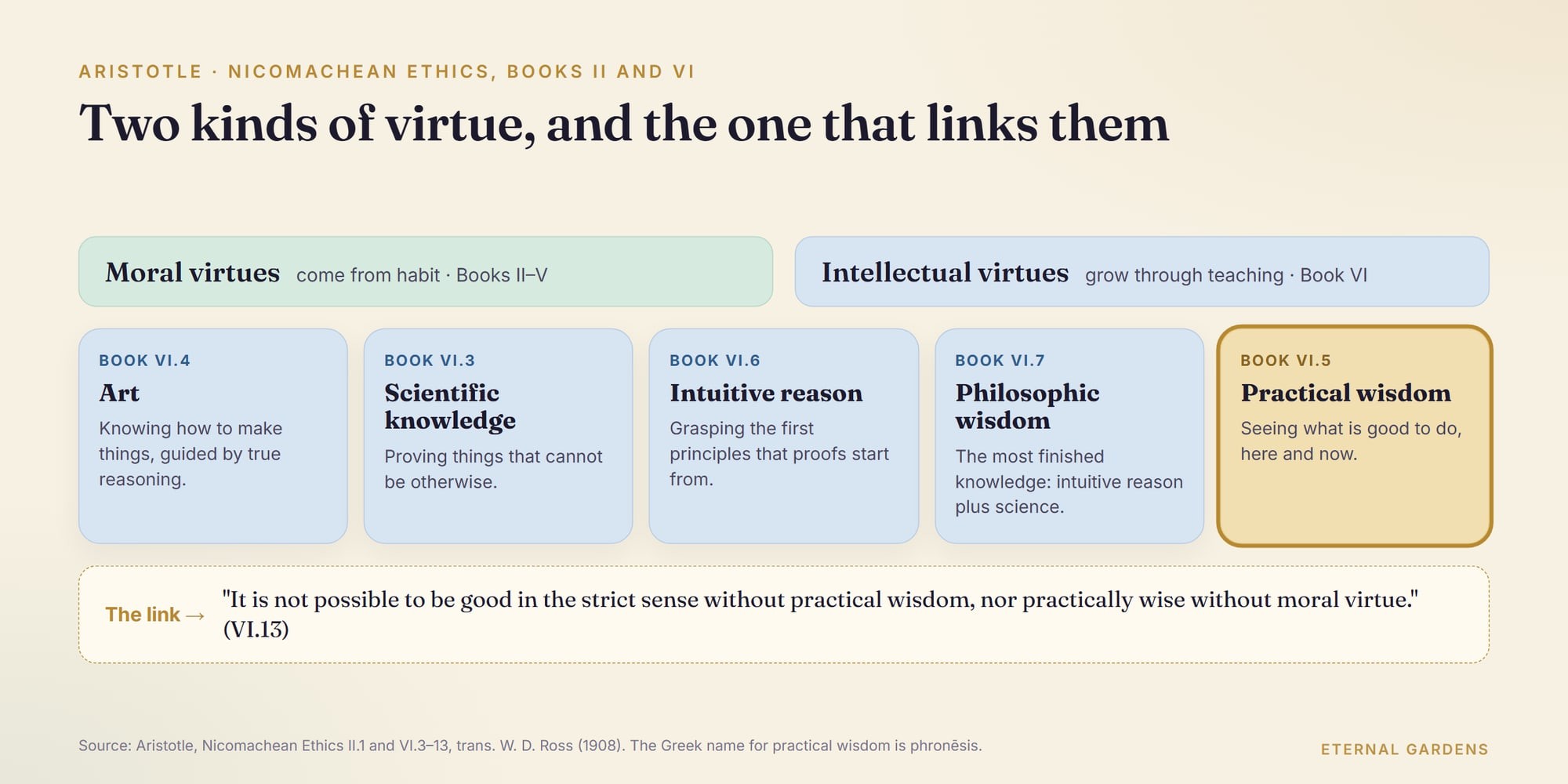
The one that matters most for the list is practical wisdom, sometimes called phronesis. Ross calls it "a true and reasoned state of capacity to act with regard to the things that are good or bad for man." It is the skill of seeing what to do in a real case. Aristotle's example is Pericles, the Athenian leader, who could see what was good for himself and for people in general.
Look back at the definition of virtue. The mean is set by "the man of practical wisdom." So the two kinds of virtue need each other. In Book VI Aristotle says "it is not possible to be good in the strict sense without practical wisdom, nor practically wise without moral virtue."
How do you hit the mean in real life?
Aristotle admits it is hard. "To miss the mark easy, to hit it difficult," he writes, because there are many ways to go wrong and only one way to go right.
His advice in Book II, chapter 9, is practical:
- Avoid the worse extreme first. If you can't hit the mean, take "the least of the evils."
- Know which way you lean. Some of us tend to one extreme and some to the other. You can tell from what gives you pleasure and pain.
- Pull hard the other way. He compares it to "straightening sticks that are bent": you bend them past straight.
- Be wary of pleasure. We do not judge it fairly, so treat it with suspicion.
He also says there is no rule that settles every case. A person who drifts a little from the mean is not blamed. But how far is too far "is not easy to determine by reasoning." In the end, "the decision rests with perception." That is why practical wisdom matters so much.
His most quoted line on this is about anger:
"Any one can get angry- that is easy- or give or spend money; but to do this to the right person, to the right extent, at the right time, with the right motive, and in the right way, that is not for every one, nor is it easy." Aristotle, Nicomachean Ethics II.9, trans. W. D. Ross (1908)
Where does Aristotle's list of virtues come from?
It comes from the Nicomachean Ethics, a work in ten books. The list itself is in Book II, and the details fill Books III to V.
Aristotle did not give the work its title. The Stanford Encyclopedia notes that the name likely comes from his son Nicomachus, who may have edited it. A second work, the Eudemian Ethics, covers much of the same ground. Scholars generally treat the Nicomachean as the later and better version.
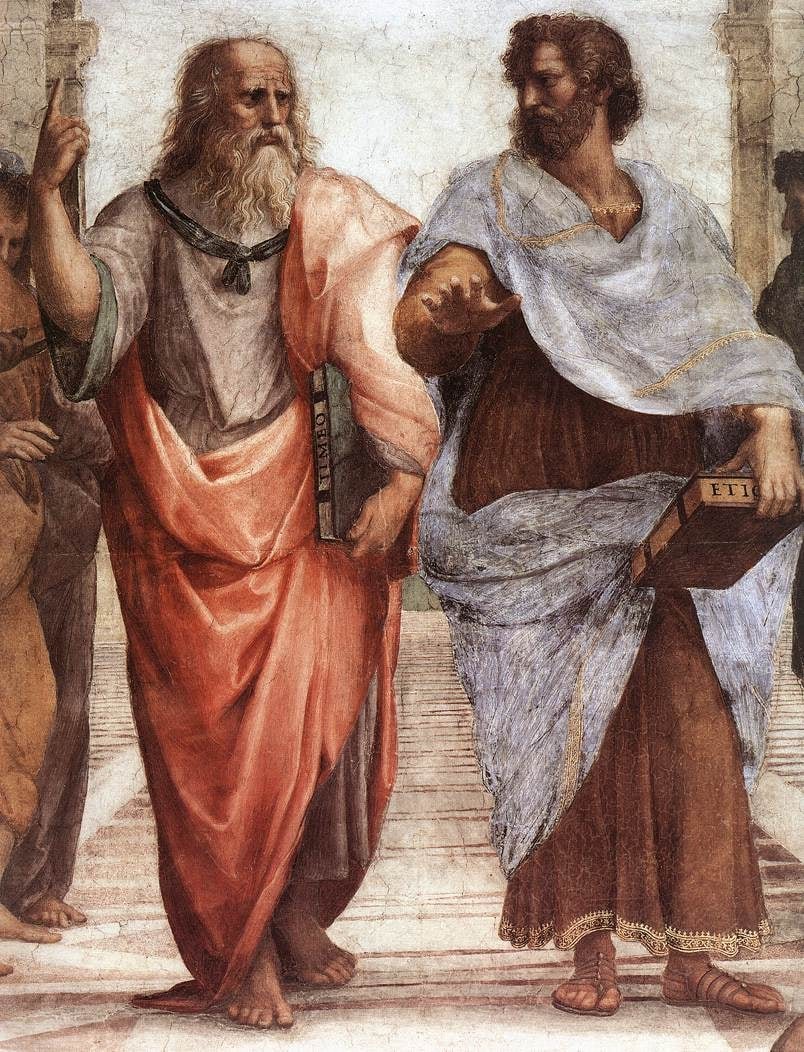
The book was famous long after him. In Raphael's fresco The School of Athens, painted in 1509, the book under Aristotle's arm is his Ethics, with "Etica" on the spine.
If you want to compare Aristotle's approach with his teacher's teacher, see these examples of the Socratic method. The Stoics later took a stricter line on emotion; our beginner's guide to Stoicism explains how.
Put your questions to Aristotle
The best way to test whether you understand the mean is to try it on a real case. You can talk with the Aristotle character on Eternal Gardens. It is an Eternal Gardens interpretation of Aristotle, grounded in published and public-domain sources. It is not Aristotle and does not speak for him. You can try it free, without an account.

The character's page says he "divided every question before answering it." So questions that ask him to draw distinctions work well. Some to try:
- Where is the mean between cowardice and rashness for a nurse, and for a soldier?
- Why is there no virtue for the right amount of envy?
- How do I tell which way I lean, toward too much or too little?
- Why is justice not just one more virtue on the list?
- Can a person have courage but not practical wisdom?
Treat the answers as a way into the text, then check them against Books II to VI. Our guide to getting reliable answers from historical AI characters explains how.
Frequently asked questions
What are Aristotle's 12 virtues?
In Book II of the Nicomachean Ethics, Aristotle lists courage, temperance, liberality, magnificence, proper pride, a nameless virtue about small honours, good temper, friendliness, truthfulness and ready wit. He adds modesty and righteous indignation, which he treats as means in feelings rather than full virtues. That makes twelve in the Book II list. Justice is treated on its own, in Book V.
What is Aristotle's golden mean?
It is the right amount of a feeling or action, lying between a vice of too much and a vice of too little. Aristotle says it is 'the mean relative to us,' so it changes with the person and the case. He never called it golden. That word comes from the Roman poet Horace, who praised 'auream mediocritatem' in Odes 2.10.
Is the golden mean the same as moderation?
No. The mean is the right response, which can be strong. Aristotle says virtue means feeling things at the right times, toward the right people, with the right motive and in the right way. It is also not halfway between the vices: he says courage is nearer to rashness than to cowardice. Some acts, like theft and murder, have no mean at all.
How does Aristotle say we become virtuous?
By practice. Moral virtue comes from habit, he says, just as people become builders by building and lyre players by playing the lyre: 'we become just by doing just acts.' It also needs practical wisdom, the intellectual virtue of seeing what to do in a real case, and it is judged over a whole life, since 'one swallow does not make a summer.'
Sources
- Aristotle, Nicomachean Ethics, trans. W. D. Ross (1908), MIT Internet Classics Archiveclassics.mit.edu
- Nicomachean Ethics, Book II (Ross), MIT Internet Classics Archiveclassics.mit.edu
- Nicomachean Ethics, Book VI (Ross), MIT Internet Classics Archiveclassics.mit.edu
- Richard Kraut, Aristotle's Ethics, Stanford Encyclopedia of Philosophyplato.stanford.edu
- Horace, Odes 2.10 (Latin text), The Latin Librarythelatinlibrary.com
- Wikipedia, The School of Athensen.wikipedia.org
- Wikimedia Commons, Sanzio 01 Plato Aristotle.jpgcommons.wikimedia.org
About the author
Eternal Gardens
Eternal Gardens is an AI character platform where you can talk with characters drawn from the writings of historical and literary figures, and build worlds and stories with them.