Zhuangzi's butterfly dream: what it means, line by line
The 62-character story that ends chapter 2 of the Zhuangzi, with its Chinese text, the main readings and how translators changed it
By Eternal Gardens
8 min read

In this article
- What happens in the butterfly dream?
- Where does the story come from?
- The chapter has many English names
- What comes just before it
- What does the butterfly dream mean?
- Reading one: you can't be sure you're awake
- Reading two: everything turns into everything
- Reading three: each thing is right as it is
- The man who said it couldn't happen
- Why does the last line matter so much?
- Is it the same as Descartes' dream argument?
- How did painters and poets use the butterfly?
- Ask Zhuangzi yourself
Zhuangzi's butterfly dream is a story of just 62 Chinese characters that closes chapter 2 of the Zhuangzi. Zhuang Zhou dreams he is a happy butterfly, then wakes and can't say whether he is a man who dreamt of a butterfly or a butterfly now dreaming it is a man. Its meaning hangs on the last line: there must be a difference, and that is "the transformation of things".
That short line has kept readers arguing for more than 2,000 years. Some see doubt about what is real. Others see a picture of constant change. Below are the passage, its place in the book and the main readings, each with a source you can check.
What happens in the butterfly dream?
Zhuang Zhou falls asleep and becomes a butterfly. He flutters about, pleased with himself, with no idea he is Zhou. Then he wakes up, solid and himself again, and is left with a question he can't settle.
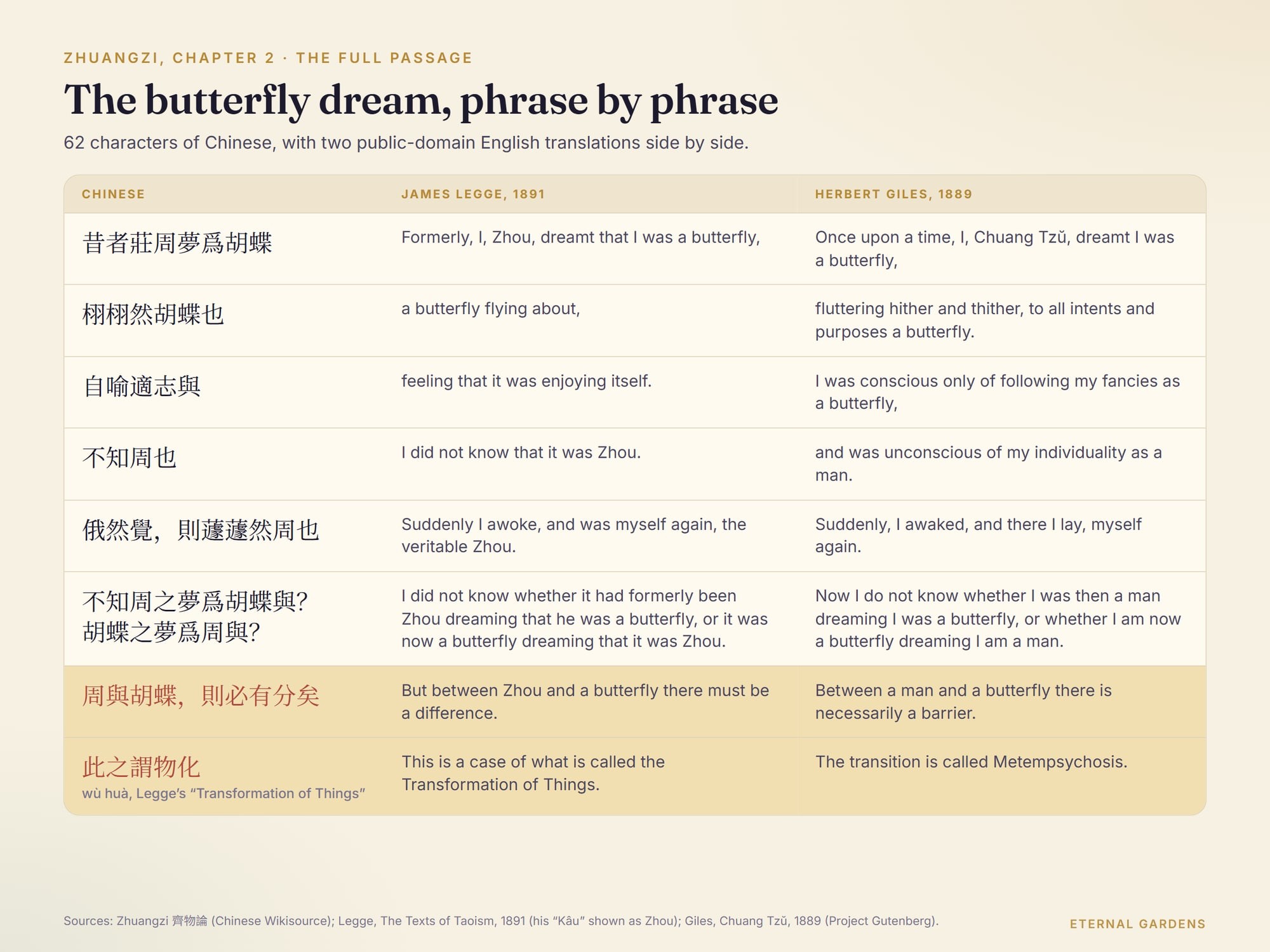
Here is the whole passage as James Legge translated it in 1891, in The Texts of Taoism. His spelling of the name, Kwang Kâu, is changed here to pinyin.
Formerly, I, [Zhuang Zhou], dreamt that I was a butterfly, a butterfly flying about, feeling that it was enjoying itself. I did not know that it was [Zhou]. Suddenly I awoke, and was myself again, the veritable [Zhou]. I did not know whether it had formerly been [Zhou] dreaming that he was a butterfly, or it was now a butterfly dreaming that it was [Zhou]. But between [Zhou] and a butterfly there must be a difference. This is a case of what is called the Transformation of Things.
That is the end of book 2 in Legge's numbering, which is chapter 2 in most modern editions.
Notice two things. The dream is pleasant, so this is not a nightmare about being trapped. And the story does not end on the famous question. It ends with a firm statement that the two are different, and then gives that difference a name.
Where does the story come from?
The butterfly dream is the last passage of chapter 2 of the Zhuangzi, a book named after Master Zhuang. According to the Stanford Encyclopedia of Philosophy, he lived in the second half of the fourth century BC. Han dynasty historians said his personal name was Zhou, that he came from the state of Meng and that he held minor posts in his home state. Little else about his life can be checked outside the book.
The book we read today was edited by Guo Xiang, who died in 312 CE. He cut it from 52 chapters to 33. The first seven, the "Inner Chapters", are usually credited to Zhuangzi himself, though some scholars doubt even that.
The chapter has many English names
Chapter 2 is called Qiwulun (齊物論) in Chinese. The title is hard to pin down, and translators have pulled it in different directions:
| Translator | Year | Title of chapter 2 |
|---|---|---|
| Herbert Giles | 1889 | The Identity of Contraries |
| James Legge | 1891 | The Adjustment of Controversies |
| Burton Watson | 2013 (complete edition) | Discussion on Making All Things Equal |
| Steve Coutinho (IEP) | online | Discussion on Smoothing Things Out |
Legge even scolded an earlier translator, a Mr Balfour, for calling it "Essay on the Uniformity of All Things". The fight over the title is a small version of the fight over the butterfly. Is the chapter about seeing that all things are one, or about calming the quarrels between points of view?
What comes just before it
The dream is not a stand-alone fable. A few paragraphs earlier, a teacher named Chang Wu-zi gives a speech about dreaming. People who dream don't know they are dreaming, he says, and only learn it on waking. Then, in Legge's words:
And there is the great awaking, after which we shall know that this life was a great dream.
He adds that the person telling you that you are dreaming is dreaming too. Right after that comes a short scene in which a penumbra asks a shadow why it keeps moving, and the shadow says it depends on something else. Then the butterfly. Read in order, the three pieces build on each other.
What does the butterfly dream mean?
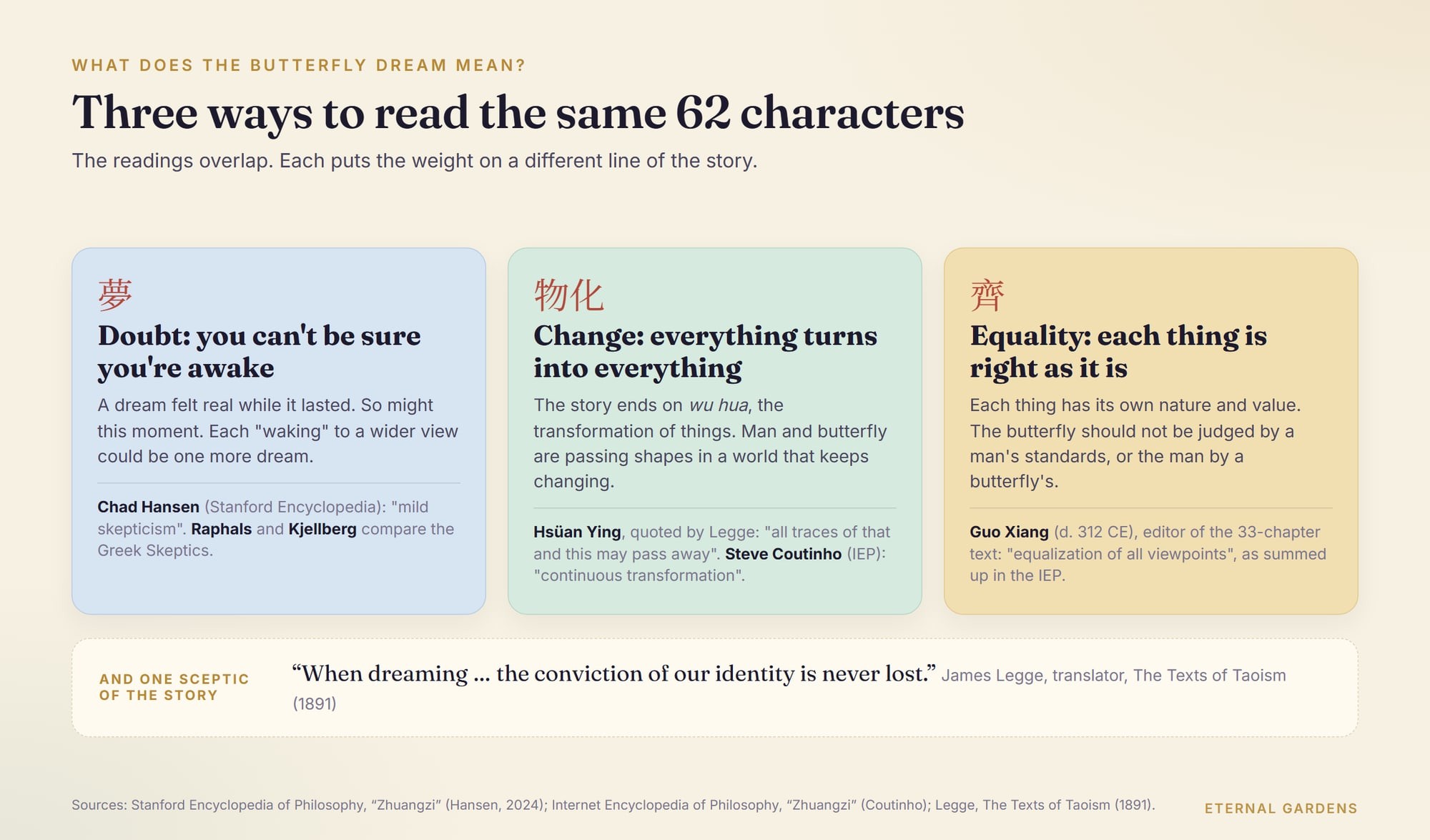
There is no single agreed meaning. Three readings come up again and again in the sources below. They are less rivals than different weights placed on the same 62 characters.
Reading one: you can't be sure you're awake
This is the version most people meet first. If a dream felt completely real while it lasted, how do you know this moment isn't one too? Chad Hansen, who wrote the Stanford entry, calls it Zhuangzi's "mild skepticism". Each time we wake up to a wider view, we feel freed from an error. Hansen points out that this feeling "may go both ways".
The doubt is mild because it doesn't end in despair. For Hansen, the "great awaking" works as a distant hope that keeps us modest about what we know. The Internet Encyclopedia of Philosophy notes that Lisa Raphals and Paul Kjellberg have compared this side of Zhuangzi with the ancient Greek Skeptics. Those thinkers held back from final judgments and found calm by doing so.
Reading two: everything turns into everything
The last line points somewhere else. In Chinese it is 物化, wu hua, which Legge rendered "the Transformation of Things". On this reading the point is change. A man becomes a butterfly, the butterfly becomes a man, and both are passing shapes in a world that never stops changing.
Legge's own footnote quotes a Chinese commentator, Hsüan Ying, who put it this way: Zhou "could be a butterfly, and the butterfly could be" Zhou, so "all traces of that and this may pass away". Steve Coutinho, in the IEP, describes Zhuangzi's world as one of "continuous transformation" between opposites. The wise person settles at the still centre of that turning and watches the changes without being thrown about by them.
Reading three: each thing is right as it is
Guo Xiang, the editor who shaped the book, read chapter 2 as "equalization of all viewpoints". Each thing has its own nature and its own value, and nothing should be judged by the standards of something else. Applied to the dream, the butterfly is right to be a butterfly and Zhou is right to be Zhou. Coutinho notes that Guo Xiang used this idea to tell people to accept their place in society, which is a fairly tame result for such a wild book.
The man who said it couldn't happen
Legge, for all his care as a translator, didn't buy the story. "Had he ever dreamt that he was a butterfly, so as to lose the consciousness of his personal identity as [Zhuang Zhou]?" he asked. "I do not think so." In his view, even in dreams "the conviction of our identity is never lost." It's a fair objection, and a useful one. It shows the story is a thought experiment, not a report of a real night's sleep.
Why does the last line matter so much?
The final words decide which reading wins. If the story ended with the question, it would be a puzzle about knowledge. Because it ends with "there must be a difference" and a name for it, many readers think the real subject is change.
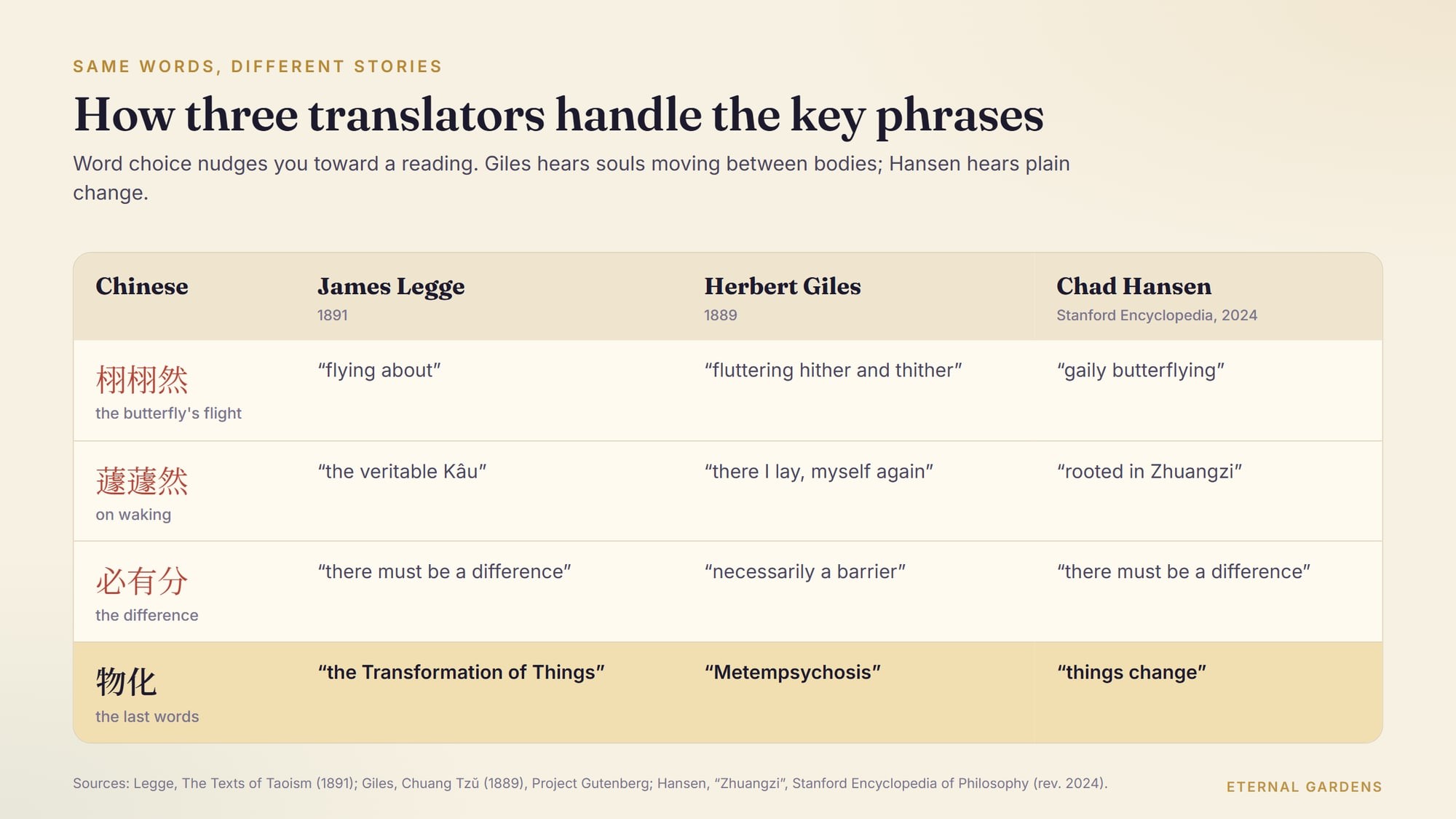
The early English translators heard that last phrase very differently. Giles, in 1889, ended with "The transition is called Metempsychosis", a word for souls moving from body to body. Legge chose "the Transformation of Things". Hansen, in the Stanford entry, gives the plainest version: "things change".
Is it the same as Descartes' dream argument?
Not quite. In his Discourse on the Method of 1637, René Descartes noticed that the thoughts we have awake can also come to us asleep, "while there is at that time not one of them true" (trans. John Veitch, Project Gutenberg). He used that doubt as a tool to reach one certain point: "I think, therefore I am".
| Zhuangzi (4th century BC) | Descartes (1637) | |
|---|---|---|
| The dream | One happy dream of being a butterfly | Dreams in general, used as a test |
| What the doubt is for | Loosening fixed views | Finding one thing that can't be doubted |
| Where it ends | "There must be a difference": change | "I think, therefore I am": a fixed self |
| Attitude to the self | Zhou and the butterfly are passing forms | The thinking self is the one sure thing |
Descartes wanted a floor to stand on. Zhuangzi seems happy to keep floating.
How did painters and poets use the butterfly?
In China the story became a stock image, and mostly a cheerful one. Jingjing Chen, writing in The China Story Yearbook 2019, traces two traditions. In one, the butterfly stands for carefree joy; the poet Su Shi, who lived in the eleventh and twelfth centuries, wrote of being "a joyful butterfly, carefree" in a dream. In the other, dreams are hazy and sad. That darker line runs through to the novel Dream of the Red Chamber. Chen says the optimistic school "gained the upper hand".
Chen also looks at the character for dream, 夢 (meng). Its earliest written form seems to show a sleeper's eyebrows, eyes and limbs moving. Later a roof and the sign for evening were added.
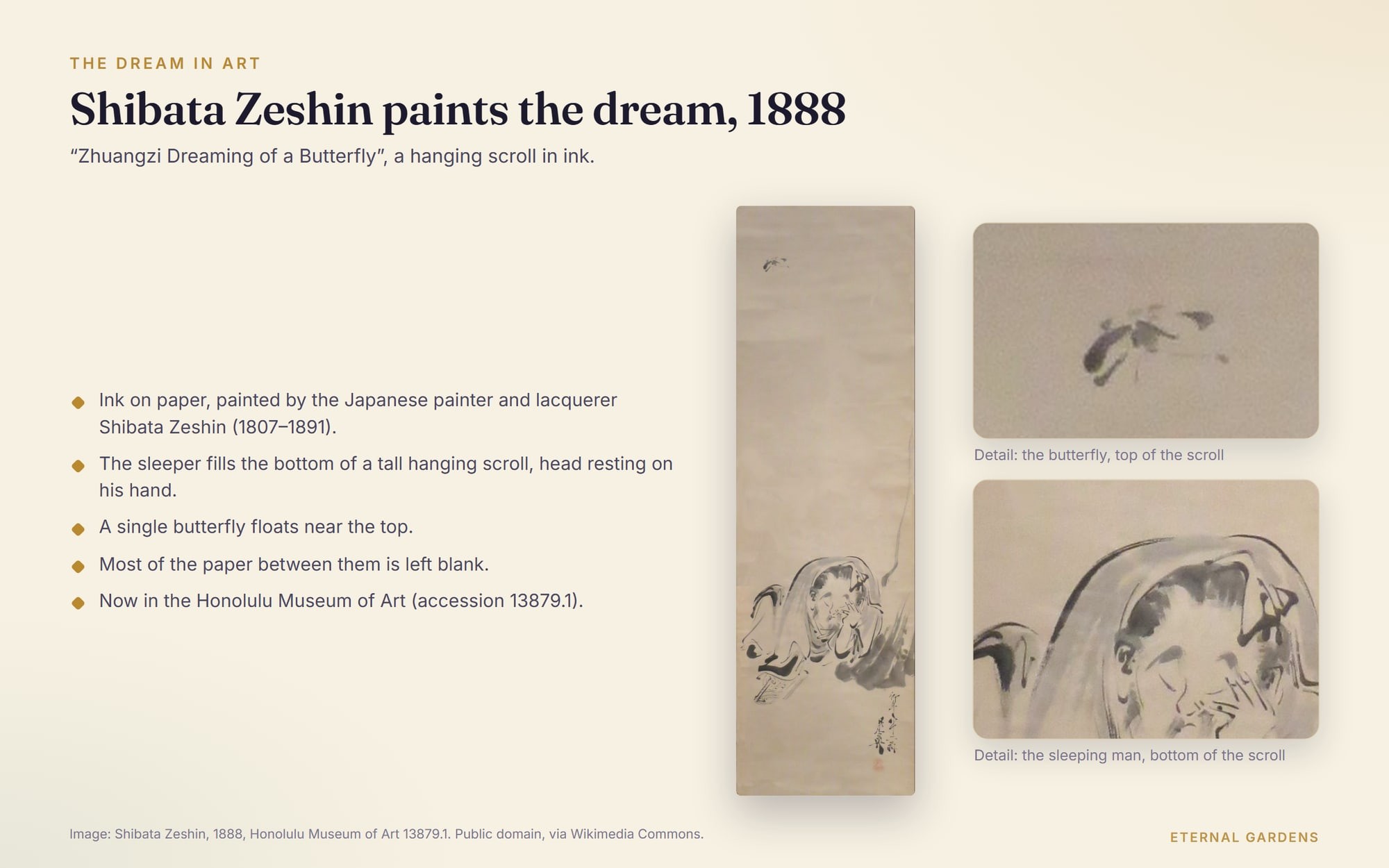
Artists painted the scene too. In Japan, Shibata Zeshin painted it in ink in 1888, with the sleeper at the bottom of a tall scroll and a single butterfly near the top.
Ask Zhuangzi yourself
If you'd like to test these readings, you can talk with the Zhuangzi character on Eternal Gardens. It is an Eternal Gardens interpretation of Zhuangzi, an AI character drawn from his writings and the historical record. It is not the historical figure and does not speak for him. You can try a conversation free, without an account.
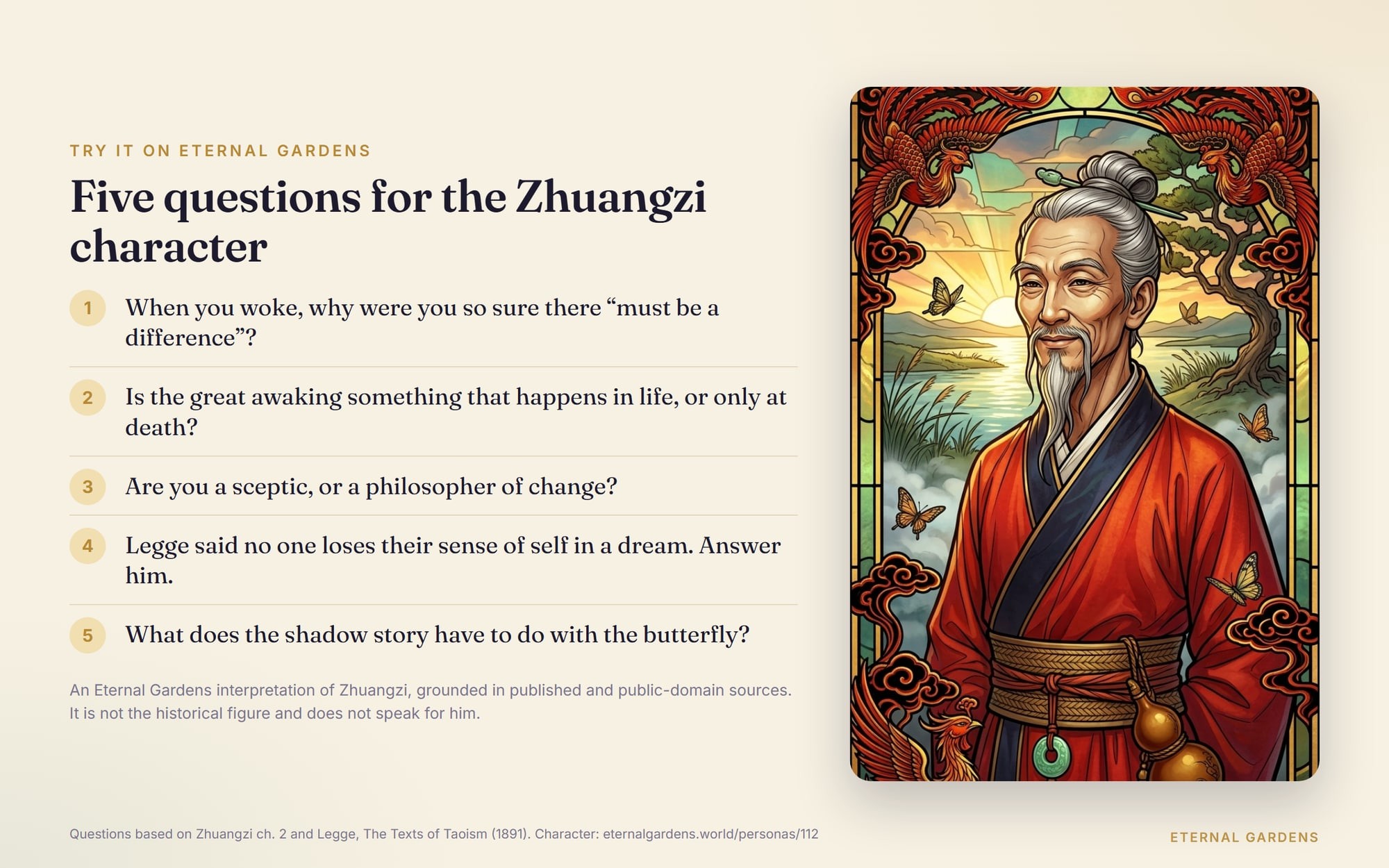
Some questions that get past the quotation and into the ideas:
- When you woke, why were you so sure there "must be a difference"?
- Is the great awaking something that happens in life, or only at death?
- Would you rather be read as a sceptic or as a philosopher of change?
- Legge said no one loses their sense of self in a dream. How would you answer him?
- What does the shadow story just before the butterfly have to do with it?
If you enjoy arguing with old thinkers, the same approach works for others. Our guide to getting good answers from AI versions of historical figures covers what to ask and how to check the replies. Confucius even appears as a character in chapter 2; for what the real man taught, see our list of real Confucius quotes on education, and the Socratic method examples show another teacher who answered questions with questions.
Frequently asked questions
What is the meaning of Zhuangzi's butterfly dream?
There is no single agreed meaning. One reading stresses doubt: if a dream can feel fully real, you cannot be sure you are awake now. Another stresses the last line, 'the transformation of things', and sees the story as about constant change. A third, from the editor Guo Xiang, says each thing, man or butterfly, is right as it is.
Where does the butterfly dream appear in the Zhuangzi?
It is the last passage of chapter 2, the Qiwulun, which Burton Watson translates as 'Discussion on Making All Things Equal'. It comes just after a speech about the 'great awaking', in which life itself may be a great dream, and a short dialogue between a penumbra and a shadow. Chapter 2 is one of the seven Inner Chapters.
What does wu hua (物化) mean?
Wu hua are the last two characters of the story. James Legge translated them in 1891 as 'the Transformation of Things', Herbert Giles in 1889 as 'Metempsychosis', and Chad Hansen in the Stanford Encyclopedia of Philosophy as 'things change'. Which version you read shapes how you understand the whole story.
Is Zhuangzi's butterfly dream the same as Descartes' dream argument?
Not quite. Descartes, in his Discourse on the Method of 1637, used dreaming as a test on the way to one certain truth: 'I think, therefore I am'. Zhuangzi's dream is a happy one, and his story ends by naming a difference and calling it transformation. Descartes wanted a fixed self; Zhuangzi seems content to let the self change.
Who wrote the butterfly dream?
It is credited to Zhuangzi, or Zhuang Zhou, who lived in the second half of the fourth century BC. The book was edited into 33 chapters by Guo Xiang, who died in 312 CE. The first seven chapters, including chapter 2, are usually credited to Zhuangzi himself, though some scholars doubt even that.
Sources
- James Legge, The Texts of Taoism, Part I (Sacred Books of the East 39, 1891), Internet Archivearchive.org
- Herbert A. Giles, Chuang Tzŭ: Mystic, Moralist, and Social Reformer (1889), Project Gutenberggutenberg.org
- 莊子/齊物論 (Chinese text), Wikisourcezh.wikisource.org
- Chad Hansen, 'Zhuangzi', Stanford Encyclopedia of Philosophy (rev. 2024)plato.stanford.edu
- Steve Coutinho, 'Zhuangzi', Internet Encyclopedia of Philosophyiep.utm.edu
- Jingjing Chen, 'Zhuangzi and his butterfly dream: the etymology of meng 夢', China Story Yearbook 2019thechinastory.org
- Burton Watson, The Complete Works of Zhuangzi, Columbia University Presscup.columbia.edu
- René Descartes, Discourse on the Method, trans. John Veitch, Project Gutenberggutenberg.org
- 'Descartes', Stanford Encyclopedia of Philosophyplato.stanford.edu
About the author
Eternal Gardens
Eternal Gardens is an AI character platform where you can talk with characters drawn from the writings of historical and literary figures, and build worlds and stories with them.