Socratic method examples: three real dialogues and how to use them
Euthyphro, Cephalus and the boy in the Meno, quoted line by line, plus the questions teachers use today
By Eternal Gardens
7 min read

In this article
- What is the Socratic method?
- Example 1: what is piety? (Euthyphro)
- Example 2: what is justice? (Republic, Book I)
- Example 3: doubling the square (Meno)
- What does Socratic questioning look like in a classroom?
- How is the Socratic method used in law school?
- Why did the Socratic method make people angry?
- Ask Socrates yourself
The Socratic method is teaching by asking questions. You ask someone to define an idea, test the definition with more questions, and show where it breaks. The clearest Socratic method examples come from Plato. Euthyphro fails to define piety, Cephalus fails to define justice, and a boy in the Meno works out how to double a square.
Below are those three scenes, quoted from Benjamin Jowett's public-domain translations. After them come the question types teachers use today, the law-school version, and the method's limits.
What is the Socratic method?
The Socratic method is a cross-examination. One person states a belief, and the other asks questions until the belief either holds up or falls apart. It usually starts with a "What is it?" question, such as "What is courage?" or "What is justice?"
Scholars call this kind of exchange an elenchus. As the Internet Encyclopedia of Philosophy puts it, Socrates "typically begins his elenchus with the question, 'what is it'?"
We only know the method second-hand. Socrates (469–399 BCE) wrote nothing. The Stanford Encyclopedia of Philosophy lists three main ancient sources for him: Plato, Xenophon and the comic playwright Aristophanes. Most famous examples come from Plato's dialogues.
Socrates said he knew nothing of importance. In Plato's Apology, he says of a man he questioned:
he knows nothing, and thinks that he knows; I neither know nor think that I know. Plato, Apology, trans. Benjamin Jowett
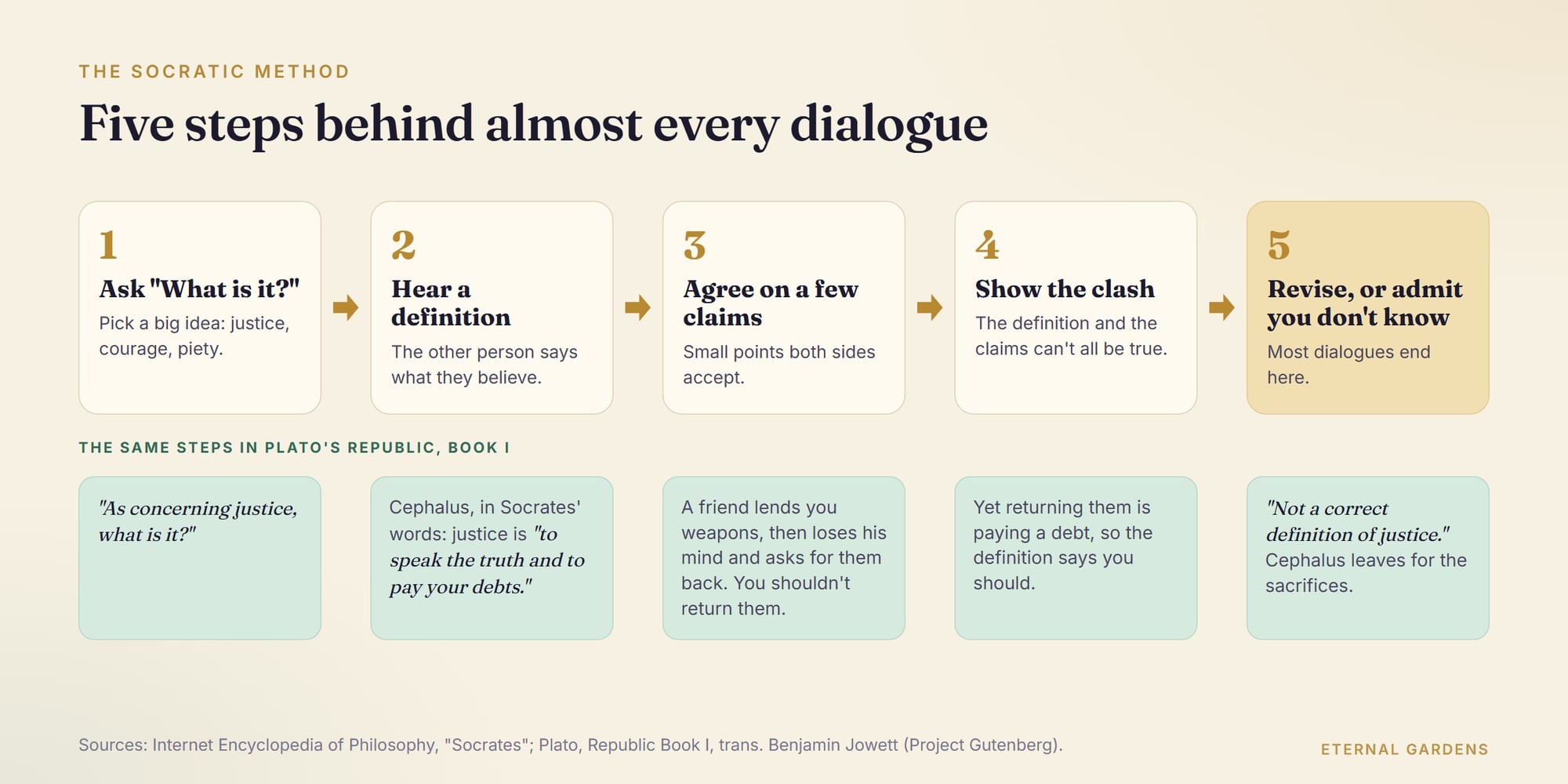
In practice, a Socratic exchange follows a pattern you can see in almost every dialogue:
- Ask a "What is it?" question.
- Get a definition.
- Get the other person to agree to a few related claims.
- Show that the definition clashes with those claims.
- Revise the definition, or admit you don't know.
Step five is where most dialogues end. Nobody wins. Both people know a little more about what they don't know.
Example 1: what is piety? (Euthyphro)
This is the classic example of Socratic questioning, because you can watch three definitions fail one after another. Socrates meets Euthyphro at the Porch of the King Archon in Athens. Socrates is there because he has been charged with a crime. Euthyphro is there to prosecute his own father.
The case is grim. A labourer on the family farm in Naxos killed a servant. Euthyphro's father tied the man up and left him in a ditch while he sent to Athens for advice. The man died of "cold and hunger and chains." Euthyphro's family say a son who prosecutes his father is impious. Euthyphro is sure he knows better.
So Socrates asks him what piety is. Here is how it goes.
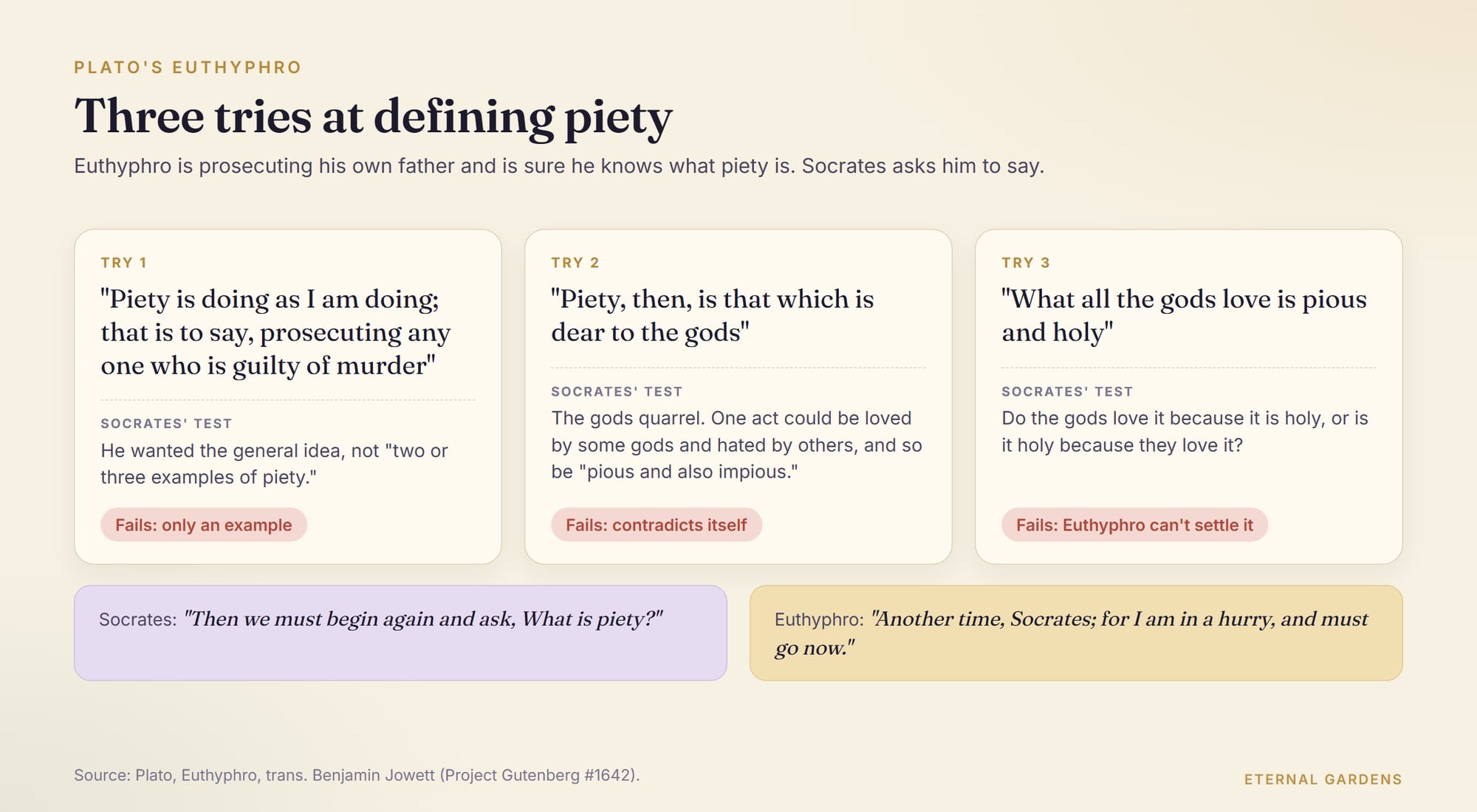
| Euthyphro's answer | Socrates' problem with it |
|---|---|
| "Piety is doing as I am doing; that is to say, prosecuting any one who is guilty of murder" | That is an example, not a definition. "I did not ask you to give me two or three examples of piety, but to explain the general idea" |
| "Piety, then, is that which is dear to the gods" | The gods quarrel. Then the same act could be loved by one god and hated by another, and be "pious and also impious" |
| "What all the gods love is pious and holy" | Do the gods love it because it is holy, or is it holy because they love it? |
That last question is the heart of the dialogue. In Jowett's words, Socrates asks "whether the pious or holy is beloved by the gods because it is holy, or holy because it is beloved of the gods." Euthyphro doesn't follow at first, and he never settles it.
The dialogue ends with no answer at all. Socrates says, "Then we must begin again and ask, What is piety?" Euthyphro replies: "Another time, Socrates; for I am in a hurry, and must go now."
Example 2: what is justice? (Republic, Book I)
This is the shortest good example, and it shows the most common Socratic move: one counterexample. At the start of the Republic, an old man called Cephalus suggests that justice means telling the truth and paying back what you owe. Socrates restates it as "to speak the truth and to pay your debts."
Socrates tests it with a single case:
Suppose that a friend when in his right mind has deposited arms with me and he asks for them when he is not in his right mind, ought I to give them back to him? Plato, Republic Book I, trans. Benjamin Jowett
Cephalus agrees he shouldn't. So paying back what you owe can't be the whole of justice. Socrates says it plainly: "speaking the truth and paying your debts is not a correct definition of justice."
Cephalus doesn't stay to argue. He hands the argument to his son Polemarchus and goes off "laughing to the sacrifices." The rest of the Republic runs to ten books. All of it is an attempt to do better.
You can try this move yourself. Take any rule that starts with "always" and look for one case where following it would be clearly wrong.
Example 3: doubling the square (Meno)
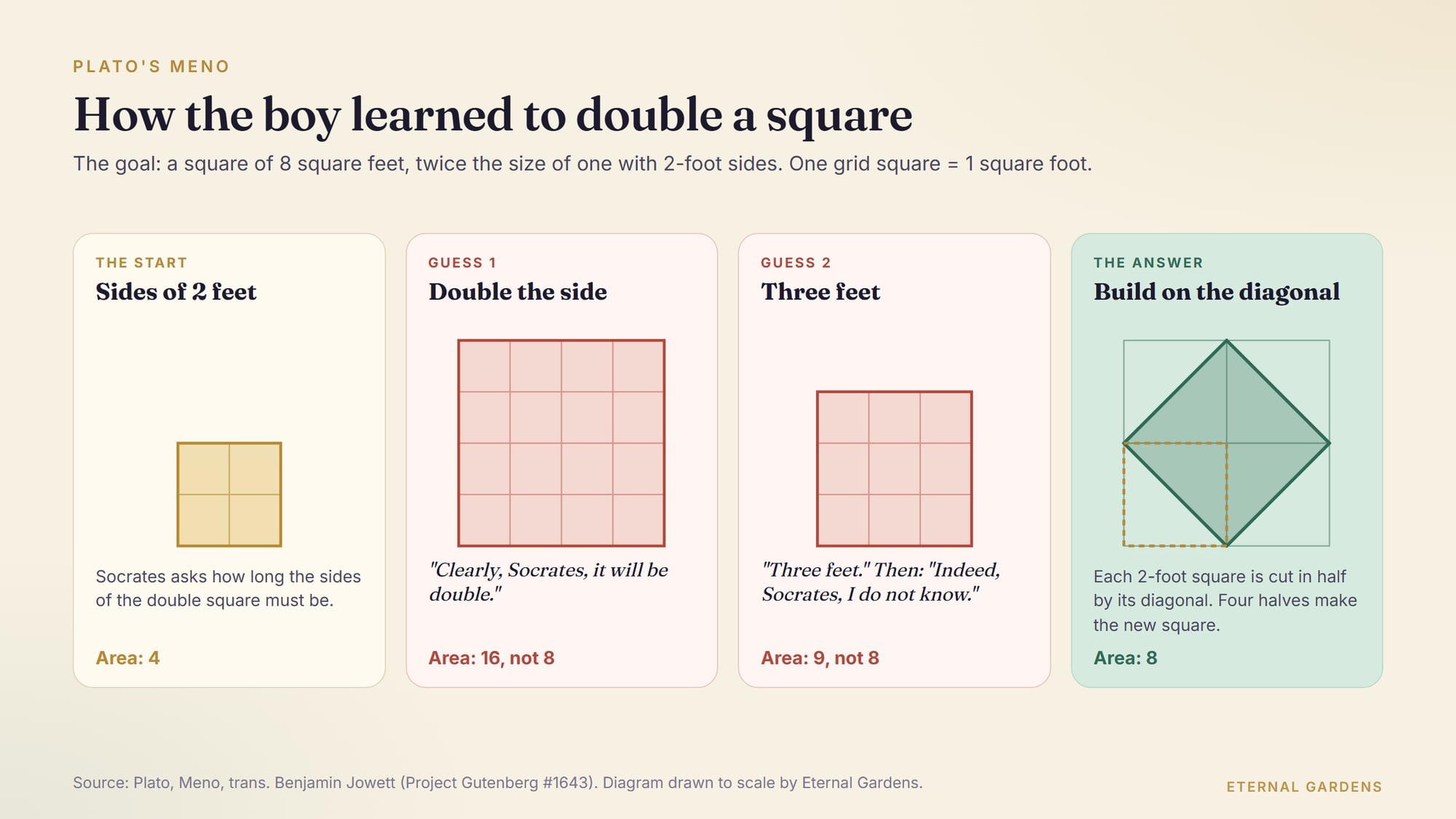
The Meno has the best Socratic method example of teaching, because the student gets somewhere. Socrates draws a square with sides of two feet, so it covers four square feet. He asks one of Meno's slaves, a boy, how long the sides of a square twice as big would be.
The boy answers quickly: "Clearly, Socrates, it will be double." But a four-foot side makes a square of sixteen, not eight. He tries again: "Three feet." That makes nine. Still wrong.
Then comes the turn. The boy says, "Indeed, Socrates, I do not know." Socrates tells Meno this is progress:
Is he not better off in knowing his ignorance? Plato, Meno, trans. Benjamin Jowett
With a few more questions, the boy sees the answer: build the new square on the diagonal of the old one. Socrates insists he has told the boy nothing. "I am not teaching the boy anything, but only asking him questions," he tells Meno.
Read the scene closely and you'll notice something. Many of Socrates' questions are leading ones, and the boy mostly says "Yes." That is a fair criticism, and good teachers watch for it.
What does Socratic questioning look like in a classroom?
In a classroom, Socratic questioning means the teacher asks open questions that make students explain and test their own answers. The goal is reasoning, not a right answer handed down.
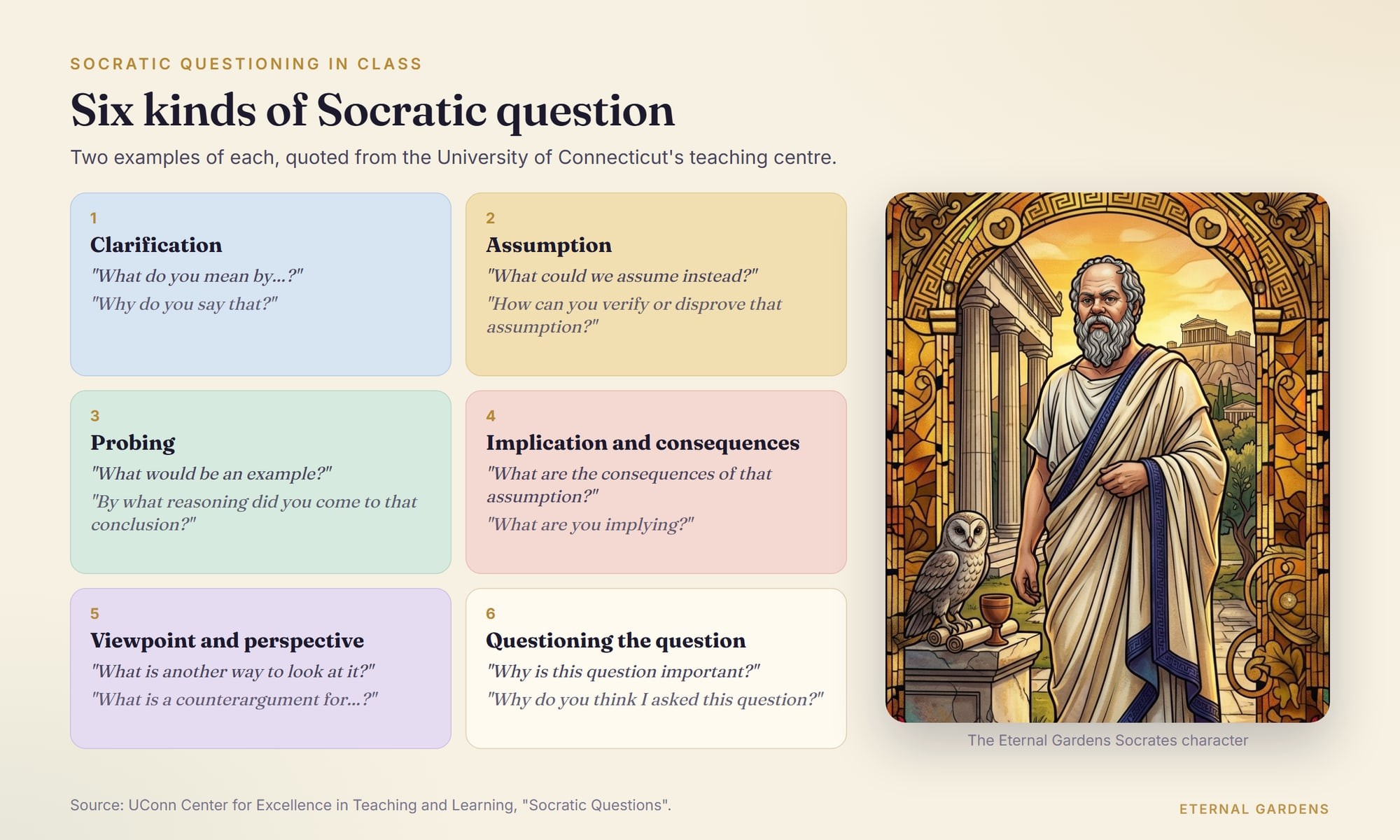
The University of Connecticut's teaching centre sorts these questions into six types. Here is one example of each, quoted from their list:
| Type of question | Example |
|---|---|
| Clarification | "What do you mean by…?" |
| Assumption | "What could we assume instead?" |
| Probing | "What would be an example?" |
| Implication and consequences | "What are the consequences of that assumption?" |
| Viewpoint and perspective | "What is another way to look at it?" |
| Questioning the question | "Why is this question important?" |
Say a student claims that lying is always wrong. Here is how a short exchange might run. It is our own example, built on the Cephalus move.
- Teacher: What do you mean by lying?
- Student: Saying something you know isn't true.
- Teacher: Is a surprise party a lie, then?
- Student: Kind of. But it's harmless.
- Teacher: So is lying wrong because it's untrue, or because it causes harm?
That last question works like Socrates' question to Euthyphro. It asks which part of the definition is doing the work.
How is the Socratic method used in law school?
In law school, a professor calls on a student and questions them closely about a court case and the judge's reasoning. That style of teaching started at Harvard Law School in 1870.
According to Harvard Magazine, Christopher Columbus Langdell became dean of Harvard Law School in 1870. He replaced lectures with real court cases. He also "introduced the question-and-answer format now called the Socratic method." Students were questioned closely on the facts and reasoning of each case.
Why did the Socratic method make people angry?
It made people angry because it showed them, in public, that they didn't know what they claimed to know. Socrates was tried in 399 BCE on charges of impiety and corrupting the young, and sentenced to death.
The Stanford Encyclopedia describes his questioning as "confusing, stinging, and stunning his conversation partners into the unpleasant experience of realizing their own ignorance." In the Meno, Meno says Socrates is like "the flat torpedo fish," which numbs anyone who touches it. In the Apology, Socrates calls himself "a sort of gadfly, given to the state by God."
The lesson for anyone using the method is simple. Ask about ideas, not to win. Socrates' best scenes work because he seems to want the answer too.
Ask Socrates yourself
If you want to feel the method from the inside, you can talk with the Socrates character on Eternal Gardens. It is an Eternal Gardens interpretation of Socrates, drawn from public-domain sources. It isn't Socrates and doesn't speak for him. The chat suggests openers like "What is justice, really?", or you can bring a belief of your own to test. You can try it free, without an account.

Some good ways in:
- Offer a definition you believe, like "Courage is not giving up," and ask him to test it.
- Ask him the Euthyphro question about something you value.
- Ask why he never wrote anything down.
- Ask him why he wouldn't stop questioning people, even at his trial.
- Ask him to question you the way he questioned the boy in the Meno.
For tips on getting accurate answers from any AI version of a historical figure, see our guide to talking to historical figures with AI. If you'd like to compare teachers, the Confucius quotes on education show a very different way of asking students to think. And Aristotle, who studied in Plato's Academy, built his ethics on a different idea: see Aristotle's list of virtues.
Frequently asked questions
What is the Socratic method in simple terms?
It is a way of teaching by asking questions instead of giving answers. One person states a belief, such as a definition of justice. The other asks follow-up questions until the belief either holds up or runs into a contradiction. It is named after Socrates, who used it in Athens in the fifth century BCE, as Plato's dialogues show.
What is a famous example of the Socratic method?
The best-known example is Plato's Euthyphro. Euthyphro is prosecuting his own father and claims to know what piety is. Socrates questions three definitions in turn. The last one leads to his famous question: do the gods love what is holy because it is holy, or is it holy because they love it? The dialogue ends without an answer.
What are the steps of the Socratic method?
A typical exchange has five steps. Ask a "What is it?" question. Hear a definition. Get agreement on a few related claims. Show that the definition clashes with those claims. Then revise the definition or admit you don't know. In Republic Book I, Socrates tests the idea that justice means paying your debts with one case: returning weapons to a friend who has lost his mind.
How do teachers use Socratic questioning today?
Teachers ask open questions that make students explain and test their own reasoning. The University of Connecticut's teaching centre lists six types: clarification, assumption, probing, implication and consequences, viewpoint and perspective, and questioning the question. A typical prompt is "What would be an example?" The aim is to get students reasoning out loud, not to hand them a right answer.
Why is the Socratic method used in law school?
Harvard Law School's dean Christopher Columbus Langdell began teaching from real cases in 1870 and questioned students closely on the facts and reasoning of each one, according to Harvard Magazine. That question-and-answer style is now called the Socratic method. The change replaced what the magazine calls "a long history of lecture and drill."
Sources
- Plato, Euthyphro, trans. Benjamin Jowett (Project Gutenberg #1642)gutenberg.org
- Plato, The Republic, trans. Benjamin Jowett (Project Gutenberg #1497)gutenberg.org
- Plato, Meno, trans. Benjamin Jowett (Project Gutenberg #1643)gutenberg.org
- Plato, Apology, trans. Benjamin Jowett (Project Gutenberg #1656)gutenberg.org
- Internet Encyclopedia of Philosophy, Socrates (James M. Ambury)iep.utm.edu
- Stanford Encyclopedia of Philosophy, Socrates (Debra Nails and S. Sara Monoson)plato.stanford.edu
- University of Connecticut CETL, Socratic Questionscetl.uconn.edu
- Harvard Magazine, Making the Case (David A. Garvin, 2003)harvardmagazine.com
- Stanford Encyclopedia of Philosophy, Aristotleplato.stanford.edu
About the author
Eternal Gardens
Eternal Gardens is an AI character platform where you can talk with characters drawn from the writings of historical and literary figures, and build worlds and stories with them.