Which Meditations translation should you read? Marcus Aurelius in English, compared
Hays, Hammond, Hard, Waterfield and the free classics, with the same passage in four translations and a plain guide to reading the book
By Eternal Gardens
7 min read

In this article
- Which translation of the Meditations is best?
- How different are the translations, really?
- What did the old translators think of each other?
- Which free translation should you read?
- What is the Meditations, and how is it put together?
- How should you read the Meditations?
- Ask Marcus Aurelius about his notebook
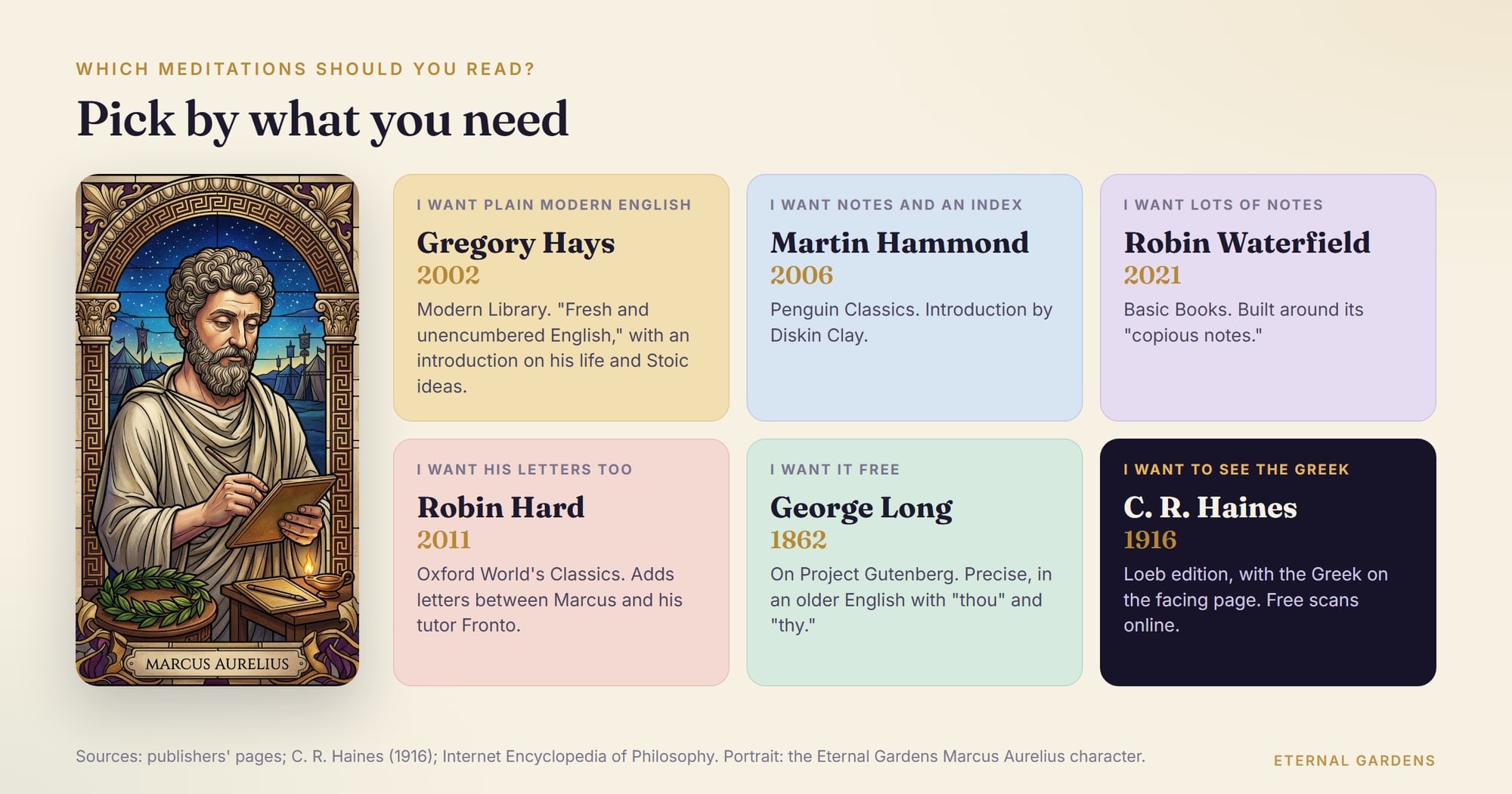
The best translation of the Meditations for most readers is a modern one. Gregory Hays (2002) is the plainest and quickest to read, while Martin Hammond (2006) and Robin Waterfield (2021) give you more help in the notes. For a free version, read George Long's 1862 translation on Project Gutenberg.
That is the short answer. The longer one depends on what you want from the book. Below, the same passage appears in four translations, so you can hear the difference yourself. Every old translation quoted here comes from a public-domain text we checked line by line.
Which translation of the Meditations is best?
There is no single best translation, but there is a best one for each kind of reader. Decide first whether you want plain modern English or a free copy. Then decide how much help you want with the text.
| Translator | Year | Publisher | What stands out | Free? |
|---|---|---|---|---|
| Gregory Hays | 2002 | Modern Library | "fresh and unencumbered English," says the publisher | No |
| Martin Hammond | 2006 | Penguin Classics | Notes and an index, with an introduction by Diskin Clay | No |
| Robin Hard | 2011 | Oxford World's Classics | Notes by Christopher Gill, plus letters between Marcus and his tutor Fronto | No |
| Robin Waterfield | 2021 | Basic Books | Built around its "copious notes" | No |
| George Long | 1862 | Many editions | Precise, in an old style with "thou" and "thy" | Yes |
| C. R. Haines | 1916 | Loeb Classical Library | The Greek on the facing page | Yes (scans) |
| Meric Casaubon | 1634 | Many editions | The first English translation | Yes |
If you only want one book, start with Hays. His publisher calls it "the first in nearly four decades" and praises its "fresh and unencumbered English." It reads fast, and his introduction covers Marcus's life and Stoic ideas.
If you want help with the names and puzzling lines, choose an edition with notes. Reviewing Hammond's version in Greece & Rome, Malcolm Heath says he "writes natural English, direct and often eloquent." Heath also praises the notes and the index. Hard's edition has notes by Christopher Gill and a selection of Marcus's letters with his tutor Fronto. Waterfield's edition is built around its notes. The Wall Street Journal called its footnotes "the volume's stand-out feature." Waterfield's publisher also quotes Brad Inwood of Yale: "This is the best translation of the Meditations available today." Treat that as one scholar's view, chosen by the publisher.
How different are the translations, really?
They differ more than you might expect. Here is Meditations 4.17 in four translations, from 1634 to 2011:
| Translation | Meditations 4.17 |
|---|---|
| Casaubon, 1634 | "Not as though thou hadst thousands of years to live. Death hangs over thee: whilst yet thou livest, whilst thou mayest, be good." |
| Long, 1862 | "Do not act as if thou wert going to live ten thousand years. Death hangs over thee. While thou livest, while it is in thy power, be good." |
| Haines, 1916 | "Behave not as though thou hadst ten thousand years to live. Thy doom hangs over thee. While thou livest, while thou mayest, become good." |
| Hard, 2011 | "Do not act as if you had ten thousand years to live ... while you have life in you, while you still can, make yourself good." |
The Hard line is the one Oxford quotes in its own description of the book. The meaning barely moves, but the sound does. The three older versions all keep "thou." Hard drops it, and "make yourself good" puts the work on you.
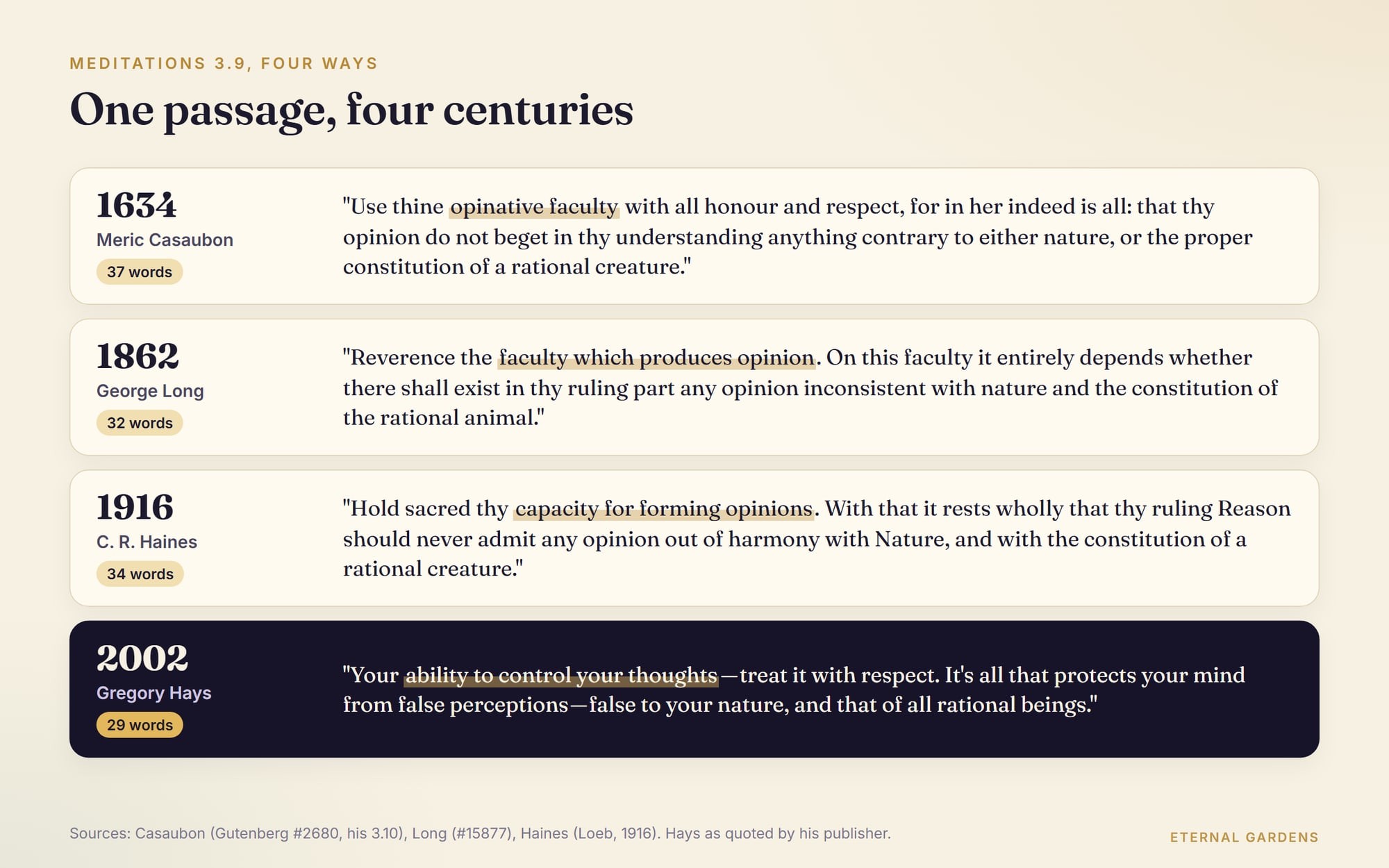
The gap grows on harder passages. In 3.9, Marcus tells himself to respect his own power of judgment. Long writes "Reverence the faculty which produces opinion." Haines writes "Hold sacred thy capacity for forming opinions." The line on Modern Library's page for the Hays edition matches the same passage. It begins: "Your ability to control your thoughts—treat it with respect."
What did the old translators think of each other?
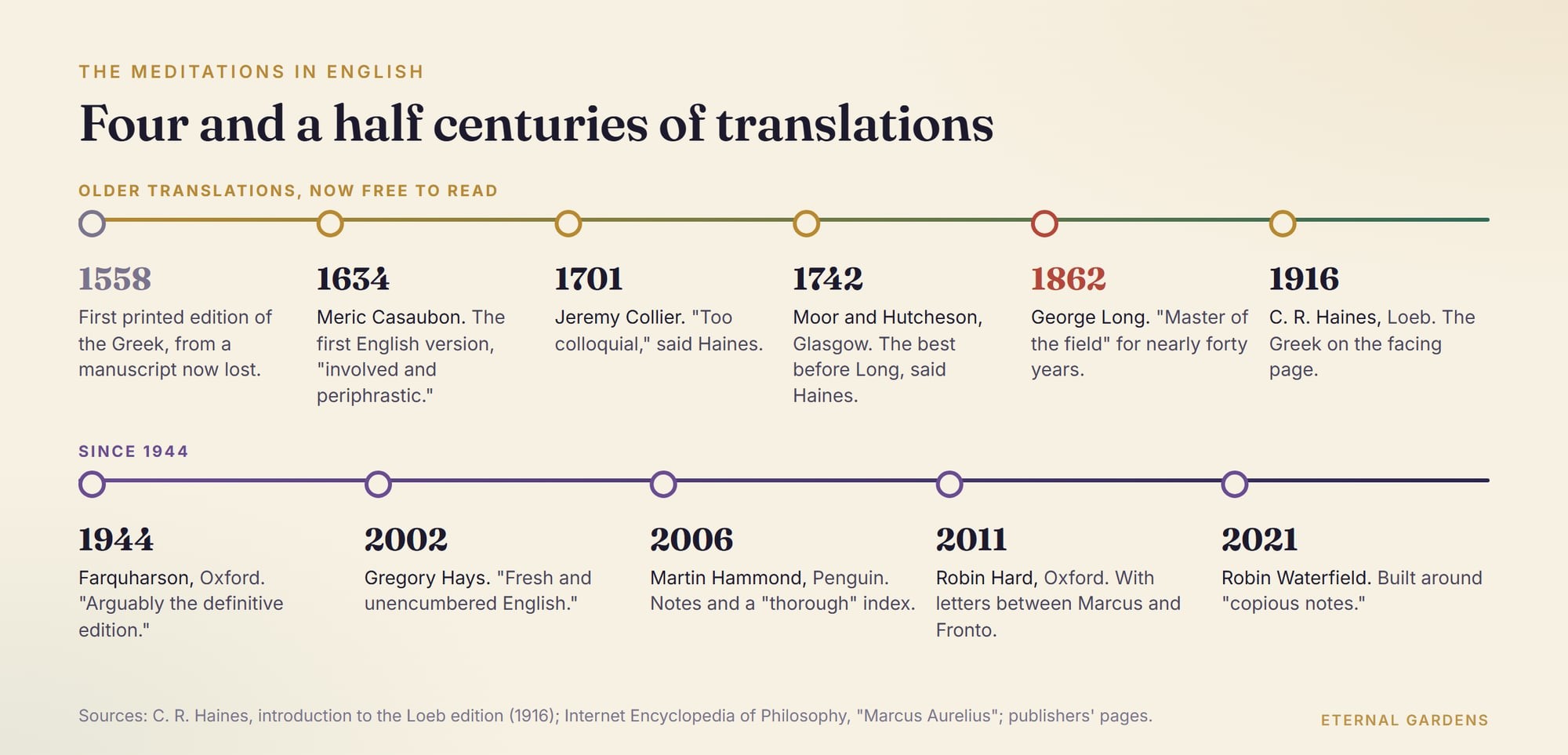
They were blunt. C. R. Haines opened his 1916 Loeb edition with a survey of the English versions before his own. His verdicts are still a useful guide to the free translations.
- Meric Casaubon's 1634 version was "the first English translation," Haines says, though "involved and periphrastic." In other words, wordy. The Gutenberg edition of Casaubon warns that his "is often rather a paraphrase than a close translation."
- Jeremy Collier's 1701 version was "too colloquial."
- James Moor and Thomas Hutcheson's 1742 version, printed in Glasgow, was "certainly the best translation, previous to Long's," in Haines's view.
- George Long's 1862 version was "in some sense the 'authorized version.'" Haines adds: "For nearly forty years it was master of the field." The critic Matthew Arnold found Long not simple enough, Haines reports, but still gave him "full credit for soundness, precision, and general excellence."
Long explains his own choices in his preface. "I could have made the language more easy and flowing," he wrote, "but I have preferred a ruder style as being better suited to express the character of the original." He also promised that "I have always given the same translation of the same word." That is useful when you want to follow a Stoic term through the book.
Haines went further toward the Greek. He preferred "to err, if error it be, on the side of over-faithfulness." He also warned against rewriting Marcus in "the terse, epigrammatic, staccato style so much in vogue at the present day." A century later, the publisher of Hays praises him for the opposite. His English, it says, conveys "the spareness and compression of the original Greek text." Both men are describing the same book. That is why the translations sound so different.
Which free translation should you read?
Read George Long. It is precise and free on Project Gutenberg. Its old-fashioned "thou" takes a few pages to get used to, and then it stops getting in the way. It also has an index of Greek terms, so you can see which English word stands for which Greek one.
Casaubon's version is also on Project Gutenberg. Haines granted it "dignity," but it is the hardest of the free versions to use. His section numbers also differ from the ones most books use. Long's 4.17, for example, is Casaubon's 4.14, and the morning passage that opens Long's Book 2 sits at the end of Casaubon's Book 1. Long notes that "the older editions" ended Book 1 that way, and that the scholar Thomas Gataker moved it.
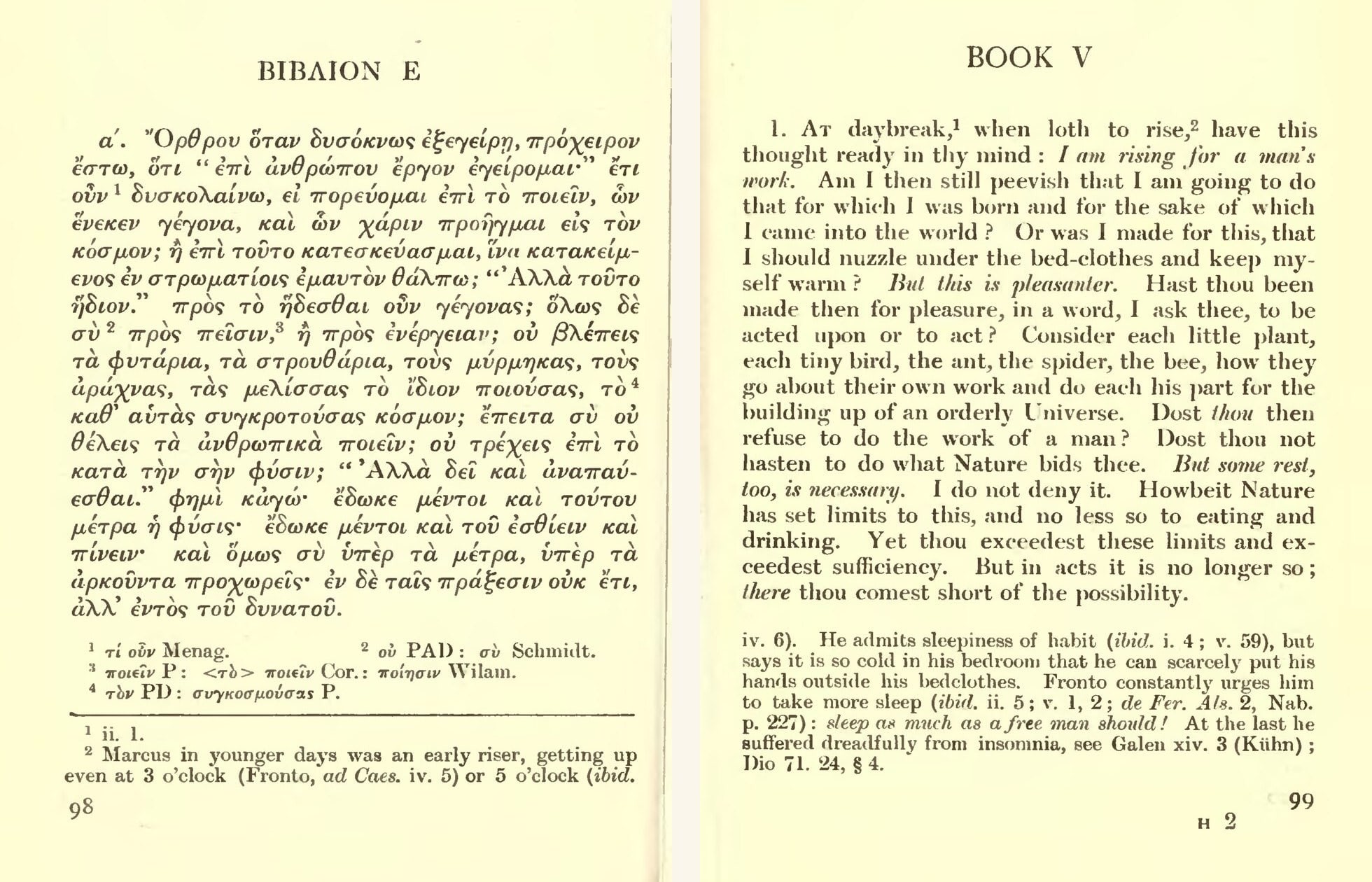
For the Greek, use Haines. The Internet Archive scan of his 1916 Loeb edition prints the Greek on the left page and his English on the right. The Internet Encyclopedia of Philosophy calls it "probably the most readily available edition of the Greek text, with a facing English translation."
What is the Meditations, and how is it put together?
The Meditations is a private notebook that Marcus Aurelius wrote in Greek. He was Roman emperor from 161 to 180 CE. The Internet Encyclopedia of Philosophy says it was "written by Marcus to himself and for his own use," probably "on campaign in central Europe, c. C.E. 171-175."
The Greek title now used, ta eis heauton, means "to himself." It may be "a later addition," the encyclopedia says, and it was first recorded around 900. The book was first printed in 1558, from a manuscript that is now lost.
It has 12 books, each split into short numbered entries. Book 1 is different from the rest. It lists what Marcus learned from his family and teachers, one person at a time. From his teacher Rusticus, for example, he borrowed the discourses of Epictetus. Two short notes name places, if they are Marcus's own. Long's translation ends Book 1 with "Among the Quadi at the Granua" and Book 2 with "This in Carnuntum." After that, in the encyclopedia's words, "The entries appear to be in no particular order."
How should you read the Meditations?
Read it slowly, and feel free to skip around. Marcus wrote it for himself, and the entries follow no plan. These habits help:
- Start with Book 2. Book 1 lists what Marcus learned from people you haven't met yet. Book 2 opens with him getting ready for a difficult day.
- Read a few entries at a time. Many are only a line or two long.
- Use the numbers. Most modern editions number each entry by book and section, such as 4.17. If a quote looks wrong, check the numbering first.
- Compare two translations on hard passages. Long is free, so he makes a good second opinion beside a modern edition.
- Follow the cross-references. The same thought often comes back in another book. Haines added "numerous references" to these parallel passages in his footnotes.
If you are new to the ideas behind the book, our guide to Stoicism for beginners explains them, with passages from Epictetus and Seneca too.
Ask Marcus Aurelius about his notebook
You can also talk with the Marcus Aurelius character on Eternal Gardens. It is an Eternal Gardens interpretation of Marcus Aurelius, grounded in public-domain sources. It is not the emperor and doesn't speak for him. You can try it free, without making an account.

Questions about the text work best:
- "Why did you write in Greek and not Latin?"
- "Who was Rusticus, and what did he teach you?"
- "What did you mean in 4.17, about ten thousand years?"
- "Why does your first book list what you learned from each teacher?"
Then check the answers against a translation. Our guide to talking to historical figures with AI explains how to do that well.
Frequently asked questions
What is the best translation of Meditations for beginners?
Gregory Hays's translation (Modern Library, 2002) is the plainest and quickest to read. His publisher describes it as "fresh and unencumbered English," and his introduction covers Marcus's life and Stoic ideas. If you want more help with names and hard passages, Martin Hammond's Penguin Classics edition (2006) and Robin Waterfield's annotated edition (2021) both come with notes.
Is there a free translation of Meditations?
Yes. George Long's 1862 translation and Meric Casaubon's 1634 translation are both free on Project Gutenberg. C. R. Haines's 1916 Loeb edition, which prints the Greek beside the English, is free as a scan on the Internet Archive. Long is the easiest of the three to use. It is precise, though written in an older English with "thou" and "thy."
Why are the section numbers different in some editions of Meditations?
Older editions divided the text differently. In Casaubon's 1634 translation, the passage most editions number 4.17 is 4.14, and the morning passage that opens Book 2 in most editions sits at the end of Book 1. George Long notes that the scholar Thomas Gataker moved those opening sections to Book 2. If a quote looks wrong, check the numbering first.
What language was Meditations written in?
Marcus Aurelius wrote the Meditations in Greek, even though he was a Roman emperor. The Internet Encyclopedia of Philosophy says it was written "to himself and for his own use," probably on campaign in central Europe around 171 to 175 CE. The Greek title now used, ta eis heauton, means "to himself," though it may be a later addition.
How should you read Meditations?
Read a few entries at a time, and feel free to start with Book 2. Book 1 is a list of what Marcus learned from his family and teachers, while Book 2 opens with him preparing for a difficult day. Use the book and section numbers, such as 4.17, to find passages. On hard passages, compare two translations, such as a modern one and George Long's free version.
Sources
- Marcus Aurelius, Meditations, trans. Meric Casaubon (Project Gutenberg #2680)gutenberg.org
- Marcus Aurelius, Thoughts, trans. George Long (Project Gutenberg #15877)gutenberg.org
- The Communings with Himself of Marcus Aurelius Antoninus, trans. C. R. Haines (Loeb, Heinemann 1916), Internet Archivearchive.org
- Internet Encyclopedia of Philosophy, Marcus Aurelius (John Sellars)iep.utm.edu
- Penguin Random House, Meditations, trans. Gregory Hays (Modern Library)penguinrandomhouse.com
- Penguin UK, Meditations, trans. Martin Hammond (Penguin Classics)penguin.co.uk
- Apple Books, Meditations with selected correspondence, trans. Robin Hard (Oxford World's Classics)books.apple.com
- Hachette Book Group, Meditations: The Annotated Edition, trans. Robin Waterfield (Basic Books)hachettebookgroup.com
- Wikimedia Commons, Marcus Aurelius (Haines 1916).djvucommons.wikimedia.org
About the author
Eternal Gardens
Eternal Gardens is an AI character platform where you can talk with characters drawn from the writings of historical and literary figures, and build worlds and stories with them.