Hildegard of Bingen's music: the songs, the Ordo Virtutum and where to listen
What the 12th-century abbess wrote, what it sounds like, how her visions shaped it, and the recordings to start with
By Eternal Gardens
7 min read
In this article
Hildegard of Bingen's music is about 70 Latin chants she wrote for her nuns in the 1100s. She also wrote a sung play, the Ordo Virtutum. Each piece is a single line of melody, and many soar well above ordinary chant. If you want one place to start listening, try the 1982 album A Feather on the Breath of God.
Below is what she wrote, what it sounds like, how it connects to her visions, and where to hear it today.
What kind of music did Hildegard of Bingen write?
She wrote sacred songs for worship in her convent, plus one music drama. Both words and music are her own.
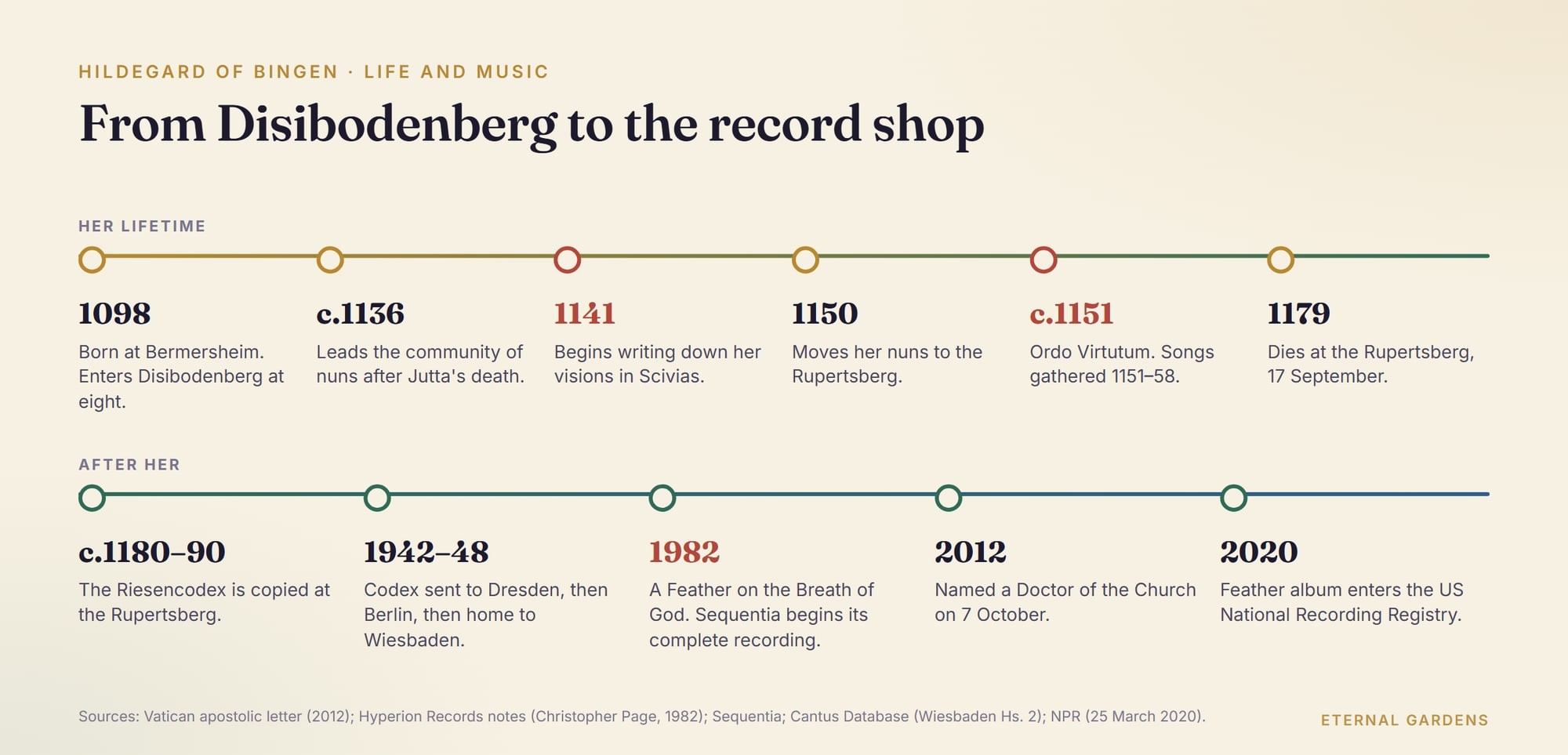
Hildegard was a Benedictine nun in the Rhineland. She was born in 1098 and entered the abbey of Disibodenberg at the age of eight. Those dates come from the Vatican's 2012 letter naming her a Doctor of the Church. Around 1136 she became the head of its community of women. In 1150 she moved her nuns to a new house at the Rupertsberg, across the river Nahe from Bingen. Most of her songs were written for them.
She collected the songs into a cycle she called the Symphonia armonie celestium revelationum. In English that is "The Symphony of the Harmony of Celestial Revelations." The cycle holds the types of chant a convent sang through the day and year:
- antiphons, short songs sung before and after psalms
- responsories, sung in reply to readings
- hymns
- sequences, long songs sung at Mass
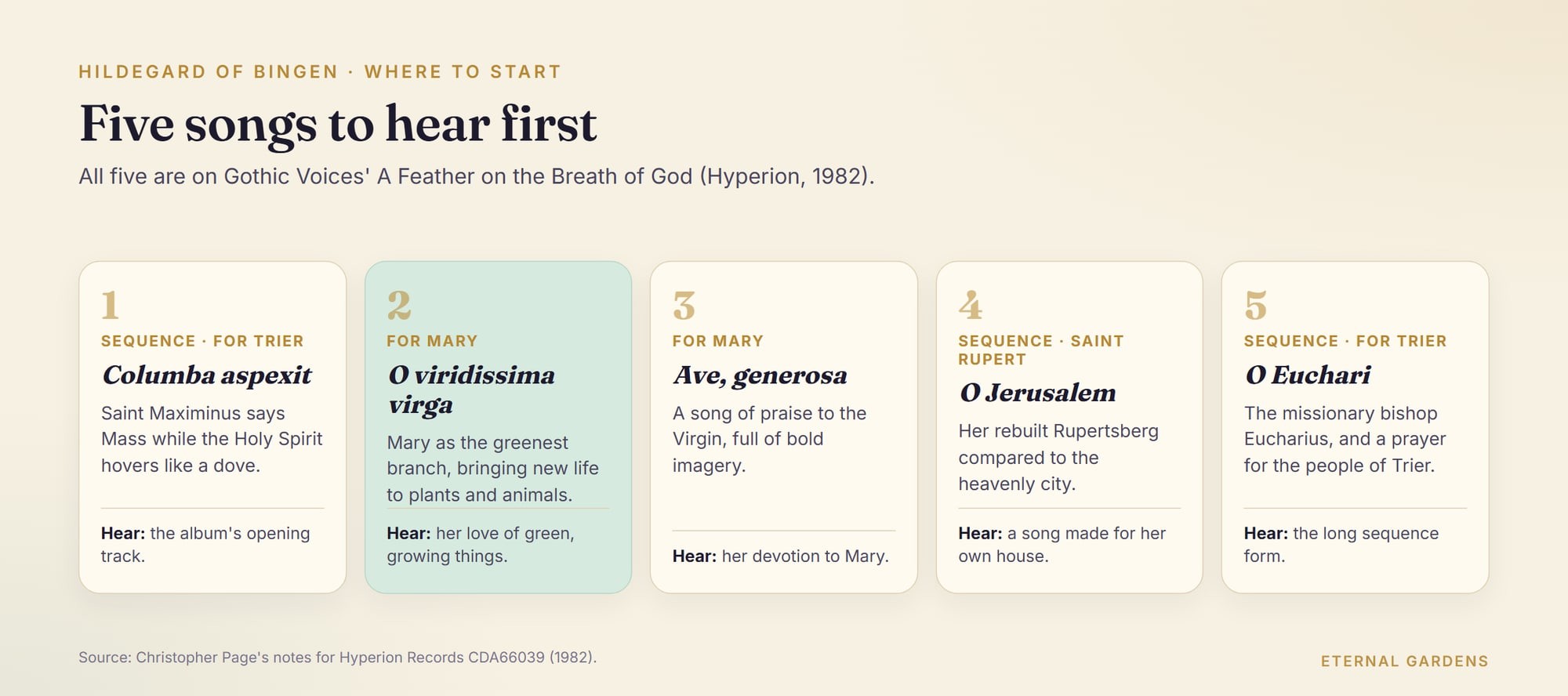
Many of the texts honour Mary or the saints. Some were written for people outside her convent. Christopher Page's notes for Hyperion Records say two of her best-known sequences were almost certainly made for the clergy of Trier. They are Columba aspexit and O Euchari.
The subjects give a feel for the whole cycle. In Columba aspexit, Saint Maximinus says Mass while the Holy Spirit hovers like a dove. O viridissima virga praises Mary as the green branch of Jesse, bringing new life to plants and animals. O ignis spiritus is addressed to the Holy Spirit as fire. O Jerusalem honours Saint Rupert, whose ruined monastery she rebuilt for her nuns.
How many songs did Hildegard write?
About 70, depending on how you count. Sequentia, the ensemble that recorded all of them, speaks of 77 songs. Other counts give 69 with music, plus a few texts whose melodies are lost.
Editions and recordings group the pieces in different ways, and a few of her poems survive without their melodies. Either way, it is one of the largest bodies of music by any named composer of the Middle Ages.
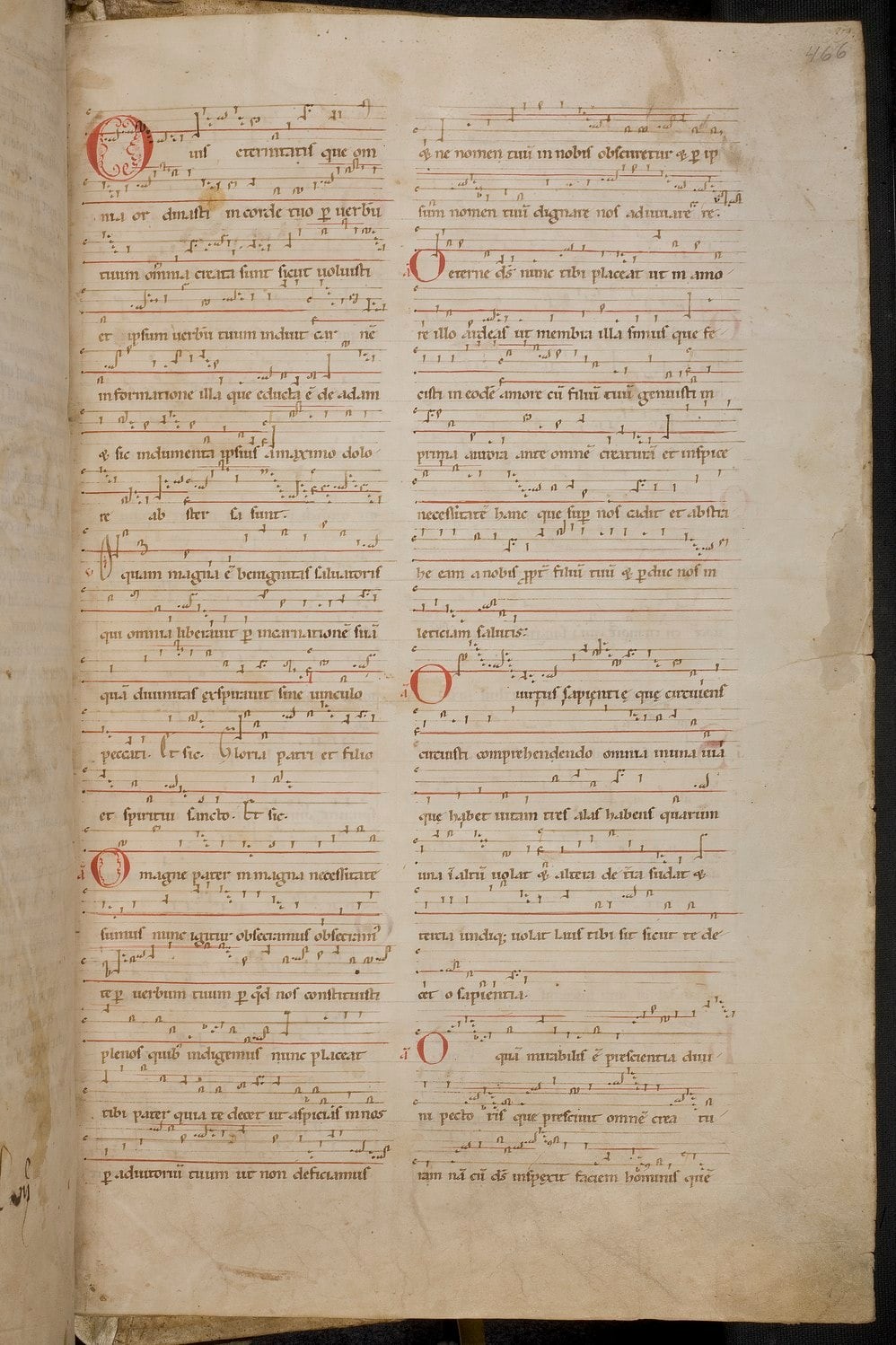
Most of it survives in one huge book, the Riesencodex, or "giant codex." Another manuscript with her songs, the Dendermonde Codex, was copied during her lifetime. The Riesencodex was made in Hildegard's own scriptorium at the Rupertsberg around 1180 to 1190, soon after her death. The Cantus database of medieval chant describes its music section as folios 466 to 481, written in two columns with 17 staves each. The book had its own adventures. In 1942 it was sent to Dresden for safety. After the war it turned up in the Soviet sector of Berlin, and it came home to Wiesbaden in March 1948.
What does Hildegard's music sound like?
It is plainchant: one melody, sung without harmony. But it soars higher and wider than most chant of its time, with long runs of notes on a single syllable.
Page described her songs as built on "a large, sometimes a massive, scale." Their range runs "from the most tranquil melody to an almost obsessive declamation at high pitch." Sequentia calls them among the most demanding vocal music ever written.
The manuscript does not tell singers everything. Its notes show the shape of the melody on a four-line staff with a red F line. But there are no marks for rhythm or speed. Every performer has to decide how fast to go, how long to hold each note and whether to add a drone. That is why two recordings of the same song can sound so different.
A few things to listen for:
- Long melismas, where one syllable is stretched across many notes.
- Short melodic figures that come back again and again in one song.
- How closely the melody follows the meaning of the words.
What is the Ordo Virtutum?
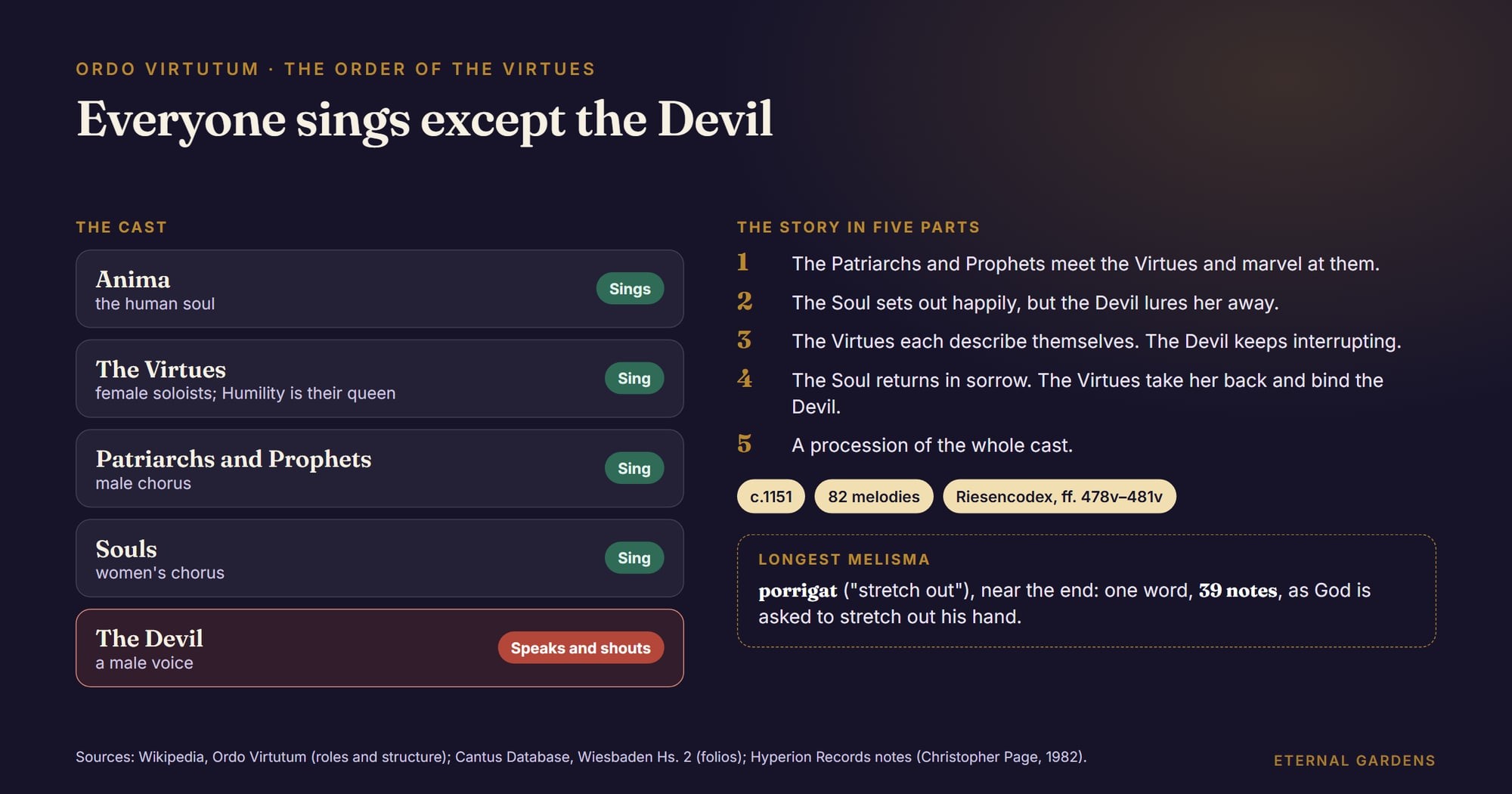
The Ordo Virtutum, or "Order of the Virtues," is a sung morality play. It was probably written around 1151, and it is often called the earliest surviving morality play by about a century.
The story is simple. A human soul, Anima, sets out happily, is tempted away by the Devil, and comes back in sorrow. The Virtues take her back and then bind the Devil. Their queen is Humility. The parts would have been sung by Hildegard's nuns, with male voices for the Patriarchs and Prophets.
The music is simpler than in her liturgical songs. Its 82 melodies use fewer notes per syllable. The great exception is near the end. The closing lines ask the audience to kneel so that God may "stretch out" his hand, and the Latin word for it, porrigat, is stretched across 39 notes.
The cleverest touch is in the casting. Every character sings except one. The Devil only speaks or shouts. He is the one figure shut out of the music. In the Riesencodex the play fills folios 478v to 481v, at the very end of the music.
If you like the idea of the virtues as characters, compare them with Aristotle's list of virtues, where each one sits between two vices. Hildegard's Virtues are Christian ones, such as Humility, Charity and Faith, and they fight rather than balance.
How are Hildegard's visions connected to her music?
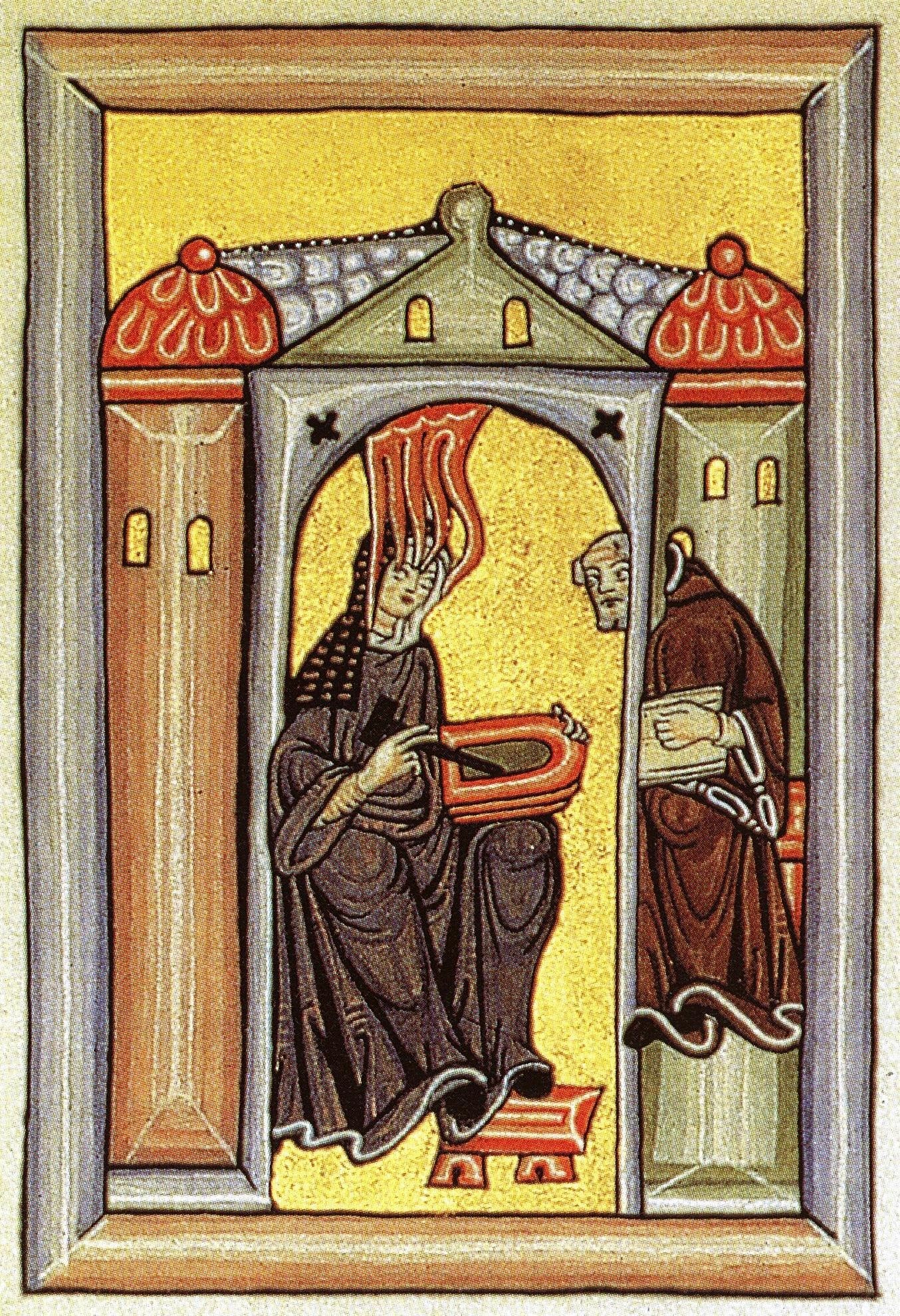
Hildegard said that her work came from visions she had had since childhood. In 1141, at about 42, she began to write them down in a book called Scivias. It took her ten years.
She was firm that she saw them awake. In Charles Singer's 1917 translation from Scivias:
"I beheld neither in sleep, nor in dream, nor in madness, nor with my carnal eyes, nor with the ears of the flesh, nor in hidden places; but wakeful, alert, with the eyes of the spirit and with the inward ears I perceived them." Hildegard of Bingen, Scivias, trans. Charles Singer (1917)
Singer was a historian of science. In the same essay he argued that her descriptions of shimmering points of light fit the visual aura of migraine, called scintillating scotoma. The Vatican's 2012 letter, by contrast, says her works were "born from a deep mystical experience." You do not have to settle that question to hear how much the visions shaped the songs. Many texts are full of fire and light, and of green, growing things.
For Hildegard, singing was part of faith itself. The Vatican letter sums up her teaching this way. People answer God both with their voices in worship and with a holy life. In the letter's words, "the whole of human life may therefore be interpreted as harmonic and symphonic."
Where can you listen to Hildegard's music?
Start with one of the two classic recordings below, then explore. The music itself is free to see in the original manuscript.
| Recording | Who | What it is | Why start here |
|---|---|---|---|
| A Feather on the Breath of God (1982) | Gothic Voices, directed by Christopher Page | 44 minutes of sequences and hymns, including Columba aspexit and O viridissima virga | A short first listen. In 2020 it entered the US National Recording Registry. |
| Sequentia's complete Hildegard (1982 to 2013) | Sequentia, co-founded by Benjamin Bagby | All 77 songs plus two recordings of the Ordo Virtutum: eight albums, almost 12 hours | The whole body of work, gathered in a 9-CD set in 2017 |
A Feather on the Breath of God was recorded in a London church in September 1981. It came out on LP in 1982 and on CD in April 1985. In March 2020, NPR reported its selection for the registry, in the same class as Whitney Houston and Dr. Dre. Its title comes from a passage Hyperion prints in its notes, in which Hildegard calls herself "a feather on the breath of God."
To see the music as Hildegard's nuns copied it, open the Riesencodex at the Wiesbaden library's digital collection. You can page through it for free.
Talk with Hildegard about her music
Want to ask why the Devil gets no song? You can talk with the Hildegard of Bingen character on Eternal Gardens. It is an Eternal Gardens interpretation of Hildegard, grounded in published and public-domain sources. It is not Hildegard and does not speak for her. You can try it free, without an account.

Her page describes her as an "abbess, composer, physician, and corrector of popes." Some questions to start with:
- Why does the Devil speak in the Ordo Virtutum when everyone else sings?
- Which of your songs would you want a first-time listener to hear?
- Did anyone teach you to write music?
- What does green mean in your songs?
- How did your nuns learn and rehearse the songs?
Treat the answers as a way in, then check them against the manuscript and the recordings. Our guide to getting reliable answers from historical AI characters explains how.
Frequently asked questions
What type of music did Hildegard of Bingen write?
She wrote plainchant: single-line sacred songs in Latin, with her own words, for the nuns of her convent. They include antiphons, responsories, hymns and sequences, collected in a cycle she called the Symphonia armonie celestium revelationum. She also wrote the Ordo Virtutum, a sung morality play. Her melodies are known for their wide range and long runs of notes on one syllable.
How many songs did Hildegard of Bingen compose?
About 70, depending on how they are counted. The ensemble Sequentia, which recorded her complete music between 1982 and 2012, speaks of 77 songs. Other counts give 69 surviving with music, plus a few poems whose melodies are lost. Most survive in the Riesencodex, a giant manuscript copied at her Rupertsberg convent around 1180 to 1190 and now in Wiesbaden.
What is the Ordo Virtutum about?
It is a sung morality play, probably from around 1151. A human soul, Anima, is lured away by the Devil, returns in sorrow and is welcomed back by the Virtues, led by their queen Humility, who then bind the Devil. It has 82 melodies. Every character sings except the Devil, who only speaks or shouts. It is often called the earliest surviving morality play by about a century.
What is the best recording of Hildegard of Bingen's music?
A good first choice is A Feather on the Breath of God by Gothic Voices, directed by Christopher Page (Hyperion, 1982). It is 44 minutes of sequences and hymns and was added to the US National Recording Registry in 2020. For everything, Sequentia recorded all of her songs and the Ordo Virtutum over 30 years, later gathered in a 9-CD set in 2017.
Sources
- Benedict XVI, Apostolic Letter proclaiming Saint Hildegard of Bingen a Doctor of the Universal Church (7 October 2012)vatican.va
- Benedict XVI, General Audience on Saint Hildegard (1 September 2010)vatican.va
- Hyperion Records, A feather on the breath of God (CDA66039), with notes by Christopher Pagehyperion-records.co.uk
- Sequentia, Hildegard von Bingen projectsequentia.org
- Cantus Database, Wiesbaden, Hochschul- und Landesbibliothek RheinMain, Hs. 2 (Riesencodex)cantusdatabase.org
- Hochschul- und Landesbibliothek RheinMain, digital collection: Riesencodex (Hs. 2)hlbrm.digitale-sammlungen.hebis.de
- NPR, National Recording Registry announces 2020 entries (25 March 2020)npr.org
- Charles Singer, The Scientific Views and Visions of Saint Hildegard, in Studies in the History and Method of Science (1917), Internet Archivearchive.org
- Wikipedia, Ordo Virtutumen.wikipedia.org
- Wikipedia, Hildegard of Bingenen.wikipedia.org
- Wikipedia, A Feather on the Breath of Goden.wikipedia.org
- Wikipedia, Sciviasen.wikipedia.org
About the author
Eternal Gardens
Eternal Gardens is an AI character platform where you can talk with characters drawn from the writings of historical and literary figures, and build worlds and stories with them.