Stoicism for beginners: the core ideas, the main Stoics and seven exercises
What Zeno, Seneca, Epictetus and Marcus Aurelius actually taught, quoted from free public-domain translations
By Eternal Gardens
7 min read

In this article
- What is Stoicism?
- Who were the main Stoics?
- What are the core ideas of Stoicism?
- Some things are up to you, and some are not
- Virtue is the only good
- Your judgments do the damage
- Live in agreement with nature
- Feelings that run past reason
- Stoic exercises from the original texts
- Which Stoic book should a beginner read first?
- Does Stoicism mean hiding your feelings?
- Ask Marcus Aurelius about it
Stoicism for beginners comes down to one idea. Some things are up to you and some are not. What is up to you, meaning your own judgments and choices, matters most. The school began in Athens around 300 BCE. Its best teachers left short, practical books that you can still read free today.
This guide covers where Stoicism came from and what it teaches. It ends with seven exercises the Stoics themselves describe. Every quotation is from a public-domain translation, with the passage number, so you can look it up.
What is Stoicism?
Stoicism is a school of Greek and Roman philosophy. It teaches that a good character is the only true good. Money and fame, in Stoic terms, are neither good nor bad. The Stoics also held that what upsets people is usually their judgment about events, not the events themselves.
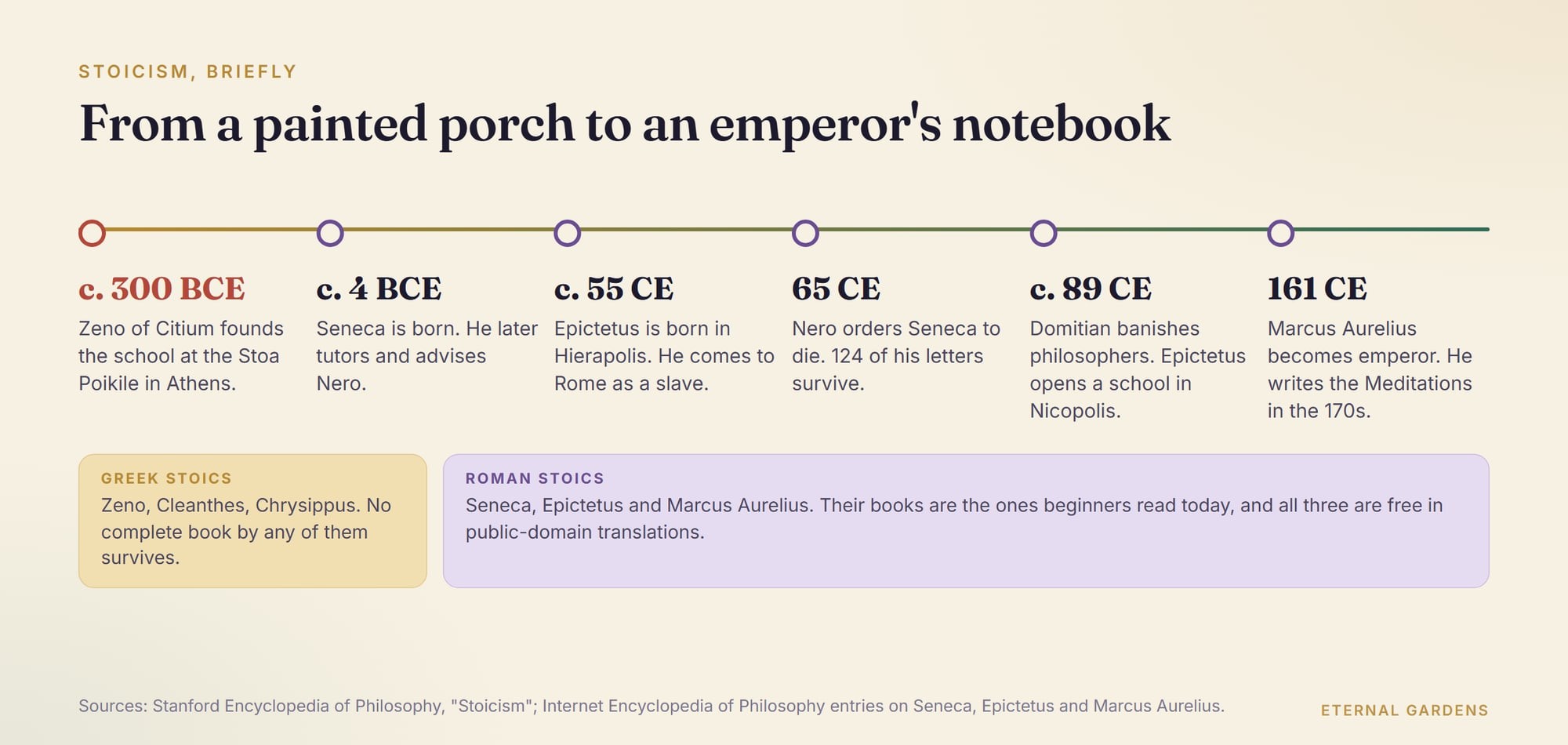
According to the Stanford Encyclopedia of Philosophy, "The Stoic school was founded around 300 BCE by Zeno of Citium." Zeno taught in the Stoa Poikile, a painted porch in the marketplace of Athens. The school is named after it.
After Zeno came Cleanthes, then Chrysippus, whom the encyclopedia calls the school's "foremost theorist and systematizer." None of their books survives complete. Chrysippus is said to have written more than 150 works, "of which only fragments remain." The Stoic books most people read today come from three Romans, writing about 300 years later.
Who were the main Stoics?
Most beginners read three Romans: Seneca, Epictetus and Marcus Aurelius. They could hardly have lived more different lives. Seneca advised the emperor Nero. Epictetus came to Rome as a slave. Marcus was the emperor.
| Stoic | Dates | Who he was | Start with |
|---|---|---|---|
| Zeno of Citium | Founded the school around 300 BCE | Taught at the painted porch in Athens | Only fragments survive |
| Seneca | c. 4 BCE–65 CE | Nero's tutor, then advisor. Ordered to die by Nero in 65 CE | Letters to Lucilius (124 survive) |
| Epictetus | c. 55–135 CE | Came to Rome as a slave and studied with the Stoic Musonius Rufus. Later ran a school in Nicopolis, in Epirus | The Enchiridion, or Handbook |
| Marcus Aurelius | 121–180 CE | Roman emperor from 161 | The Meditations |
The dates for Seneca and Epictetus come from the Internet Encyclopedia of Philosophy entries on Seneca and Epictetus. Most of what we have from Epictetus, including the Handbook, was written down by his student Arrian.
What are the core ideas of Stoicism?
Stoicism has a handful of core ideas. Only some things are in your control. Virtue is the only real good. And your judgments, more than events, cause your distress. Each idea has a famous passage behind it.
Some things are up to you, and some are not
This is the first line of Epictetus's Handbook:
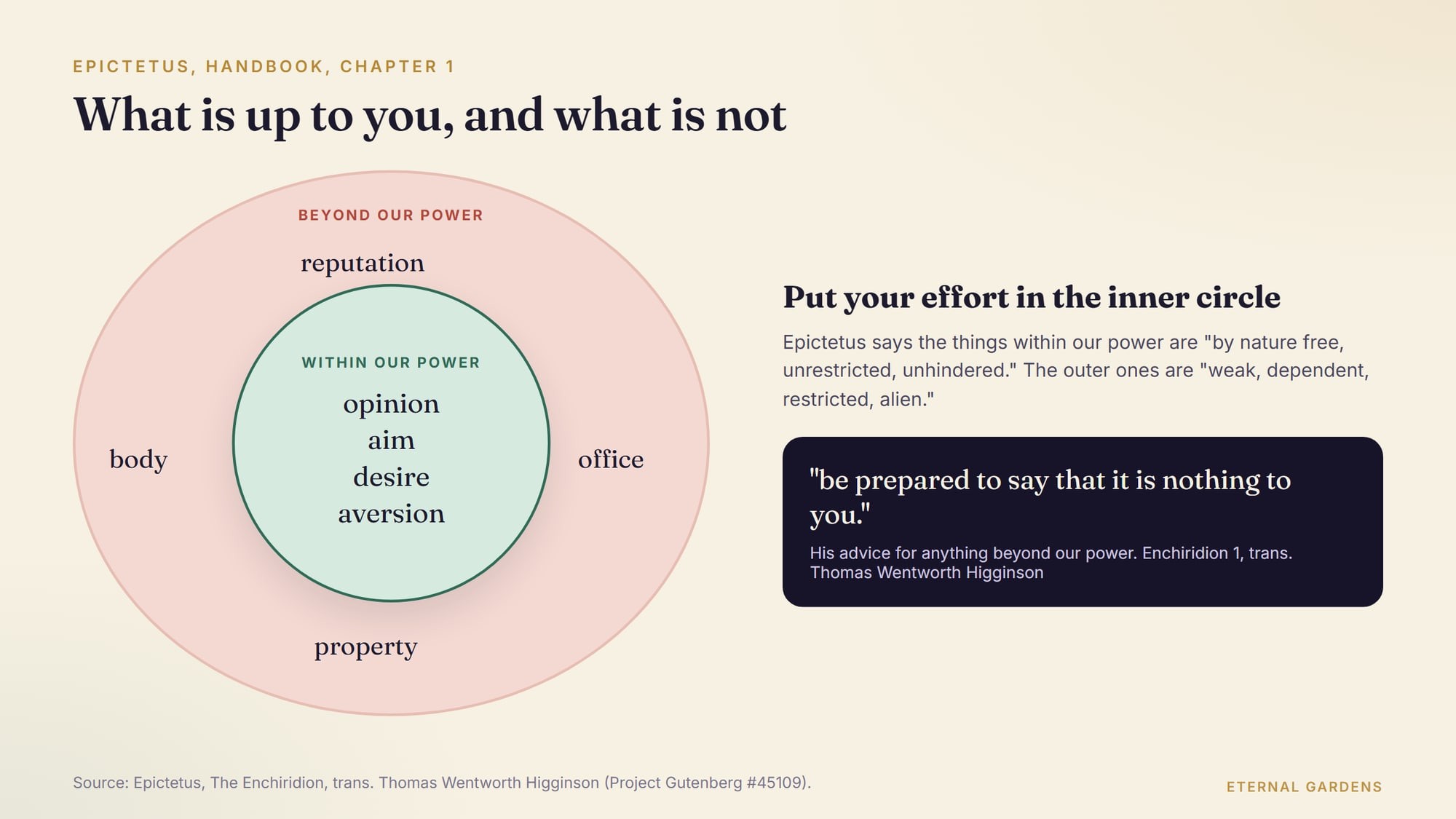
There are things which are within our power, and there are things which are beyond our power. Epictetus, Enchiridion 1, trans. Thomas Wentworth Higginson
He then sorts them. Within our power are "opinion, aim, desire, aversion." Beyond it are "body, property, reputation, office." The point is to spend your effort where it can work. When something is beyond your power, Epictetus says, "be prepared to say that it is nothing to you."
Virtue is the only good
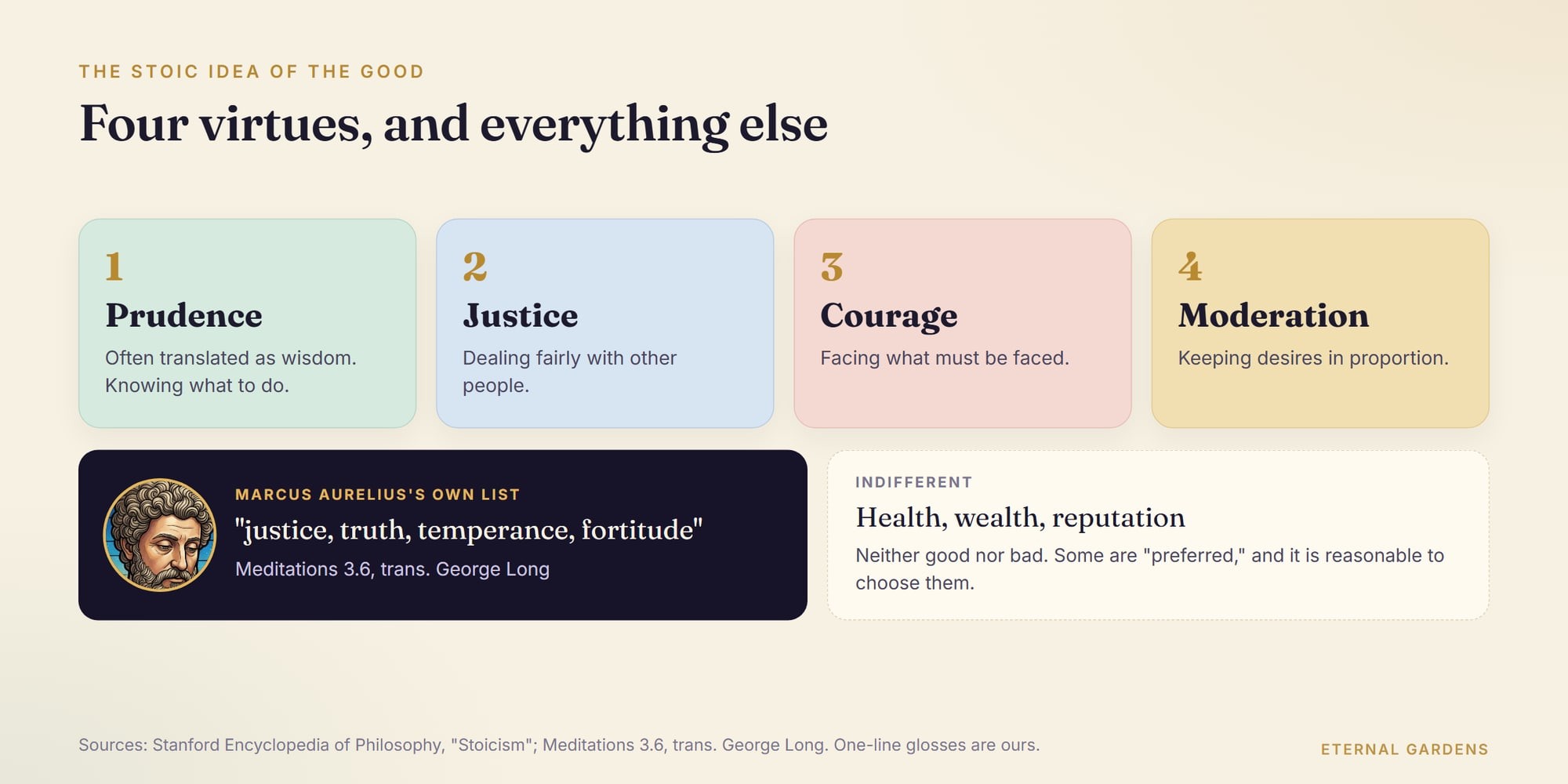
The Stoics counted four main virtues. The Stanford Encyclopedia lists them as "prudence, justice, courage, moderation." Marcus Aurelius names a slightly different set in Meditations 3.6: "justice, truth, temperance, fortitude."
The Stoics called everything else "indifferent," including health and wealth. That doesn't mean worthless. They said some things are "preferred," and it is reasonable to choose them. They just can't make you a good person, and losing them can't make you a bad one.
Your judgments do the damage
Chapter 5 of the Handbook puts it in one line:
Men are disturbed not by things, but by the views which they take of things. Epictetus, Enchiridion 5, trans. Thomas Wentworth Higginson
Epictetus gives death as his example. If death were terrible in itself, he says, it would have seemed so to Socrates.
Live in agreement with nature
Zeno described the goal of life as "living in agreement." Cleanthes, who ran the school after him, added "with nature." The Stanford Encyclopedia explains that this meant two things at once: your own human nature, which is rational, and the order of the whole world.
For the Stoics, human nature is also social. In their view, people naturally cooperate, much as bees and ants do. Some Stoics went further and called every human being a citizen of one world city. You can hear this in Marcus's morning exercise. He expects to meet rude and dishonest people, then reminds himself that the wrongdoer "is akin to me."
Feelings that run past reason
The Stoics had a precise word for the feelings they wanted to master: passions. The Stanford Encyclopedia defines a passion as an "impulse which is excessive and disobedient to the dictates of reason." The Stoics sorted passions into four kinds. Distress and fear are about bad things, now or to come. Pleasure and appetite are about good things, now or to come. The wise person, in their view, still feels. They called those calmer, reasonable feelings "good feelings."
Stoic exercises from the original texts
The ancient Stoics treated philosophy as practice, and their books are full of small exercises. Here are seven, each with the passage where it comes from.
- Sort what is up to you. When something bothers you, ask whether it is within your power. If not, Epictetus says, it is "nothing to you" (Enchiridion 1).
- Preview the day each morning. Marcus wrote: "Begin the morning by saying to thyself, I shall meet with the busybody, the ungrateful, arrogant, deceitful, envious, unsocial" (Meditations 2.1).
- Picture what an outing will be like. Before going to the public baths, Epictetus says, picture "some persons pouring out, others pushing in, others scolding, others pilfering" (Enchiridion 4).
- Remember what things are. If you have a favourite cup, remind yourself it is just a cup. Then "if it is broken, you can bear it" (Enchiridion 3).
- Practise going without. Seneca told his friend Lucilius to spend a few days on the "scantiest and cheapest fare" in rough clothes. Then ask: "Is this the condition that I feared?" (Letter 18).
- Review the day each evening. Seneca did this every night. "I pass the whole day in review before myself," he wrote (On Anger 3.36).
- Look from above. Marcus tells himself to "Look down from above on the countless herds of men." Then he remembers how many people will never even know his name (Meditations 9.30).
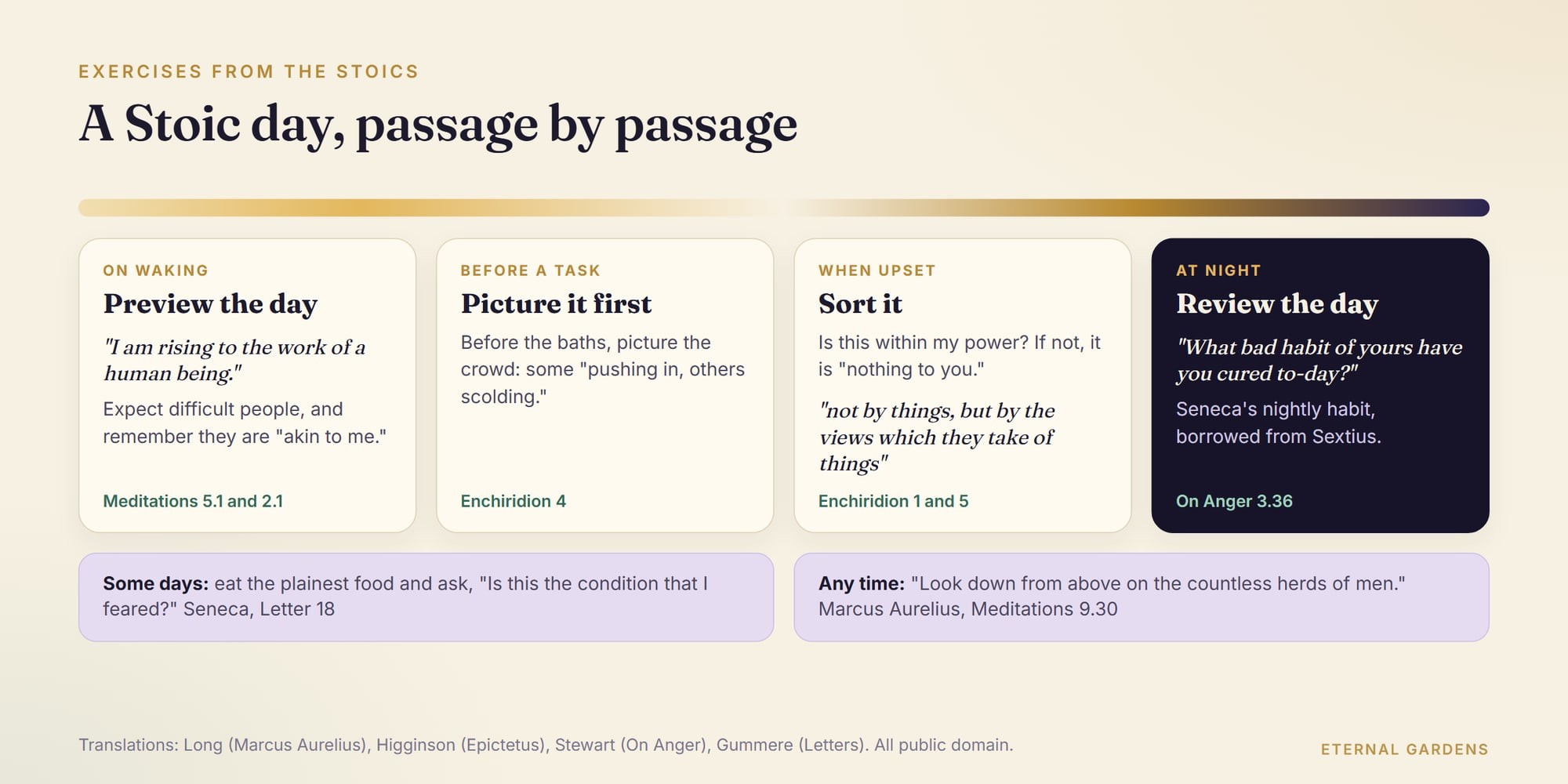
Seneca took the evening review from an earlier philosopher called Sextius. Each night, Sextius asked himself this: "What bad habit of yours have you cured to-day? what vice have you checked? in what respect are you better?" That is still a good way to try it.
Which Stoic book should a beginner read first?
Start with Epictetus's Handbook. Higginson's translation runs to 51 short chapters, under 9,000 words in all. Then try Seneca's letters, which read like advice from a friend, and the Meditations last.
All three are free online in public-domain translations:
- Epictetus, Enchiridion, trans. Thomas Wentworth Higginson, on Project Gutenberg.
- Seneca, Moral Letters to Lucilius, trans. Richard Mott Gummere, on Wikisource (Letter 18 is linked here).
- Marcus Aurelius, Meditations, trans. George Long, on Project Gutenberg.
The Meditations has many translations, old and new, and they read very differently. We compare them in our guide to the best translation of Meditations.
Does Stoicism mean hiding your feelings?
No. In everyday English, a stoic person is one "not giving in to one's emotions," as Dictionary.com puts it. The ancient Stoics meant something more specific. They wanted to get rid of feelings based on false judgments, not all feelings.
The Stanford Encyclopedia notes that the Stoic wise person still has "good feelings," which respond to what is truly good, such as virtue. Marcus Aurelius opens the Meditations with a whole book on what he learned from his family and teachers. It starts with his grandfather Verus. That is not a man who felt nothing.
Ask Marcus Aurelius about it
If you'd like to talk these ideas through, you can talk with the Marcus Aurelius character on Eternal Gardens. It is an Eternal Gardens interpretation of Marcus Aurelius, grounded in public-domain sources. Its page describes the notes he wrote by lamplight on campaign, which survive as the Meditations. It is not the emperor and doesn't speak for him. You can try it free, without making an account.

Questions that stay close to the texts work best:
- "What did you borrow from Epictetus?"
- "Why did you write the morning exercise in Book 2?"
- "What did you mean by looking down from above?"
- "Which of the four virtues did you find hardest as emperor?"
Then check his answers against the passages above. How far should you trust an AI version of a historical figure? Our guide to talking to historical figures with AI explains. Zeno, the founder, was "a voracious reader of Socratic dialogues," says the Stanford Encyclopedia, so our Socratic method examples are a good next read.
Frequently asked questions
What is Stoicism in simple terms?
Stoicism is a school of Greek and Roman philosophy founded in Athens around 300 BCE by Zeno of Citium. It teaches that a good character is the only true good, and that money, health and fame are neither good nor bad. It also holds that people are usually upset by their judgments about events, not by the events themselves.
What is the dichotomy of control?
It is the idea that opens Epictetus's Handbook: some things are within our power and some are not. Within our power, in Higginson's translation, are "opinion, aim, desire, aversion." Beyond it are "body, property, reputation, office." Epictetus advises putting your effort into the first group. For anything in the second, he says, "be prepared to say that it is nothing to you."
What are the four Stoic virtues?
The Stanford Encyclopedia of Philosophy lists them as prudence, justice, courage and moderation. Prudence is often translated as wisdom. Marcus Aurelius names a slightly different set in Meditations 3.6: "justice, truth, temperance, fortitude." For the Stoics, virtue was the only real good. Things like health and wealth were "indifferent," though some were "preferred" and reasonable to choose.
What should a beginner read first on Stoicism?
Start with Epictetus's Handbook, also called the Enchiridion. Higginson's translation has 51 short chapters and runs under 9,000 words. Then read Seneca's Letters to Lucilius, which read like advice from a friend, and the Meditations of Marcus Aurelius. All three are free online in public-domain translations on Project Gutenberg and Wikisource.
Does being stoic mean not having feelings?
No. In everyday English, stoic means not giving in to one's emotions. The ancient Stoics aimed to get rid of passions, which they defined as impulses that run past reason, such as excessive fear. They held that the wise person still has "good feelings" that respond to what is truly good. Marcus Aurelius gave a whole book of the Meditations to what he learned from his family and teachers.
Sources
- Stanford Encyclopedia of Philosophy, Stoicismplato.stanford.edu
- Internet Encyclopedia of Philosophy, Seneca (Robert Wagoner)iep.utm.edu
- Internet Encyclopedia of Philosophy, Epictetus (Keith H. Seddon)iep.utm.edu
- Internet Encyclopedia of Philosophy, Marcus Aurelius (John Sellars)iep.utm.edu
- Epictetus, The Enchiridion, trans. Thomas Wentworth Higginson (Project Gutenberg #45109)gutenberg.org
- Marcus Aurelius, Meditations, trans. George Long (Project Gutenberg #15877)gutenberg.org
- Seneca, On Anger, in Minor Dialogues, trans. Aubrey Stewart (Project Gutenberg #64576)gutenberg.org
- Seneca, Moral Letters to Lucilius, Letter 18, trans. Richard Mott Gummere (Wikisource)en.wikisource.org
- Dictionary.com, stoicdictionary.com
About the author
Eternal Gardens
Eternal Gardens is an AI character platform where you can talk with characters drawn from the writings of historical and literary figures, and build worlds and stories with them.