AI market research for small business: what to ask and what to check
Use AI to read competitor sites, reviews and search data faster, then check every source before you act on it.
By Réson
8 min read
In this article
- What can AI do for small business market research?
- Start with a one-page research brief
- How do you research competitors with AI?
- How can AI help you understand customers?
- Where do real demand signals come from?
- How do you scan competitor prices safely?
- How do you make AI show its sources, and check them?
- What can't AI know about your market?
- Try this workflow in Réson
A small business can use AI for market research by giving it one narrow question, pointing it at public sources such as competitor sites and official statistics, and asking for a link behind every claim. AI market research for small business is fast at reading and sorting. You still open the sources and add what only you know.
That last part matters more than any prompt. A chatbot with web search can skim dozens of pages faster than you can open them. It can't see your sales or the conversation you had at the counter this morning. It also gets sources wrong more often than most people expect. This guide covers the four research jobs AI handles well, a one-page brief to start from, and a simple way to check what comes back.
What can AI do for small business market research?
AI is good at the reading part of research. It scans public pages quickly and sorts what it finds into tables and themes. It is weak at anything that needs private data or real counts.
You're not alone in trying it. In the second quarter of 2026, 19.2% of Canadian businesses said they used AI to produce goods or deliver services, according to Statistics Canada's survey on business conditions. Among those users, data analytics was the most common use, at 36.6%. For businesses with one to four employees, the share using AI was 19.9%.
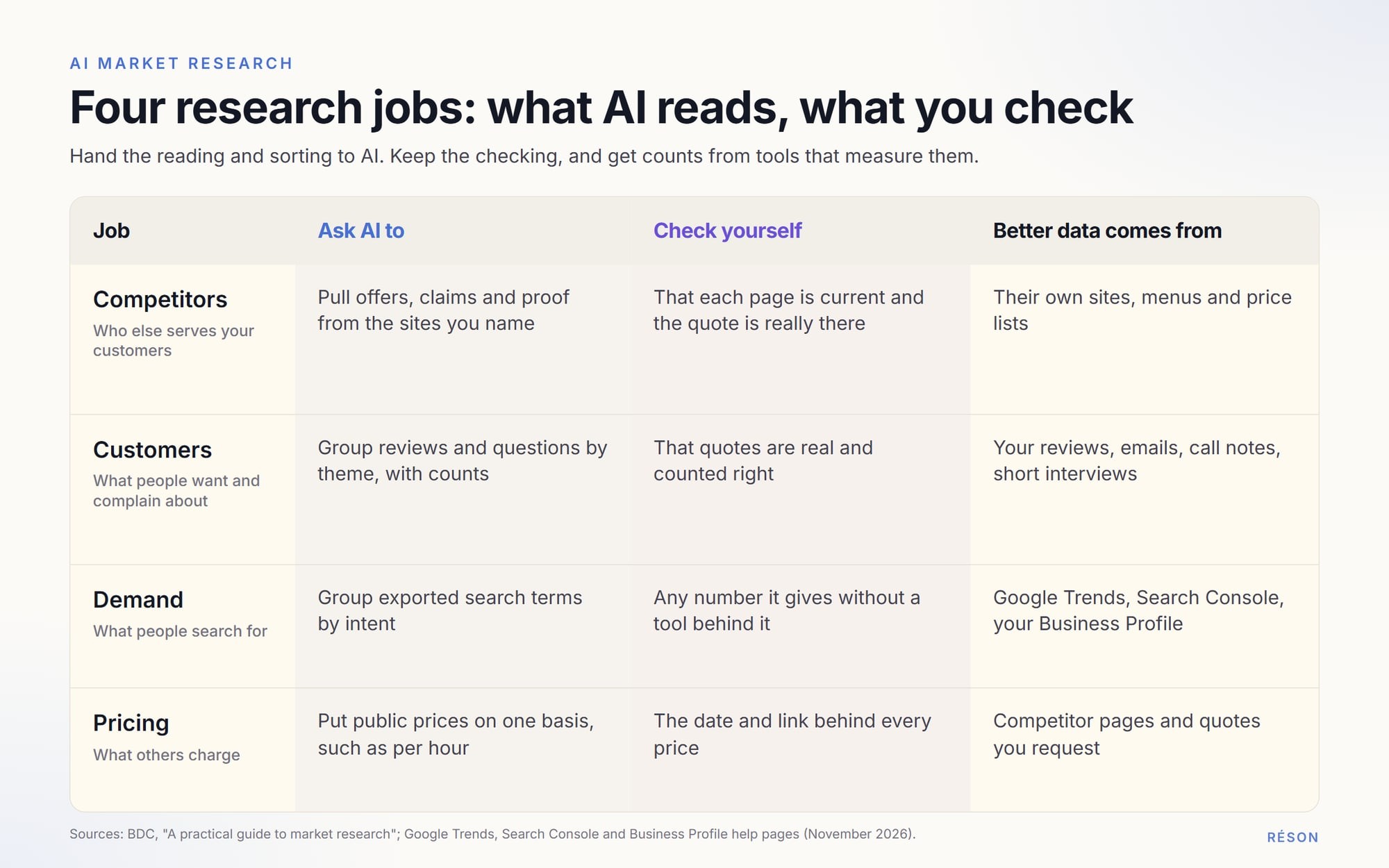
Most small-business research falls into four jobs. The table shows what to hand to AI and what to keep for yourself.
| Research job | Ask AI to | Check yourself | Better data comes from |
|---|---|---|---|
| Competitors | Pull offers and claims from their sites | That each page is current | Their sites, menus and price lists |
| Customers | Group reviews and questions by theme | That quotes are real and counted right | Your reviews, emails and calls |
| Demand | Group exported search terms by intent | Any number it gives without a tool behind it | Google Trends, Search Console, your Business Profile |
| Pricing | Put public prices on one comparable basis | Date and source of every price | Competitor pages, quotes you request |
Start with a one-page research brief
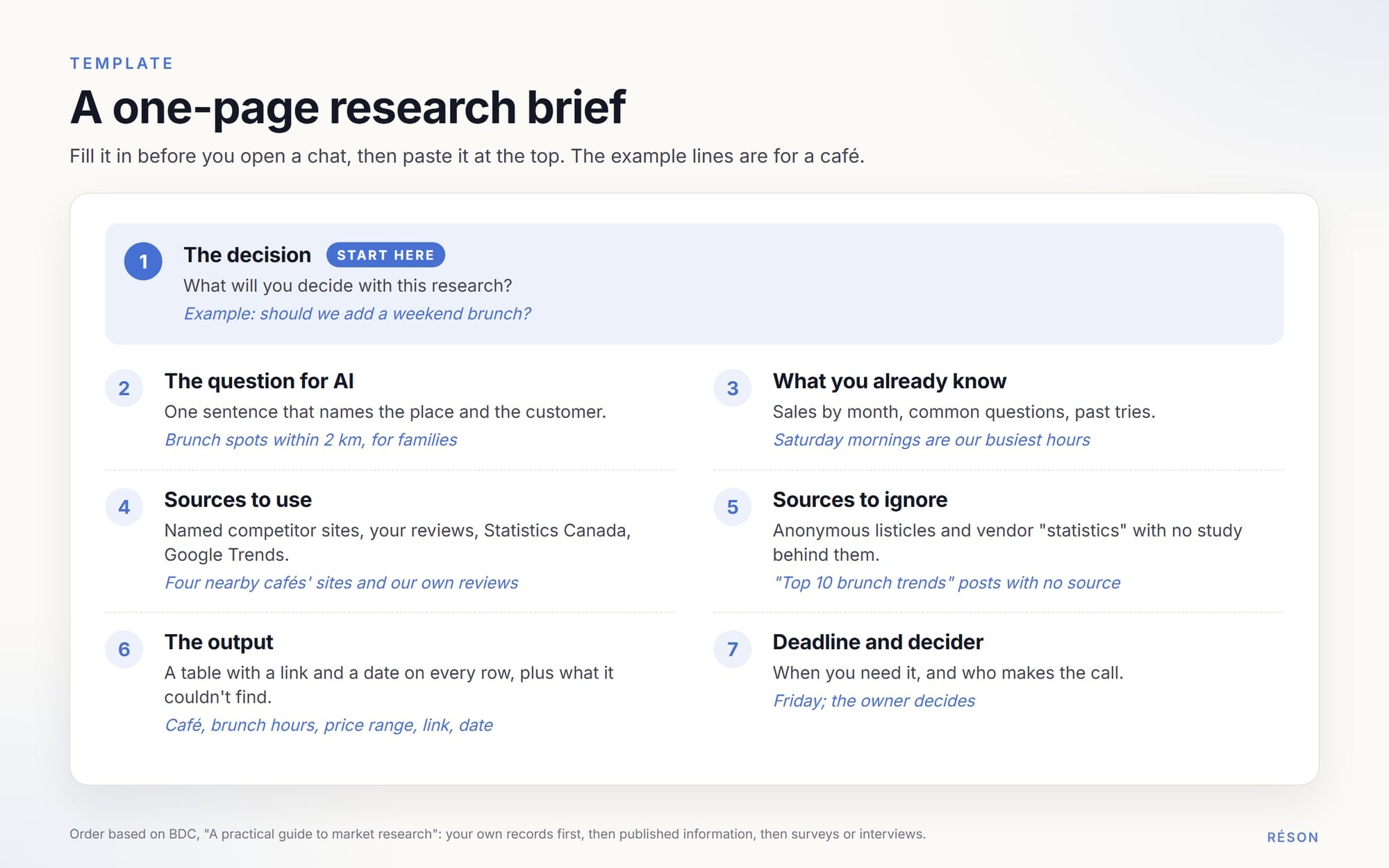
A research brief is a short page that says what decision the research is for, what you already know and which sources count. Writing it first keeps the AI from producing a generic "market overview" that answers nothing.
The Business Development Bank of Canada's practical guide to market research gives a useful order. Start with your own sales records and what frontline staff hear. Then scan published information before you run surveys or interviews. A brief puts that order on paper.
Fill in these lines, in plain words:
- The decision. "Should we add a weekend brunch?" is a decision. "Learn about the café market" is not.
- The question for AI. One sentence that names the place and the customer.
- What you already know. Sales by month, the questions customers ask most, what you've tried before.
- Sources to use. Named competitor sites, your reviews, Statistics Canada tables, Google Trends.
- Sources to ignore. Anonymous listicles, and vendor "statistics" with no study behind them.
- The output. A table with a link and a date on every row, plus a list of what it couldn't find.
- The deadline and who decides.
Paste the brief at the top of your chat. If the tool lets you attach files, attach your own notes instead of retyping them. For more on the facts you give AI tools, see how to build a business knowledge pack.
How do you research competitors with AI?
Pick the competitors yourself, then ask AI to read their pages and fill a table. Don't ask a chatbot "who are my competitors?" and trust the list. It may name businesses that closed or never served your area.
A map search for your service and town gives you real, local names to start from. Paste their website addresses with a request like this one: "Read the five websites below. Make one row per business with what they sell, who they say it's for, their main claim and the proof they show. Quote the line you used for each cell, and give the date on the page. Write 'not found' when a page doesn't say."
Then read the table against the sites. Look for the gaps a customer would notice. Maybe nobody in town publishes prices. Maybe nobody serves customers in French, or every competitor uses the same stock photos. Those gaps are where your marketing can say something true and different.
How can AI help you understand customers?
AI can sort a pile of customer words into themes fast. The words have to be real: your reviews, emails, survey answers and call notes.
Before you paste anything, remove names and contact details. Then ask for themes with counts and two short quotes each, so you can see where every theme came from. Ask what customers praise and what they complain about. Ask what they want to know before buying, too. That last group is often the most useful, because each question is a page or a post you could write.
Reviews of competitors are public and worth reading. Read them yourself and paste the excerpts you want analyzed. That way you know every quote exists.
AI doesn't replace talking to people. BDC describes telephone interviews of 10 to 30 minutes as an efficient way to get feedback from current or prospective customers in business-to-business markets. For a shop or café, a short chat with regulars does the same job. AI helps on both sides of the call. It can draft a short, neutral question list before, and summarize your notes after. Keep the call itself human.
Where do real demand signals come from?
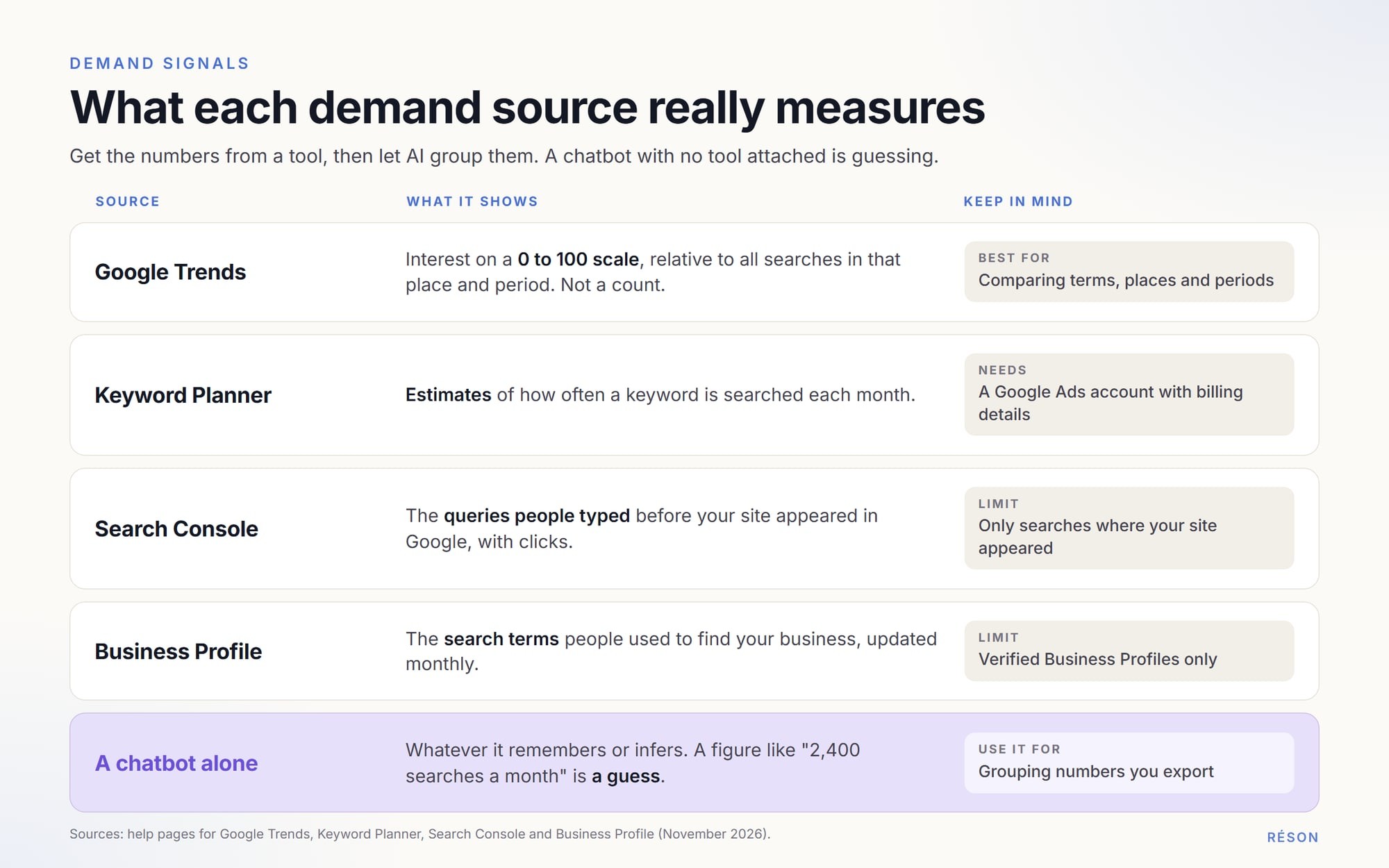
Real demand data comes from tools that measure searches or visits, not from a chatbot's memory. When an AI says a phrase gets "2,400 searches a month" and no tool is attached, treat that number as a guess.
Here is what each common source actually shows:
- Google Trends works from a sample of searches. It scales each point from 0 to 100, relative to all searches in that place and period. That makes it good for comparing interest over time, not for counting searches.
- Google's Keyword Planner gives estimates of monthly searches. To use it, you need a Google Ads account with billing details entered.
- Search Console's Performance report lists the queries people typed before your site appeared in Google results, with clicks for each.
- Your Google Business Profile has a Searches metric: "the search terms people used to find your business," per Google's Business Profile help. It needs a verified profile and updates monthly.
AI becomes useful once you have these numbers. Export the queries and ask it to group them by intent. Typical groups are people comparing prices, people looking for something nearby, and people with a problem to solve. The grouping is quick to check because you can see the raw list.
How do you scan competitor prices safely?
Collect public prices in a sheet with the link and the date you saw each one. Then ask AI to put them on one basis, such as price per hour or per person, and to list what each price includes.
AI can mix up sale prices with regular ones, or pick up a price from another region. The date column is your check. If a price isn't published, write "quote only" rather than letting the tool estimate it.
There is one line not to cross. Read competitors' public prices, but don't share or agree on prices with them. The Competition Bureau's competitor collaboration guidelines explain that agreeing with a competitor to fix or control prices is an offence under section 45 of the Competition Act. Helping competitors monitor each other's prices can also help prove such an agreement. This is general information, not legal advice.
How do you make AI show its sources, and check them?
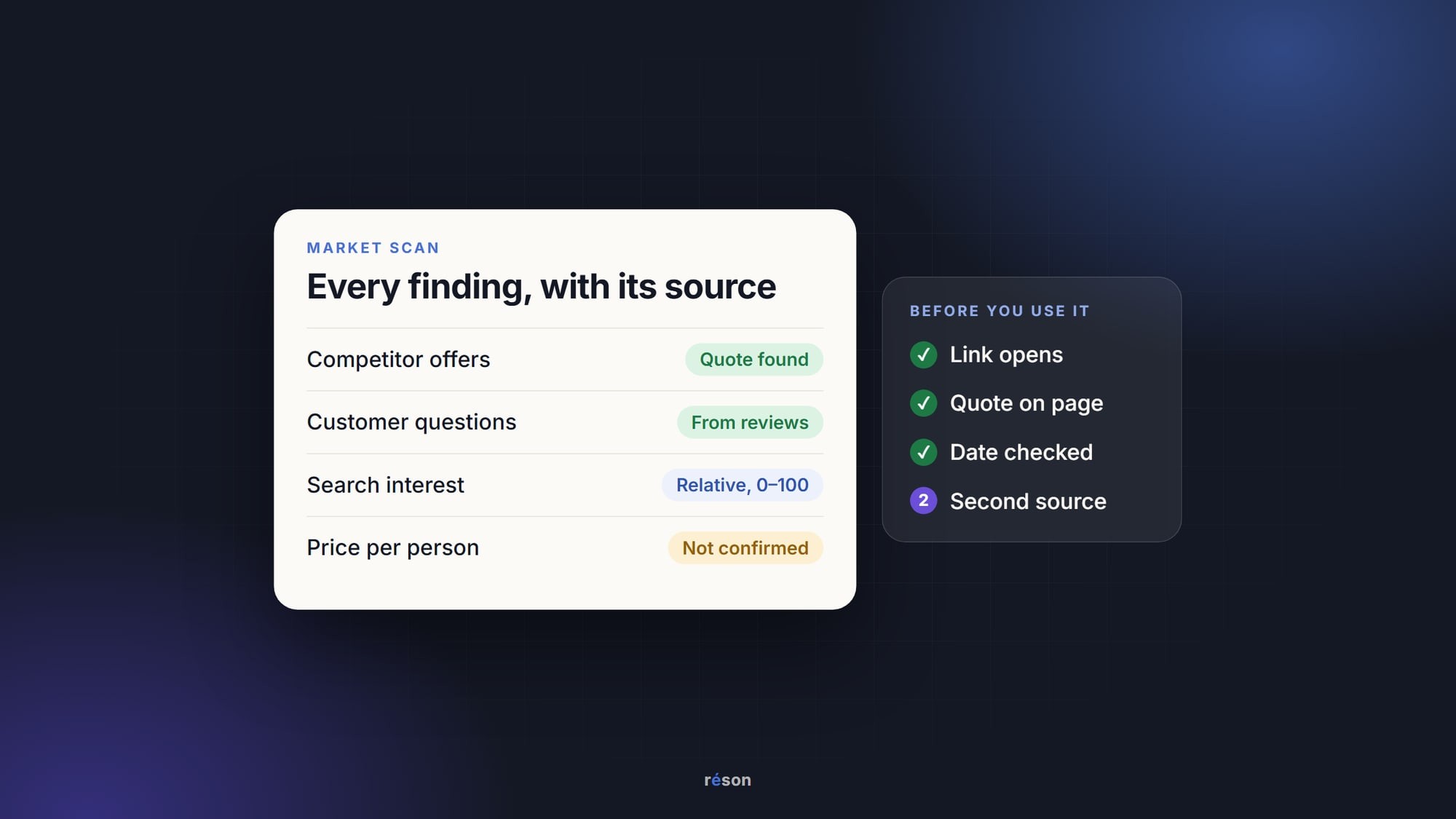
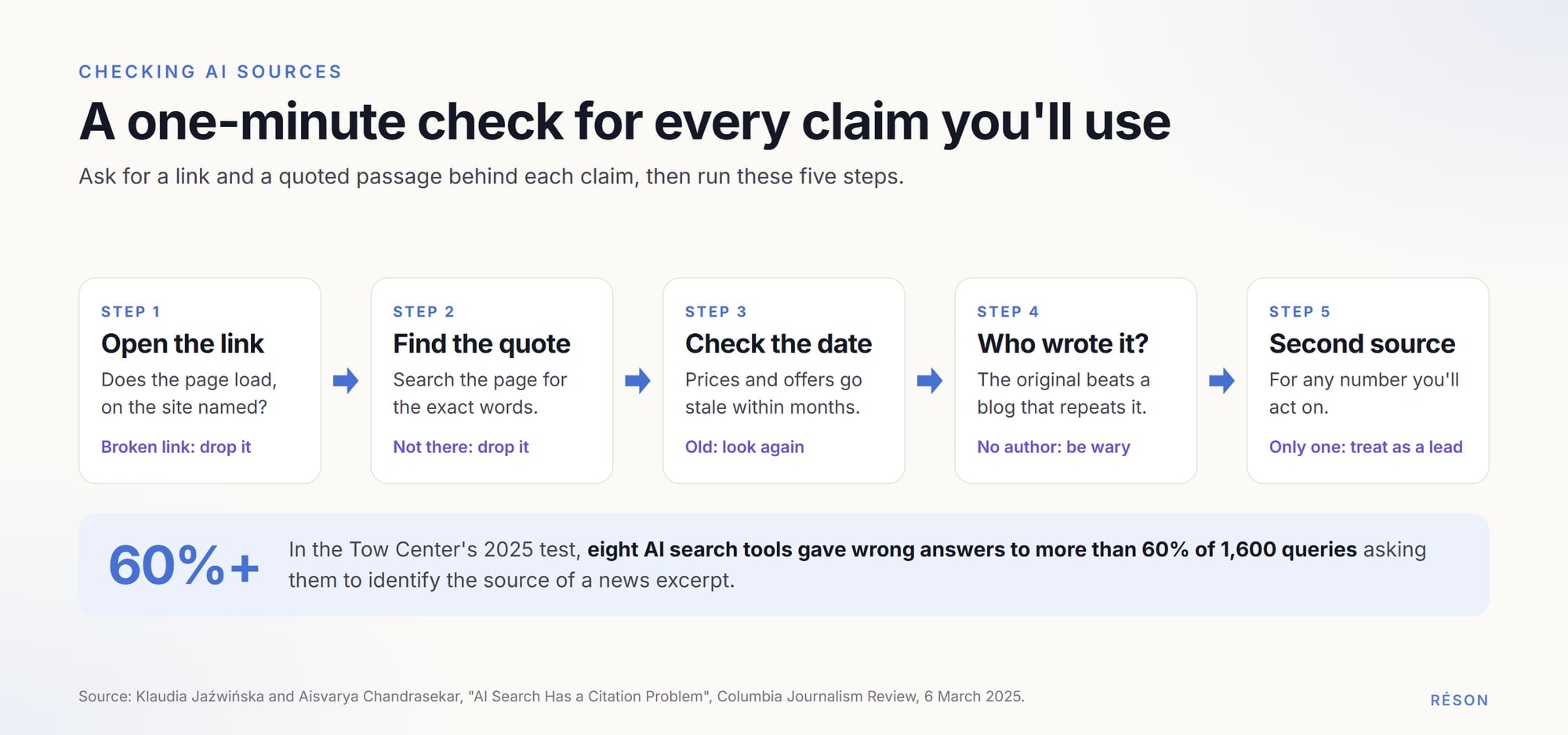
Turn on web search or a research mode, and ask for a link and a short quoted passage behind every claim. Then open every link. The quoted passage is the key step, because you can search the page for those exact words.
Checking is not optional. In a 2025 test by the Tow Center at Columbia, eight AI search tools were wrong on more than 60% of 1,600 queries when asked to identify the source of a news excerpt. More than half of the answers from two of the tools cited fabricated or broken links.
A five-step check takes about a minute per claim:
- Open the link. If it fails, drop the claim.
- Find the quoted words on the page. If they aren't there, drop the claim.
- Check the date. Prices and offers older than a few months need a second look.
- Ask who wrote it. The original source, such as a government table, beats a blog that repeats it.
- For any number you'll act on, find a second source.
Ask the tool to sort its findings into "confirmed with a source" and "not confirmed." Anything in the second group is a lead to follow, not a fact. For prompts that work with general chatbots, see ChatGPT prompts for small-business marketing.
What can't AI know about your market?
AI can't know anything that isn't written down where it can read it. That rules out much of what decides whether a small business does well.
It can't see your sales or your customer list. It doesn't know a competitor's revenue unless they publish it. It can't measure real search volume or foot traffic without a tool that does. It knows little about very local markets with thin web coverage, such as a rural town or a small trade. And it can't tell you why your best customers chose you. Only they can, which is why the interviews matter.
The good news is that these gaps are predictable. Put your own numbers in the brief and use measurement tools for counts. Treat AI as a fast reader that needs supervision.
Try this workflow in Réson
Réson is an AI marketing workspace for small businesses in Canada and Québec. It works in English and in French, and it follows the same habits as this guide. You start a goal by writing what you want to achieve. Réson then runs live research with its sources and stated limitations. Next comes a strategy you approve or revise, and a first batch of content for your review.
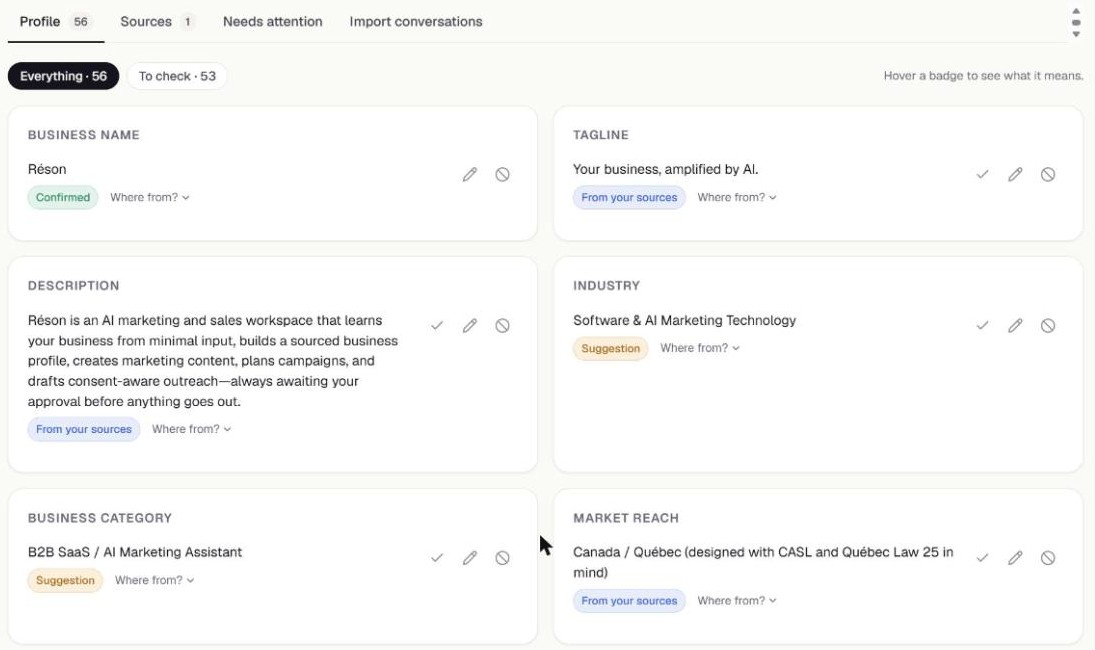
Your business profile works the same way. Each fact shows where it came from, and anything without a source is marked as a suggestion until you confirm it. For B2B prospecting, company research shows the excerpts behind each candidate. Details such as an employee count that the sources don't confirm appear under "Still to verify."
You can start a free 14-day Réson trial with every feature and no credit card. Plans start at CA$79 a month after that. If you'd rather compare tools first, our guide to choosing an AI marketing workspace has a scorecard you can use on any option.
Frequently asked questions
Can ChatGPT do market research for my small business?
A general chatbot can do the reading part: summarizing competitor pages, grouping reviews by theme and putting public prices in one table. Turn on web search and ask for a link and a quoted passage behind every claim. It can't see your sales, real search volumes or why customers chose you, so add those yourself and check every source before you act.
Is AI market research accurate?
Only as accurate as the sources you check. In a 2025 Tow Center test published by the Columbia Journalism Review, eight AI search tools gave wrong answers to more than 60% of 1,600 queries about where news excerpts came from. Treat AI findings as leads, open every link, find the quoted words on the page and confirm important numbers with a second source.
Can AI tell me how many people search for my product?
Not on its own. A chatbot without a measurement tool is guessing when it gives a monthly search figure. Google Trends shows relative interest on a 0 to 100 scale, not counts. Keyword Planner gives estimates but needs a Google Ads account with billing details. Search Console and your Business Profile show the terms people used to find you.
What should I avoid pasting into an AI tool for market research?
Remove customer names, email addresses, phone numbers and order numbers before you paste reviews, emails or call notes. The themes and the wording are what matter for research, not who said it. Also check your AI tool's data settings and privacy policy, and keep confidential figures such as margins out of tools you haven't reviewed.
Is it legal to use AI to compare competitor prices in Canada?
Reading and comparing prices that competitors publish is normal research. What crosses the line is sharing or agreeing on prices with competitors: the Competition Bureau's guidelines explain that agreeing with a competitor to fix or control prices is an offence under section 45 of the Competition Act. This is general information, not legal advice; ask a lawyer about your situation.
Sources
- Statistics Canada: Analysis on artificial intelligence use by businesses in Canada, second quarter of 2026www150.statcan.gc.ca
- BDC: A practical guide to market research to help you make better decisionsbdc.ca
- Google Trends Help: FAQ about Google Trends datasupport.google.com
- Google Ads Help: Use Keyword Plannersupport.google.com
- Search Console Help: Performance report (Search results)support.google.com
- Google Business Profile Help: Understand your Business Profile performance and insightssupport.google.com
- Columbia Journalism Review (Tow Center): AI Search Has a Citation Problemcjr.org
- Competition Bureau Canada: Competitor Collaboration Guidelinescompetition-bureau.canada.ca
About the author
Réson
Réson is an AI marketing workspace for small businesses. It learns your business from your website, drafts posts, campaigns and articles, and waits for your approval before anything goes out.