Small business marketing without an agency: what AI can and can't do
What a small team can run in-house with AI, what still deserves a specialist, and a two-hour weekly routine.
By Réson
8 min read
In this article
- Can a small business do its own marketing without an agency?
- What can a small team run in-house with AI?
- Which marketing work still benefits from a specialist?
- Brand strategy
- Paid ads at scale
- Video production
- Legal review
- Is it cheaper to do your marketing in-house with AI?
- A weekly 2-hour marketing routine
- How do you hire a specialist for just one job?
- When is it time to bring in an agency?
- Try this routine in Réson
Yes, for most of the routine work. A small team can run its marketing without an agency by letting AI draft the weekly posts and the monthly newsletter, then spending about two hours a week editing and approving them. Brand strategy and paid ads at scale still go better with a specialist. So do video shoots and legal review, and you can hire help for that piece only.
That split is the honest answer, and it is not anti-agency. Good agencies do work that AI can't. What has changed is the cost of the everyday part: with AI, a first draft of a post can take minutes instead of an afternoon. This guide shows what you can keep in-house, what to hand out, how to compare the costs with your own numbers, and a two-hour weekly routine you can start on Monday.
Can a small business do its own marketing without an agency?
Yes, if someone on the team owns it for a fixed slot each week. AI writes fast first drafts. It doesn't know which offer matters this month, and it can't approve its own work.
Most Canadian businesses are small enough that this is the real choice. In December 2024, micro-enterprises with one to four employees made up 59.1% of Canadian employer businesses, according to the federal Key Small Business Statistics 2025.
Many have started with AI anyway. Statistics Canada's survey for the second quarter of 2026 found that 19.9% of businesses with one to four employees had used AI to produce goods or deliver services in the previous 12 months. Across all AI users, 19.8% used it for marketing automation. Among AI users with one to four employees, only 10.7% said they had turned to external consultants or vendors because of AI. Most of the smallest businesses are working it out without outside help.
The Business Development Bank of Canada puts the trade-off plainly. In its guide to writing a marketing plan, senior business advisor Mallika Kazim says:
"While you can do the basics on your own, you may want outside help from somebody who has done this before and can teach you about the costs involved and what to expect."
AI makes the basics faster. It doesn't remove the need for that outside view.
What can a small team run in-house with AI?
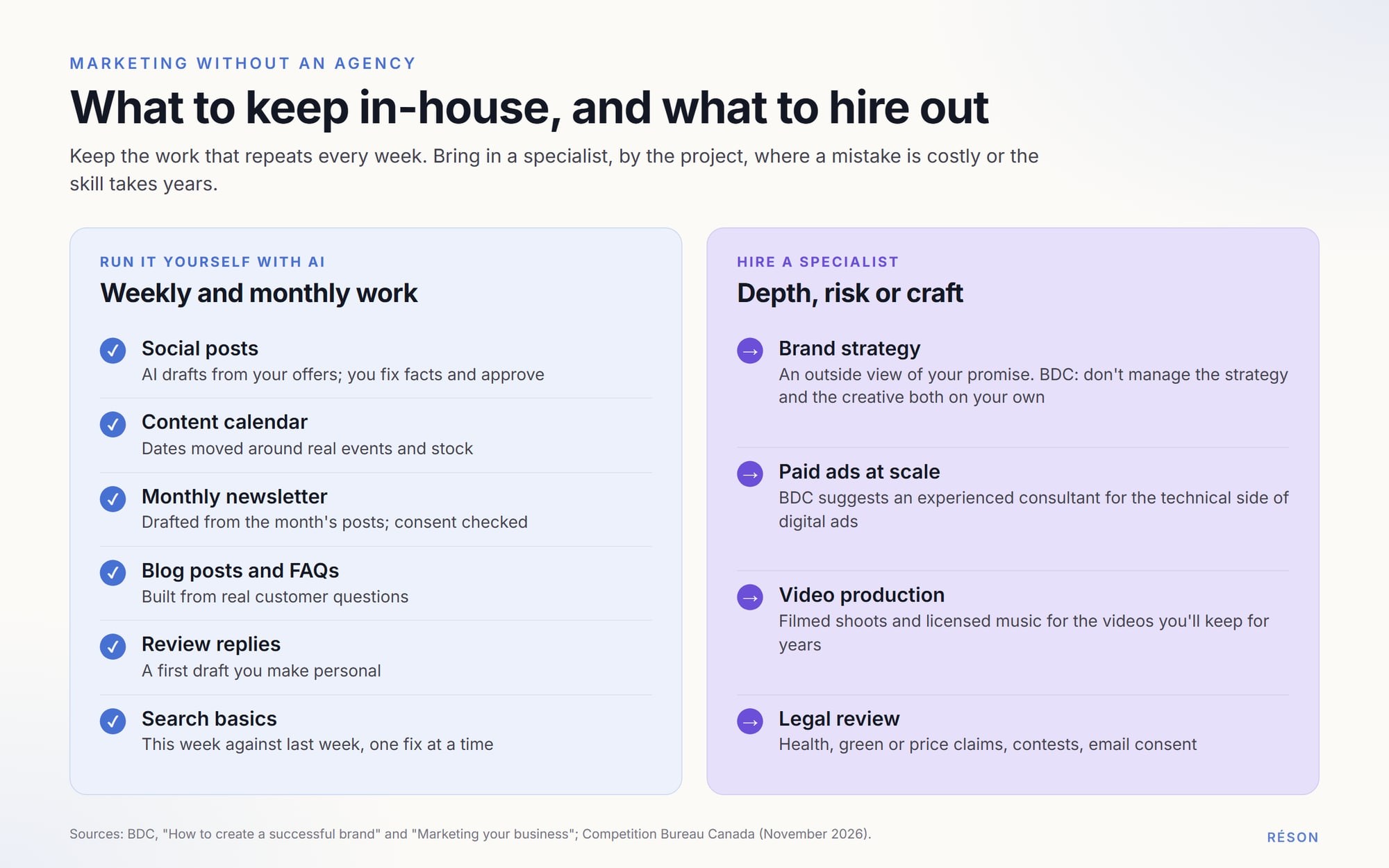
The repeating work: weekly social posts, a monthly email, a simple content calendar, answers to common customer questions, and a weekly look at your search numbers. Each of these follows a pattern, so a good draft is easy to check against what you know.
| Job | What AI does | What you do |
|---|---|---|
| Weekly social posts | Drafts posts from your offers and news | Picks the topic, fixes facts, approves |
| Content calendar | Spreads posts and dates across the month | Moves dates around real events and stock |
| Monthly newsletter | Drafts the email from the month's posts | Checks consent and the unsubscribe link |
| Blog posts and FAQs | Turns customer questions into a draft | Adds real examples, checks every claim |
| Review replies | Suggests a polite first reply | Makes it personal, sends it yourself |
| Search basics | Compares this week's numbers with last week's | Decides what to fix first |
The newsletter needs one extra check in Canada. Canada's anti-spam legislation covers commercial electronic messages, and a promotional newsletter is one. Read our CASL checklist for small businesses before your first send. For the blog side, our guide to AI blog writing for small business covers the edit pass that keeps posts from sounding generic.
Which marketing work still benefits from a specialist?
Work where a mistake is costly, or where skill takes years to build. For most small businesses that means four areas, and you can hire each one by the project.
Brand strategy
Your brand is the promise behind every post, and an AI draft is only as specific as the promise you give it. BDC's guide on how to create a successful brand says that a brand about "the best quality for the price" is "far too generic." Kazim suggests splitting the work with an outside party. You might define your values and customers yourself and hire an agency for the logo and tagline, or the other way round. "But it's best not to manage both parts on your own."
Paid ads at scale
A small boosted post is easy to test yourself. A larger budget spread over search and social ads is different. There, the settings and the tracking decide where the money goes. BDC's marketing primer says: "Due to the technical nature of digital advertising campaigns, it's good to get help from an experienced consultant."
Video production
AI can draft a script and a storyboard, and it can make short clips for social. A filmed shoot with real people and licensed music is a craft. It is worth paying a videographer for the few videos you will use for years, such as a homepage film.
Legal review
AI doesn't check your claims against the law. The Competition Bureau states that all representations "that are false or misleading in a material respect are subject to the Act," and courts look at the general impression, not only the literal words. Health claims and green claims are worth a lawyer's hour. So are contests, and email to people who haven't agreed to receive it. This is general information, not legal advice.
Websites and technical search fixes sit close to this list. Google's page Do you need an SEO? says a small local business can probably do much of the work itself. It names a redesign or a new site launch as the best time to hire help.
Is it cheaper to do your marketing in-house with AI?
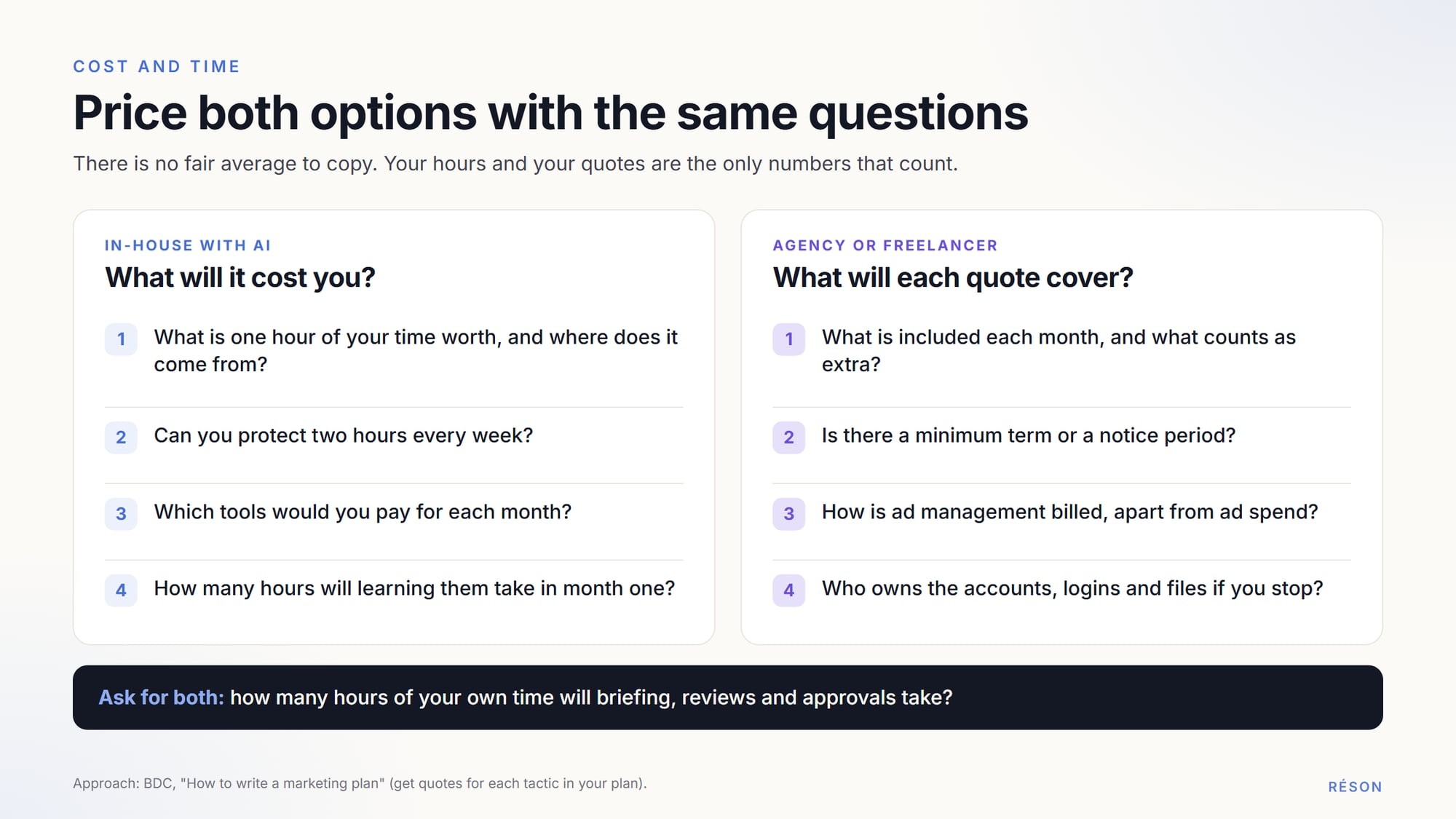
Often, but only you can work it out, because the answer depends on your hours and your quotes. Price both options with the same list of questions rather than trusting anyone's average.
Start with your own time. Two hours a week is about eight hours a month. Ask what those hours are worth to you. Do they come out of selling time, or out of your evenings? Then add the tools you would pay for each month, and the hours it takes to learn them in the first month.
For the agency side, BDC suggests you get quotes on "how much it'll cost to execute each tactic" in your plan. Ask each agency or freelancer the same things:
- What exactly is included each month, and what counts as extra?
- Is there a minimum term or a notice period?
- How is ad management billed, and is it separate from the ad spend itself?
- If we stop, who owns the ad accounts and website logins? Who keeps the photos and files?
- How many hours of my time will reviews and approvals take?
That last question matters for both options. An agency still needs someone on your side to brief it and approve its work. Count those hours too.
A weekly 2-hour marketing routine
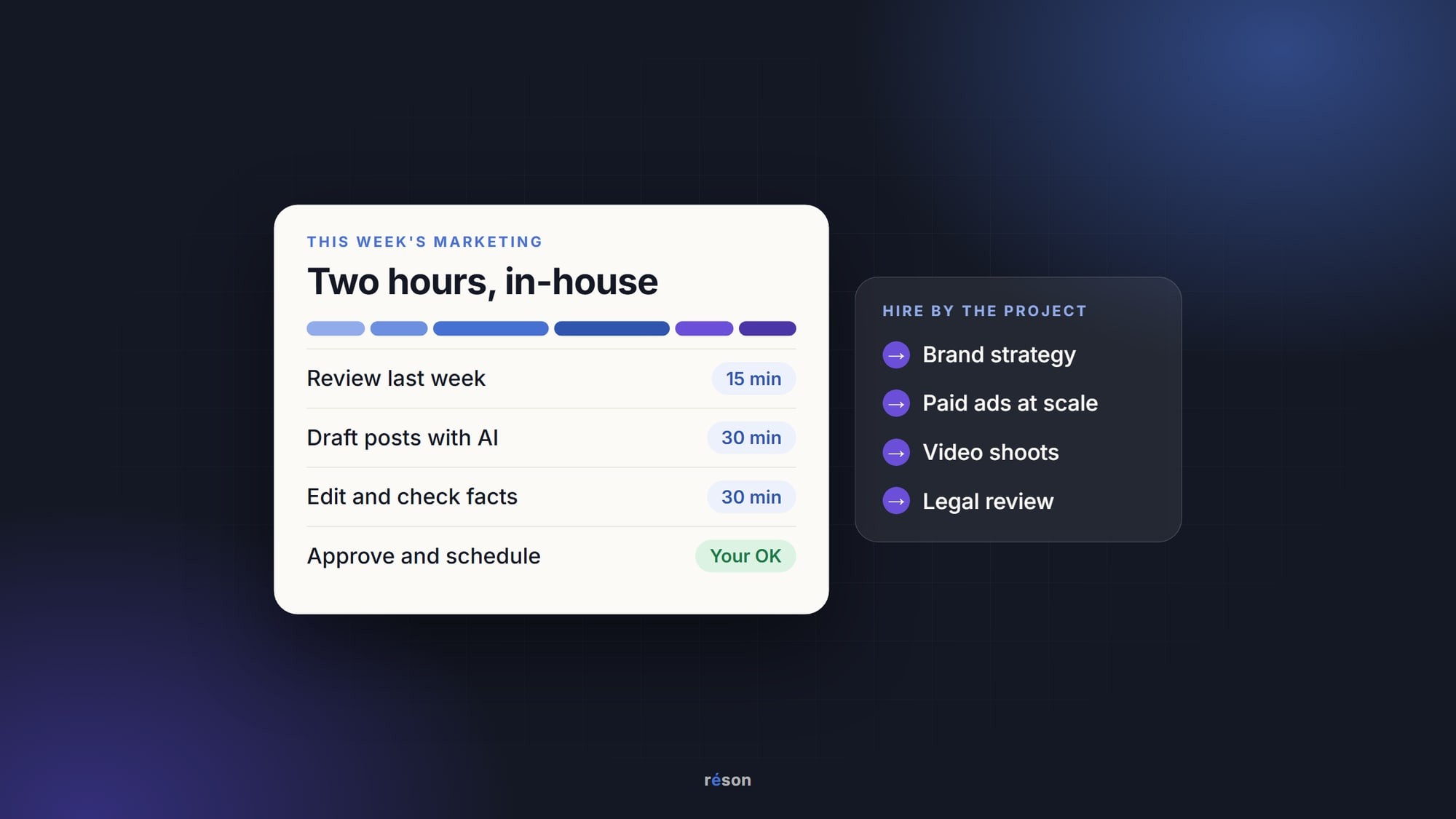
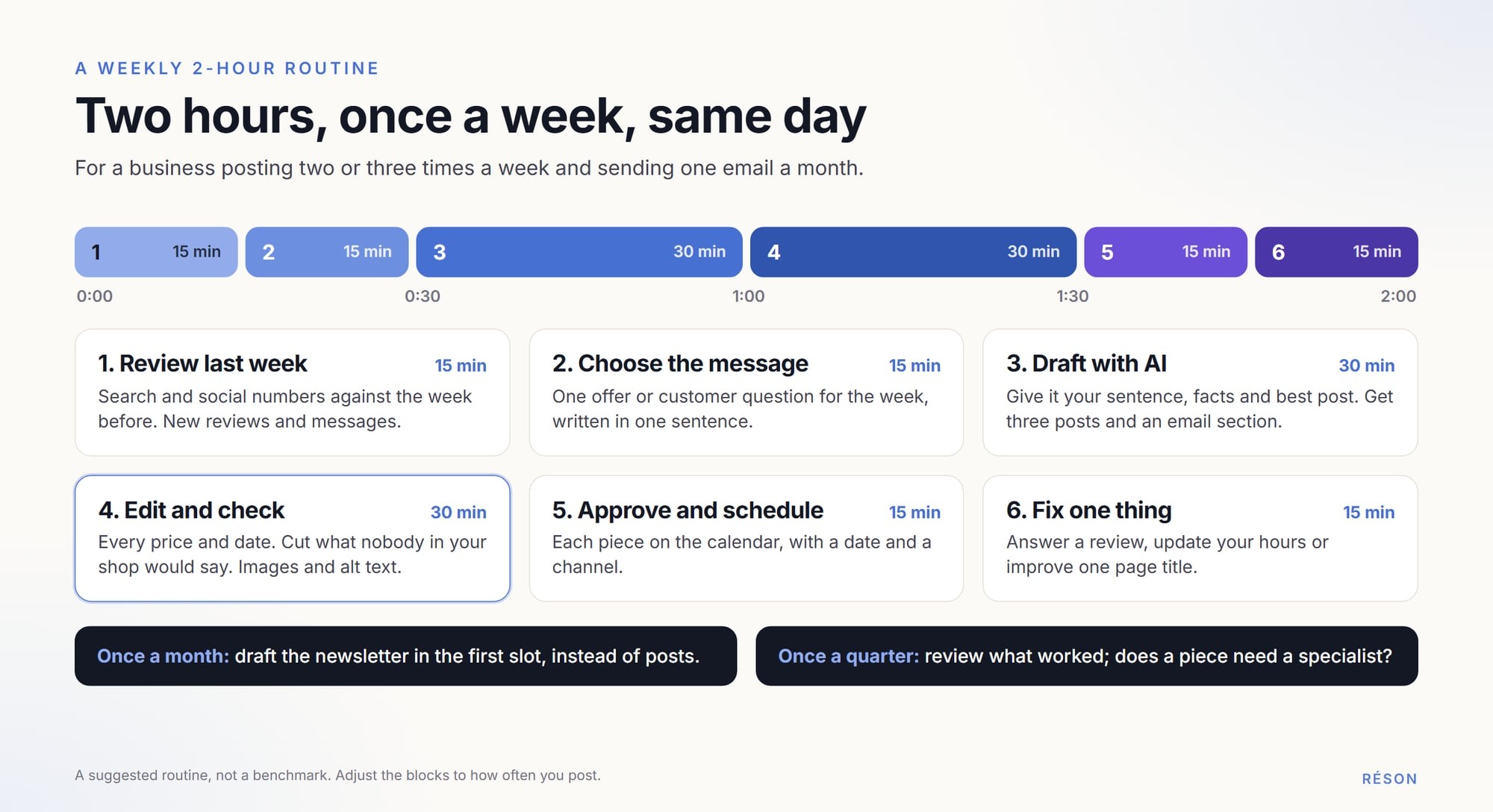
Book one slot on the same day each week and treat it like a client meeting. Here is a routine that fits in two hours for a business posting two or three times a week and sending one email a month.
- Review last week, 15 minutes. Open your search and social numbers and note what changed against the week before. Read new reviews and messages.
- Choose the week's message, 15 minutes. Pick one offer or customer question to build the week around, and write it in one sentence.
- Draft with AI, 30 minutes. Give the tool your sentence and the facts behind it, plus last week's best post. Ask for three posts and one short email section.
- Edit and check, 30 minutes. Fix every price and date. Cut the phrases nobody in your shop would say. Check images and alt text.
- Approve and schedule, 15 minutes. Put each piece on the calendar with a date and a channel.
- Fix one thing, 15 minutes. Answer a review, update your opening hours or improve one page title.
Once a month, use the first slot of the month to draft the newsletter instead of the posts. Once a quarter, look at what worked and decide whether any piece now needs a specialist. If your weekly meeting tends to drift, our guide to the weekly content review gives a short list of decisions to make each time.
How do you hire a specialist for just one job?
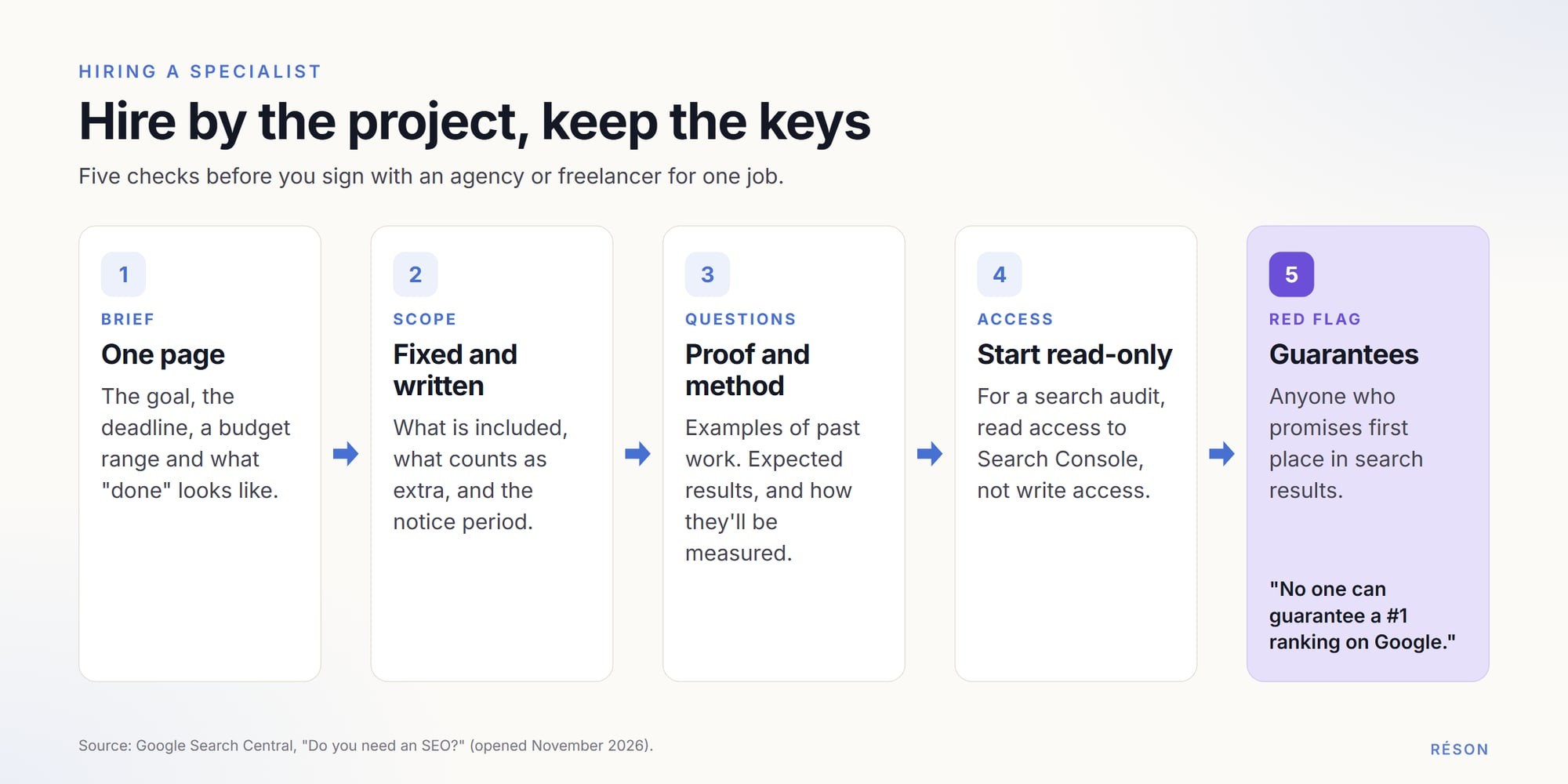
Write a one-page brief, ask for a fixed scope, and keep the keys to your own accounts. A specialist hired by the project is easier to judge than a monthly retainer.
Put the goal and the deadline in the brief, with a budget range, and say what "done" looks like. Then ask questions like the ones Google suggests for hiring help with search. Ask to see examples of previous work. Ask what results they expect and how they will measure them. Ask whether they will share every change they make.
Two rules from the same Google page apply to any marketing hire. First, "No one can guarantee a #1 ranking on Google." If someone promises first place, Google's advice is to "find someone else." Second, if they offer an audit, give them read access to your Search Console data only, not write access. Google also reminds owners that they are responsible for what the companies they hire do.
When is it time to bring in an agency?
When the work outgrows your two hours, or when the stakes outgrow your skills. Some signs:
- You keep skipping the weekly slot because sales or service come first.
- You are about to spend a real budget on ads and can't read the results with confidence.
- You are rebranding, launching a new site or entering a new market.
- A new claim or contest makes you unsure what the law allows.
- You have the drafts but nobody who can judge whether the strategy is right.
Bringing in help doesn't mean starting over. An agency that receives your calendar and your numbers can start faster. You keep the routine for the parts you still run.
Try this routine in Réson
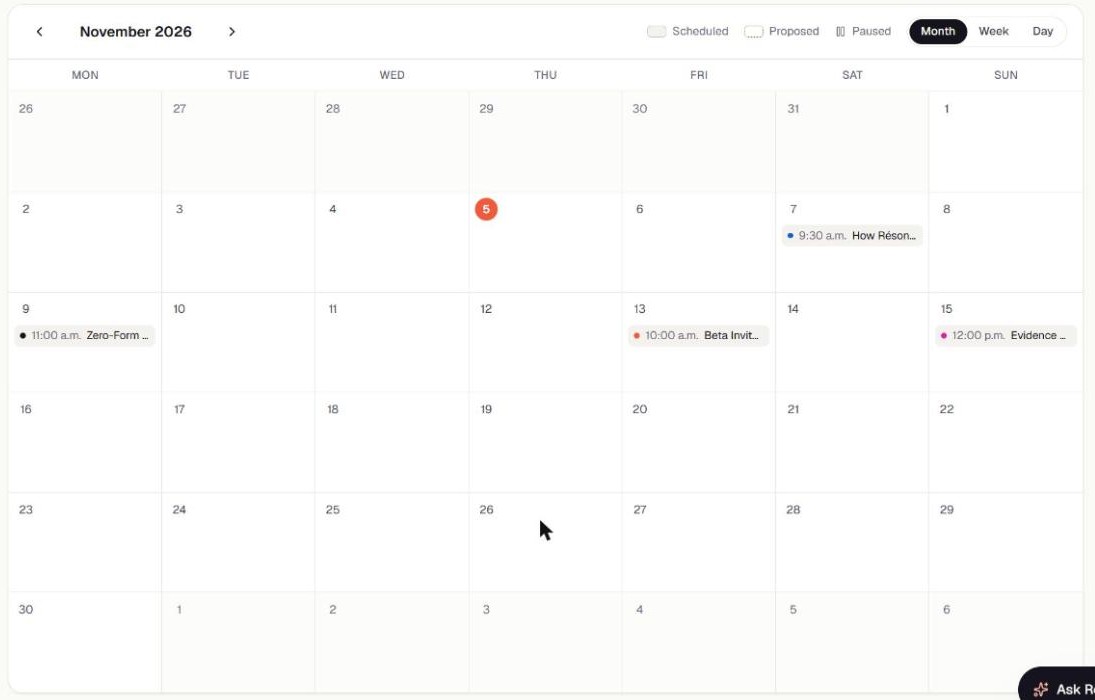
Réson is an AI marketing workspace for small businesses in Canada and Québec. It works in English and French. It fits the in-house routine above. You can set up an automation in a sentence, such as "every Friday morning, draft next week's posts." The drafts go to your approval queue, and approved items move to your calendar. Nothing is published or sent without your OK. Today you review what you create, then export or download it.
The Visibility overview can connect to Google Search Console read-only and compare this week with last week. It also gives a ranked list of what to do next, which covers the first and last blocks of the routine.
You can try Réson free for 14 days, with every feature and no credit card. Plans start at CA$79 a month after that. If you do work with an agency, Réson also has an Agency plan (CA$499 a month) for agencies and teams running several brands. For more on planning a month of posts with any tool, see our guide to an AI content calendar.
Frequently asked questions
Can AI replace a marketing agency for a small business?
For routine work, often yes. AI can draft weekly posts, a monthly newsletter and blog posts that you edit and approve in about two hours a week. It doesn't replace the judgment of a good specialist. Brand strategy, larger paid ad budgets, filmed video and legal review of claims still go better with someone experienced, and you can hire them for one project instead of a monthly retainer.
How much time does it take to do your own marketing with AI?
A business posting two or three times a week and sending one email a month can fit the work into one two-hour slot each week: review last week, choose one message, draft with AI, edit, approve and fix one small thing. This is a suggested routine, not a measured average. The editing block matters most, because skipping it is how generic or wrong posts get published.
What marketing should a small business outsource?
Outsource the work where a mistake is costly or the skill takes years: brand strategy, paid advertising at scale, filmed video production and legal review of claims, contests or email consent. BDC's advice suggests outside help for branding and for the technical side of digital ads. Keep the repeating weekly work, such as posts, the calendar and the newsletter, in-house.
Is it cheaper to do marketing in-house with AI than to hire an agency?
It depends on your numbers, not on an average. Price your own hours and the tools you would pay for, then get quotes for each tactic in your plan, as BDC suggests. Ask what each quote includes, any minimum term, how ad management is billed and who owns the accounts. Count the hours you would spend managing an agency too.
What should I ask before hiring a marketing agency or freelancer?
Ask for examples of past work, what results they expect and how they will measure them, what is included and what counts as extra, and who owns the accounts and files if you stop. Google's advice on hiring search help adds two rules: no one can guarantee a #1 ranking, and for an audit, give read access to Search Console, not write access.
Sources
- ISED: Key Small Business Statistics 2025ised-isde.canada.ca
- Statistics Canada: Analysis on artificial intelligence use by businesses in Canada, second quarter of 2026www150.statcan.gc.ca
- BDC: How to write a marketing planbdc.ca
- BDC: How to create a successful brandbdc.ca
- BDC: Marketing your business, essential read for entrepreneursbdc.ca
- Competition Bureau Canada: False or misleading representations and deceptive marketing practicescompetition-bureau.canada.ca
- Google Search Central: Do you need an SEO?developers.google.com
- Government of Canada: Canada's anti-spam legislationised-isde.canada.ca
About the author
Réson
Réson is an AI marketing workspace for small businesses. It learns your business from your website, drafts posts, campaigns and articles, and waits for your approval before anything goes out.