Sherlock Holmes deduction: how his reasoning really works
Holmes called it deduction. Most of the time it was abduction, and the difference tells you when to trust him.
By Eternal Gardens
9 min read

In this article
- What does Holmes mean by "deduction"?
- The Afghanistan example, step by step
- Deduction, induction and abduction: what's the difference?
- Is Sherlock Holmes's deduction really abduction?
- What Holmes actually calls it
- Where Holmes really does deduce
- How to reason like Holmes
- The dog that did nothing in the night-time
- When Holmes's reasoning fails
- Why it always works in the books
- A catchphrase and a real-life model
- Practise with the Holmes character
Sherlock Holmes calls his method "the science of deduction," but most of his famous deductions are not deductions in the strict sense. A logician would call them abductions: guesses about the best explanation for small clues. Holmes mixes in induction too, and real deduction only now and then.
That sounds like a quibble. It isn't. Once you see which kind of reasoning Holmes is using, you can tell when he is on firm ground and when he is gambling. You can also start doing it yourself.
What does Holmes mean by "deduction"?
For Holmes, deduction means reading a person's history from small physical details. He sets out the idea in A Study in Scarlet, the novel that introduced him in Beeton's Christmas Annual for 1887. Its second chapter is even titled "The Science of Deduction."
In that chapter, Watson finds a magazine article called "The Book of Life." Holmes wrote it. It opens with a big claim:
"From a drop of water," said the writer, "a logician could infer the possibility of an Atlantic or a Niagara without having seen or heard of one or the other." A Study in Scarlet, Part I, ch. 2
The article says a man's trade shows in his finger nails, his coat-sleeve, his boot and his trouser knees. Watson calls it "ineffable twaddle." Then Holmes explains how he knew, on their first meeting, that Watson had been in Afghanistan.
The Afghanistan example, step by step
Here is Holmes's own account of the "train of reasoning," from the same chapter:
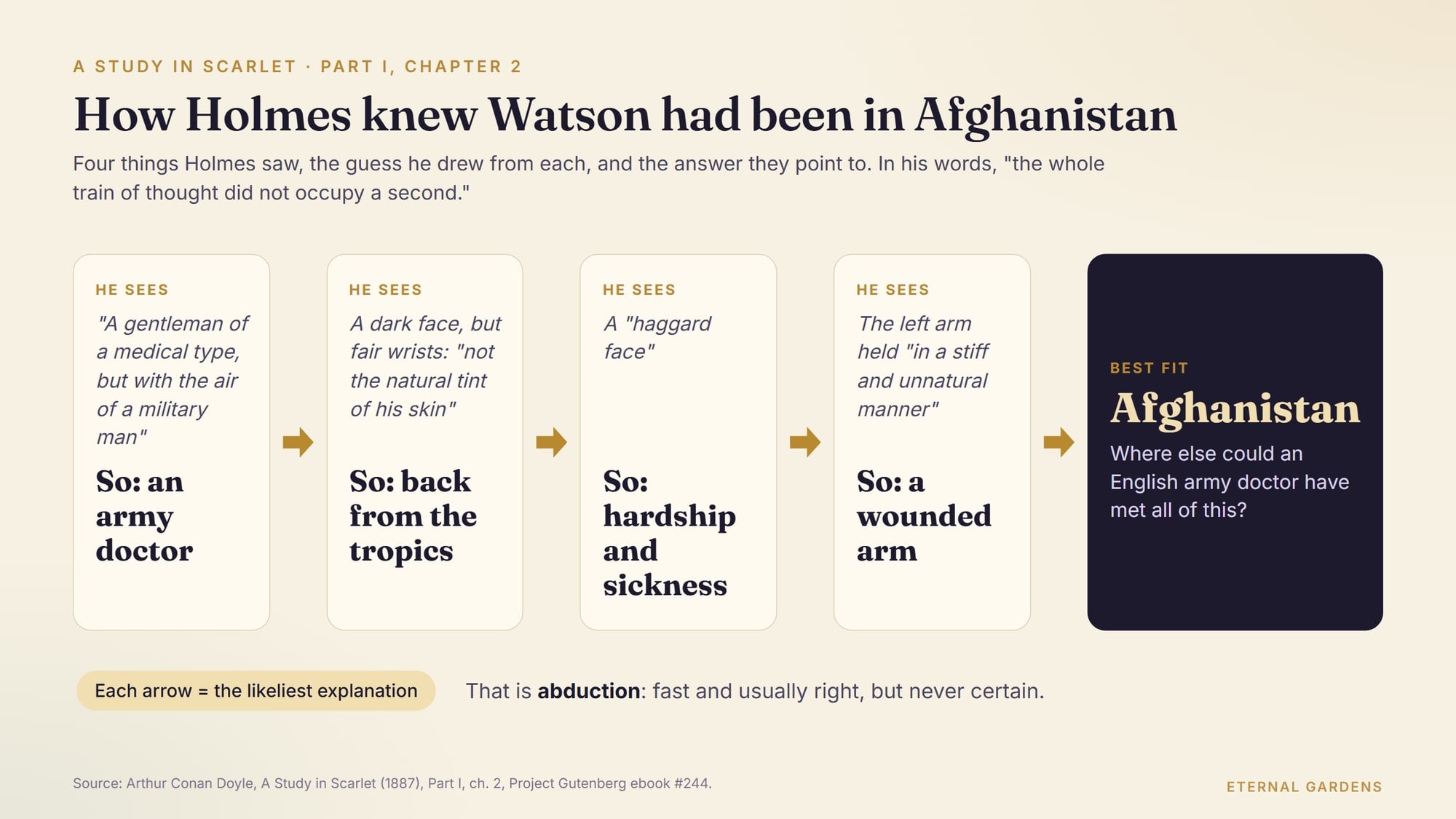
"Here is a gentleman of a medical type, but with the air of a military man. Clearly an army doctor, then. He has just come from the tropics, for his face is dark, and that is not the natural tint of his skin, for his wrists are fair." A Study in Scarlet, Part I, ch. 2
He goes on. Watson's haggard face shows hardship and sickness. He holds his left arm "in a stiff and unnatural manner," so it was injured. Where could an English army doctor have suffered all that in the tropics? "Clearly in Afghanistan." Holmes says the whole chain "did not occupy a second."
Deduction, induction and abduction: what's the difference?
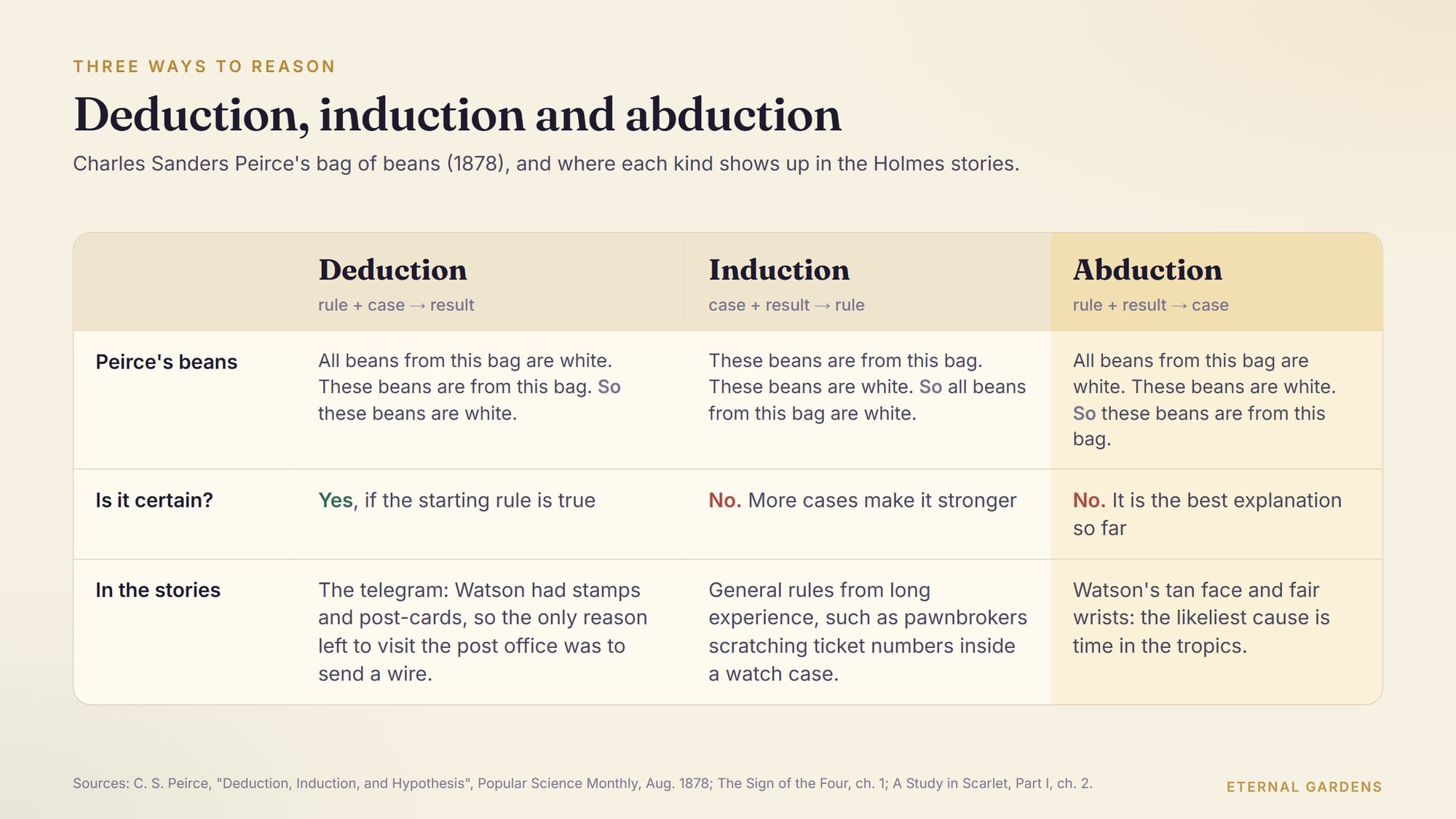
Deduction moves from a rule to a conclusion that must be true if the rule is true. Induction moves from many cases to a general rule. Abduction moves from a surprising fact to the explanation that would best account for it.
The clearest teaching example is more than 140 years old. In August 1878, the American philosopher Charles Sanders Peirce published "Deduction, Induction, and Hypothesis" in Popular Science Monthly. He used a bag of beans. The same three statements appear in each kind of reasoning, in a different order.
| Kind | You start with | You conclude | Peirce's beans | Is it certain? |
|---|---|---|---|---|
| Deduction | A rule and a case | A result | All beans from this bag are white. These beans are from this bag. So these beans are white. | Yes, if the rule is true |
| Induction | Cases and results | A rule | These beans are from this bag. They are white. So all beans from this bag are white. | No. More samples make it stronger |
| Abduction | A rule and a result | A case | All beans from this bag are white. These beans are white. So these beans are probably from this bag. | No. It is the best available explanation |
Peirce called the third kind "hypothesis." He also called it "retroduction" and "abduction." His definition fits Holmes well: "Hypothesis is where we find some very curious circumstance, which would be explained by the supposition that it was a case of a certain general rule, and thereupon adopt that supposition." Swap the beans for Watson's tan and you have the Afghanistan scene.
The Stanford Encyclopedia of Philosophy entry on abduction puts the key difference simply. In deduction, the conclusion "is necessarily true if the premises from which it is inferred are true." In abduction, there is "an appeal to explanatory considerations." Today it is often called inference to the best explanation.
Is Sherlock Holmes's deduction really abduction?
Mostly, yes. Each step in the Afghanistan chain picks the likeliest explanation for a clue. A stiff arm could come from a riding fall at home. None of the steps is forced, so the conclusion is not guaranteed.
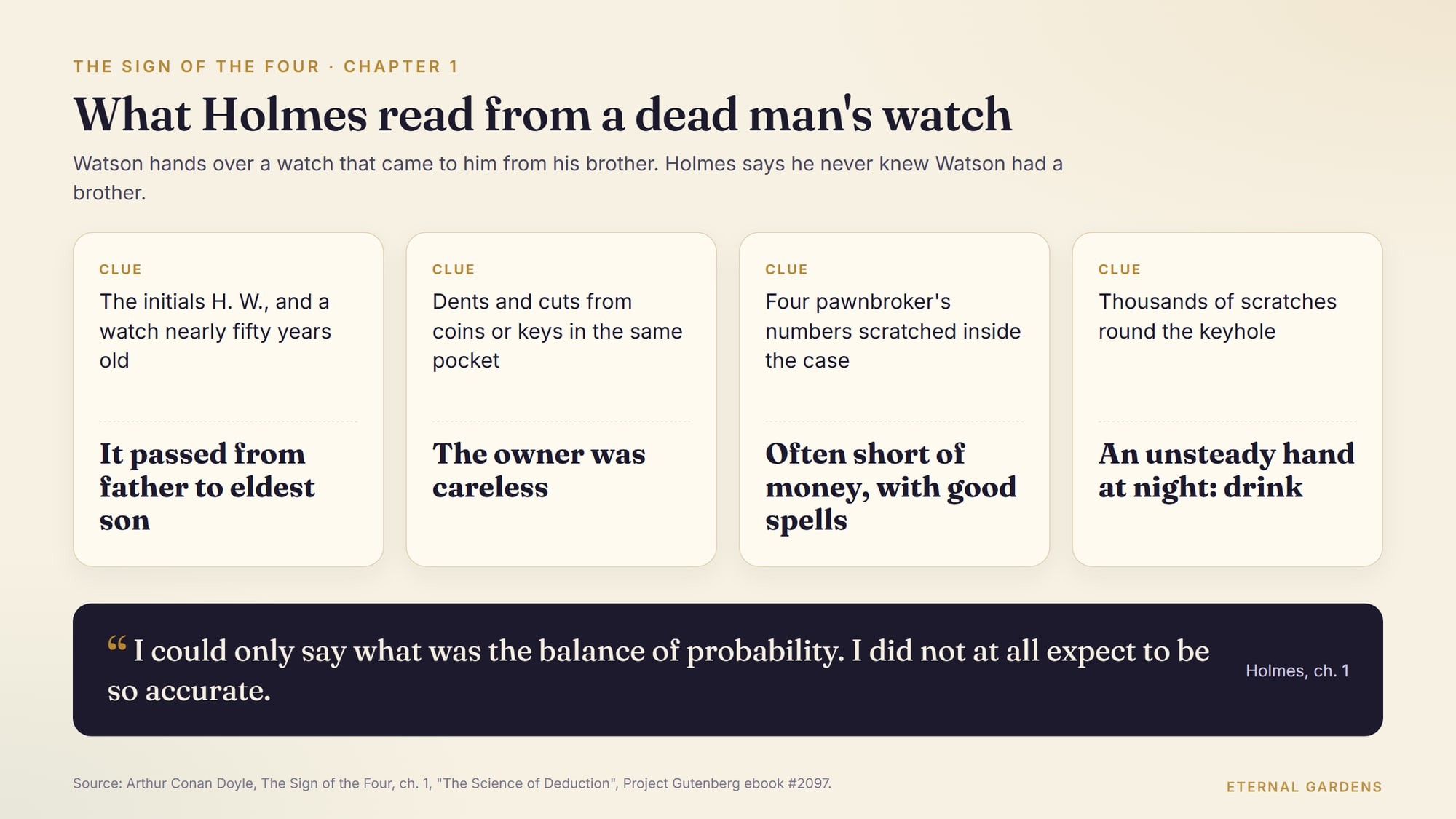
Holmes half admits this in The Sign of the Four. Watson hands him a watch that belonged to his late brother. Holmes reads the owner's life from it:
- The initials H. W. and the watch's age, nearly fifty years, suggest it passed from father to eldest son.
- Dents and cuts on the case suggest a careless owner who kept coins or keys in the same pocket.
- Four pawnbroker's numbers scratched inside suggest he was often short of money, and got the watch back in better times.
- Thousands of scratches round the keyhole suggest an unsteady hand winding it at night, which Holmes reads as drink.
Watson is stunned. Every point is true. Holmes replies: "I could only say what was the balance of probability. I did not at all expect to be so accurate." A moment later he insists, "I never guess."
That is abduction in a sentence. Holmes doesn't guess at random. He picks the most probable explanation and knows it could be wrong.
What Holmes actually calls it
We searched the full texts of all four novels and 56 short stories on Project Gutenberg. Forms of "deduce" and "deduction" appear dozens of times. The word "abduction" turns up only in its everyday sense of kidnapping, in "The Solitary Cyclist" and "The Priory School." Holmes uses "inductive" just once, in "The Six Napoleons," where he traces a pearl "by a connected chain of inductive reasoning."
Where Holmes really does deduce
Holmes does sometimes use true deduction. He lists every possibility and rules out all but one. If the list was complete, the last one must be true. This is reasoning by elimination.
The neatest example is also in chapter 1 of The Sign of the Four. Holmes sees reddish mud on Watson's boot that matches fresh roadworks outside the Wigmore Street Post-Office. "So much is observation. The rest is deduction." Watson didn't write a letter that morning, and he already has stamps and post-cards. "What could you go into the post-office for, then, but to send a wire?"
Holmes states the rule in chapter 6 of the same novel:
"How often have I said to you that when you have eliminated the impossible whatever remains, however improbable, must be the truth?" The Sign of the Four, ch. 6
The logic is airtight. The weak spot is the list. If you forgot a possibility, the answer that "remains" may be wrong. Watson could have gone in to buy a postal order.
How to reason like Holmes
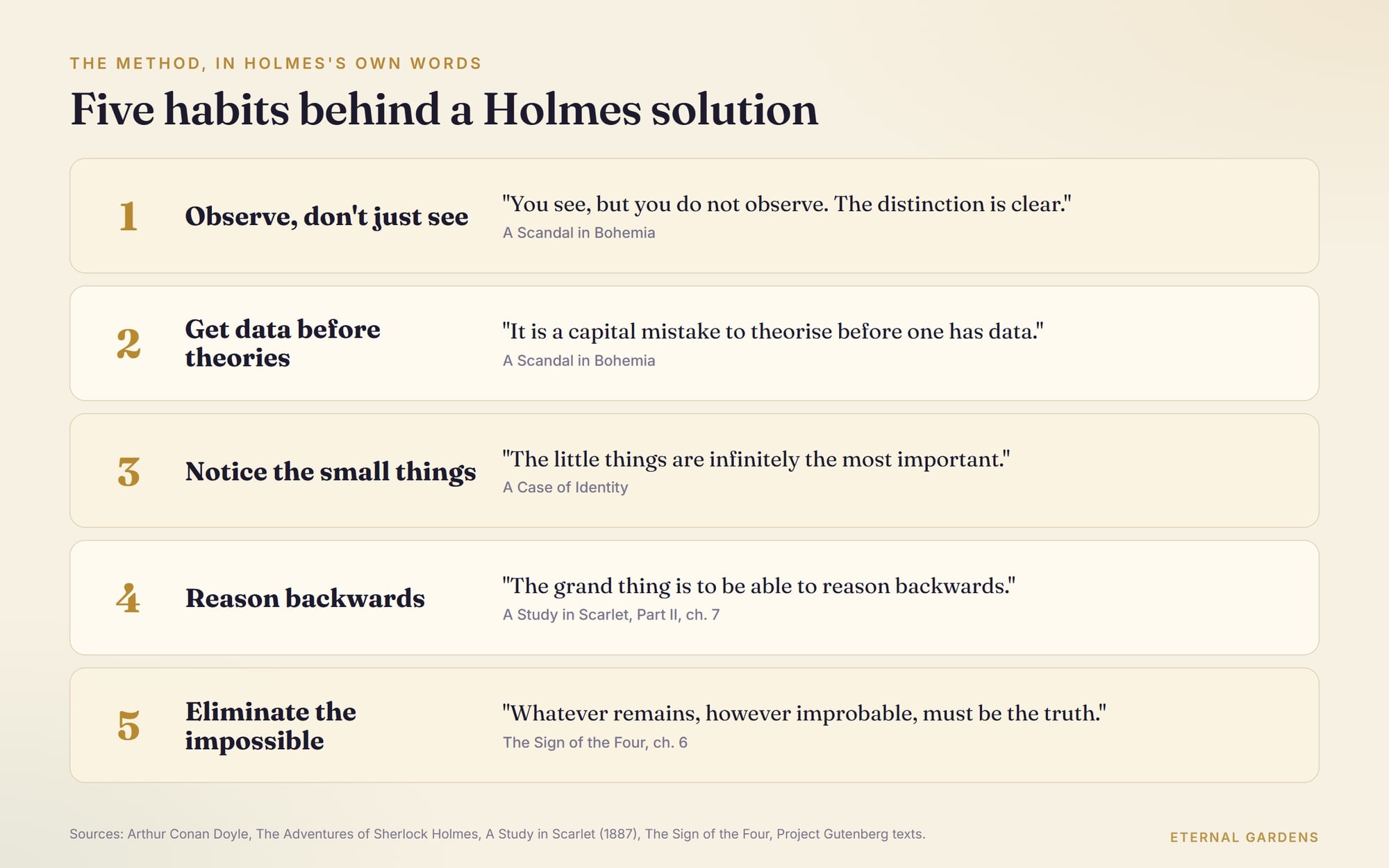
Holmes's method has a clear order. You can pull it out of his own words in the stories.
- Observe, don't just see. In "A Scandal in Bohemia," Holmes asks how many steps lead up to their rooms. Watson has climbed them hundreds of times and doesn't know. Holmes does: seventeen. "You see, but you do not observe."
- Collect data before you theorise. In the same story he warns: "Insensibly one begins to twist facts to suit theories, instead of theories to suit facts."
- Notice small things. "It has long been an axiom of mine that the little things are infinitely the most important" ("A Case of Identity").
- Reason backwards. At the end of A Study in Scarlet, Holmes says most people can predict a result from events. Few can start from the result and work out the steps. "That is a very useful accomplishment, and a very easy one, but people do not practise it much."
- Eliminate. Rule out the impossible, then test what is left.
The dog that did nothing in the night-time
One of Holmes's best-known clues is something that didn't happen. In "Silver Blaze," a racehorse vanishes from its stable at night. An inspector asks if there is anything Holmes wants him to notice.
"To the curious incident of the dog in the night-time." "The dog did nothing in the night-time." "That was the curious incident," remarked Sherlock Holmes. Silver Blaze, in The Memoirs of Sherlock Holmes
Later Holmes explains. A dog was kept in the stables. Yet someone took the horse out, and the dog didn't bark enough to wake the two lads sleeping in the loft. "Obviously the midnight visitor was some one whom the dog knew well."
This is abduction again, from an absence. A barking dog would be a clue. A silent one is a clue too, if you expected noise.
When Holmes's reasoning fails
Abduction is only as good as the rules behind it. Some of Holmes's rules are simply wrong. In "The Adventure of the Blue Carbuncle," he studies a lost hat. He decides its owner is "highly intellectual." His reason? The hat is large. "It is a question of cubic capacity," he says, "a man with so large a brain must have something in it."
A big hat proves a big head, not a sharp mind. The step from rule to conclusion is fine. The rule is the problem, so the conclusion is worthless. It may be the most useful lesson in the stories. Check the rule before you trust the chain.
Why it always works in the books
Real clues fit many stories. In fiction, the author makes sure the likeliest story is the true one. Holmes even teases Watson about this in "The Crooked Man." He says the effect of Watson's "little sketches" depends on "retaining in your own hands some factors in the problem which are never imparted to the reader." In real life, nobody holds those factors back for you, so a good reasoner keeps a second and third explanation in mind.
A catchphrase and a real-life model
Holmes never says "Elementary, my dear Watson" in any of the stories. He says "Elementary" on its own once, in "The Crooked Man," and the next words are "said he." And the method had a real model. Arthur Conan Doyle studied medicine at the University of Edinburgh from 1876 to 1881. One of his professors there, Dr Joseph Bell, "is said to have inspired" the character, according to the university.
Practise with the Holmes character
You can test these ideas in conversation. Eternal Gardens has a Sherlock Holmes character built from Conan Doyle's public-domain stories. Its page describes it as "built for original mysteries, disciplined evidence, and fair-minded deduction." It is an AI character based on the books, so treat it as a sparring partner, not an authority.
Some good things to ask:
- Walk me through the Afghanistan reasoning. Which step is weakest?
- Give me three clues about a stranger, and let me infer their job.
- In the watch case, what other explanation could fit the keyhole scratches?
- When does "eliminate the impossible" lead you astray?
- Set me a short original mystery, and grade my reasoning.

If you'd like to talk with the Holmes character on Eternal Gardens, a first chat is free and needs no account. For more on getting good answers from characters like this, see our guide to talking with AI versions of historical and literary figures. Holmes's habit of asking the next question has a lot in common with the Socratic method. And if you want to build a mystery setting of your own, try worldbuilding with an AI character.
Frequently asked questions
Is Sherlock Holmes's reasoning deduction or abduction?
Mostly abduction. Holmes calls his method the science of deduction, but most of his famous inferences pick the likeliest explanation for a clue, as with Watson's tan in A Study in Scarlet. That is what Charles Sanders Peirce called hypothesis or abduction. Holmes uses strict deduction mainly when he rules out every option but one, as with Watson's telegram in The Sign of the Four.
What is the difference between deduction, induction and abduction?
Deduction goes from a rule to a conclusion that must be true if the rule is true. Induction goes from many cases to a general rule. Abduction goes from a surprising fact to the explanation that would best account for it. Peirce showed all three in 1878 with a bag of white beans, using the same three statements in a different order each time.
Did Sherlock Holmes ever say "Elementary, my dear Watson"?
No. The phrase does not appear in any of Arthur Conan Doyle's four Holmes novels or 56 short stories. Holmes says "Elementary" on its own once, in "The Crooked Man" in The Memoirs of Sherlock Holmes, and the words that follow are "said he." The famous line is not in the original texts.
Who was the real-life inspiration for Sherlock Holmes?
Arthur Conan Doyle studied medicine at the University of Edinburgh from 1876 to 1881. The university says one of his professors, Dr Joseph Bell, is said to have inspired the character. It describes Bell as a pioneering forensic pathologist whose scientific approach was unusual for the time, and Holmes's habit of reading a stranger's history from small details echoes it.
What does "when you have eliminated the impossible" mean?
It is Holmes's rule from chapter 6 of The Sign of the Four: once every impossible explanation is ruled out, whatever remains, however improbable, must be the truth. The logic is sound only if your list of possibilities was complete. If you missed an option, the answer that remains can still be wrong, so careful reasoners keep more than one explanation in mind.
Sources
- A Study in Scarlet, Arthur Conan Doyle (Project Gutenberg #244)gutenberg.org
- The Sign of the Four, Arthur Conan Doyle (Project Gutenberg #2097)gutenberg.org
- The Adventures of Sherlock Holmes (Project Gutenberg #1661)gutenberg.org
- The Memoirs of Sherlock Holmes (Project Gutenberg #834)gutenberg.org
- The Return of Sherlock Holmes (Project Gutenberg #108)gutenberg.org
- C. S. Peirce, Illustrations of the Logic of Science VI: Deduction, Induction, and Hypothesis (1878), Wikisourceen.wikisource.org
- Stanford Encyclopedia of Philosophy: Abductionplato.stanford.edu
- Stanford Encyclopedia of Philosophy: Charles Sanders Peirceplato.stanford.edu
- University of Edinburgh: Sir Arthur Conan Doyle (1859-1930)medicine-vet-medicine.ed.ac.uk
- Grolier Club, Sherlock Holmes in 221 Objects: A Study in Scarletgrolierclub.omeka.net
About the author
Eternal Gardens
Eternal Gardens is an AI character platform where you can talk with characters drawn from the writings of historical and literary figures, and build worlds and stories with them.