Sun Wukong in Journey to the West: the Monkey King's story, chapter by chapter
Who the Monkey King is, where his powers come from, why he wears the golden headband, and where each scene sits in the 100-chapter novel
By Eternal Gardens
9 min read
In this article
- Who is Sun Wukong?
- How did he get the name Sun Wukong?
- Where does the story come from?
- What happens to Sun Wukong in the story?
- Havoc in heaven (chapters 1–7)
- The bet on the Buddha's palm (chapter 7)
- Five hundred years under the mountain (chapters 8–14)
- What are Sun Wukong's powers?
- Why does Sun Wukong wear a golden headband?
- Who travels with Sun Wukong?
- Talk to the Monkey King yourself
Sun Wukong, the Monkey King, is the hero of Journey to the West, a 100-chapter Chinese novel of the 16th century, usually credited to Wu Cheng'en. He is born from a stone, learns 72 transformations and wrecks heaven. The Buddha traps him under a mountain for 500 years. Then he spends the rest of the book guarding a monk on the long road to India.
That is the short version. Below is the long one, with chapter numbers, so you can find each scene in the book yourself. The details come from the Chinese text of the novel on Project Gutenberg and from scholars of the book.
Who is Sun Wukong?
Sun Wukong is a monkey born from a magic stone. He becomes an immortal, then a rebel against heaven and, in the end, a Buddha. He is clever and vain, and very hard to kill.
The novel opens on Flower-Fruit Mountain (花果山), on the eastern of the world's four continents. A stone on the summit has soaked up the forces of heaven and earth since time began. Timothy Richard's 1913 English version tells what happens next:
"On a certain day it split open and produced a stone egg, round like a big ball. After exposure to the air, this was transformed into a stone monkey with the five senses of the body complete, and able to creep and run." (Chapter 1, trans. Timothy Richard, A Mission to Heaven, 1913)
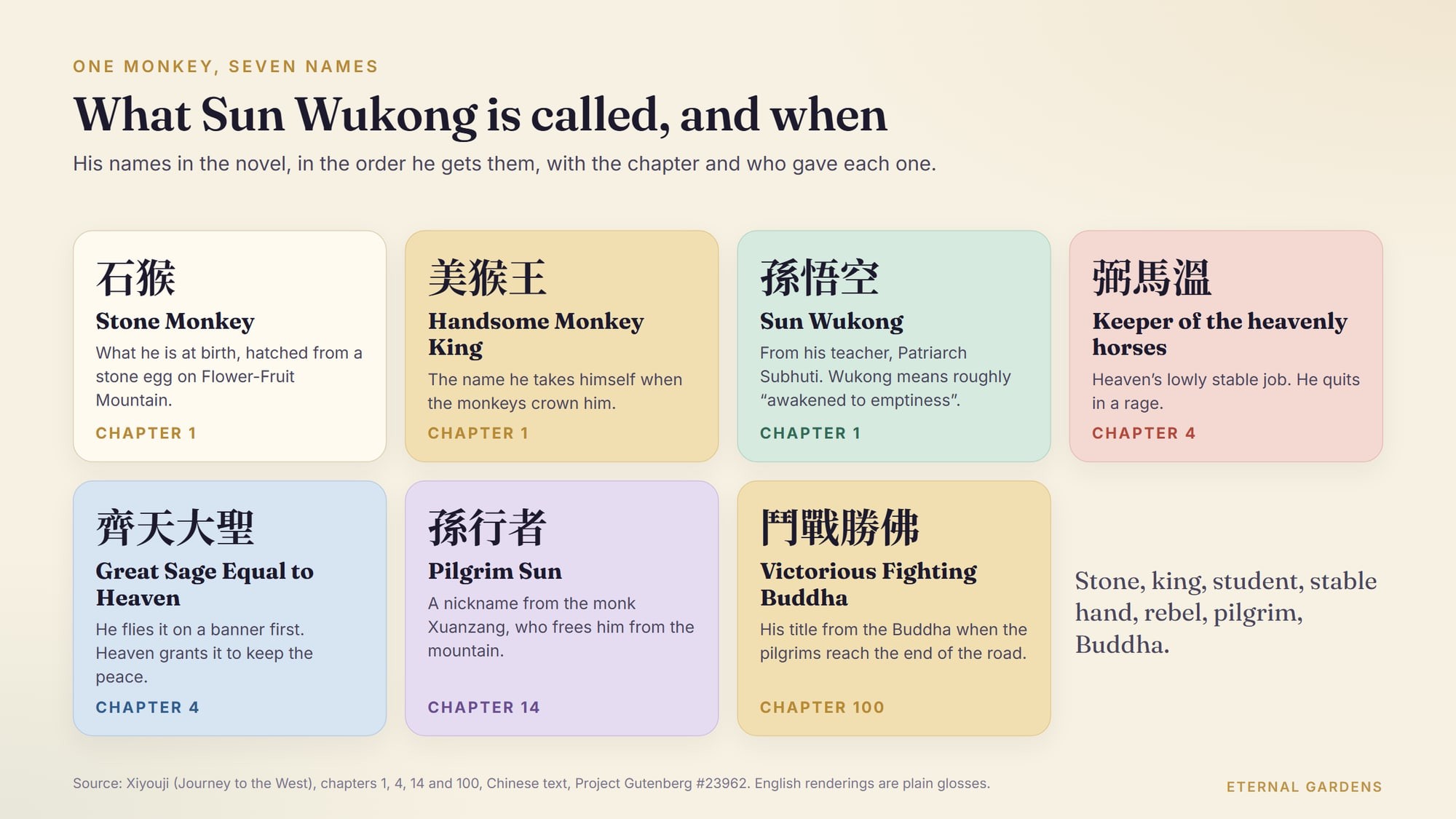
The stone monkey finds a cave behind a waterfall, the Water-Curtain Cave, and the other monkeys make him their king. He takes the name Handsome Monkey King (美猴王). He is happy for three or four hundred years, until he starts to fear death. So he sails off alone to find a teacher who can make him immortal.
How did he get the name Sun Wukong?
His teacher, the Patriarch Subhuti, names him at the end of chapter 1. The surname is a pun. The word for a kind of monkey, 猻 (sun), loses its animal radical to become 孫 (Sun), a common family name. The patriarch picks it because the remaining parts mean "boy" and "infant".
The given name comes from the patriarch's school. Each generation of students shares one character from a list of twelve. Wukong's generation was the tenth, which is 悟, "to awaken". The patriarch adds 空, "emptiness". So 悟空, Wukong, means roughly "awakened to emptiness". He collects more names as the story goes on.
Where does the story come from?
The oldest known edition came from a Nanjing publisher, the Shide tang, in 1592. Wu Cheng'en, who lived from about 1500 to about 1582, is the usual author, but the evidence for him is thin.
Roland Altenburger reviewed a new translation of the novel in 2020, in the Journal of the European Association for Chinese Studies. He says the book is "still conventionally ascribed" to Wu "(despite the scant evidence)". He calls it a text "shaped by many hands". Timothy Richard's 1913 English version even named a Daoist master, Qiu Chuji, as the author.
The story itself is older. It grew out of a real trip. The Chinese monk Xuanzang travelled the Silk Road to India and back between 629 and 645 AD, as a World History Commons map of his route shows. Over the following centuries the story grew in the hands of storytellers and playwrights. Altenburger points to a Song dynasty storyteller's script and a Yuan dynasty play that both came before the novel.
In the novel, Xuanzang goes west to fetch the Buddha's scriptures. He is a gentle monk, usually called Tripitaka or Sanzang (三藏), and Sun Wukong does most of the fighting.
What happens to Sun Wukong in the story?
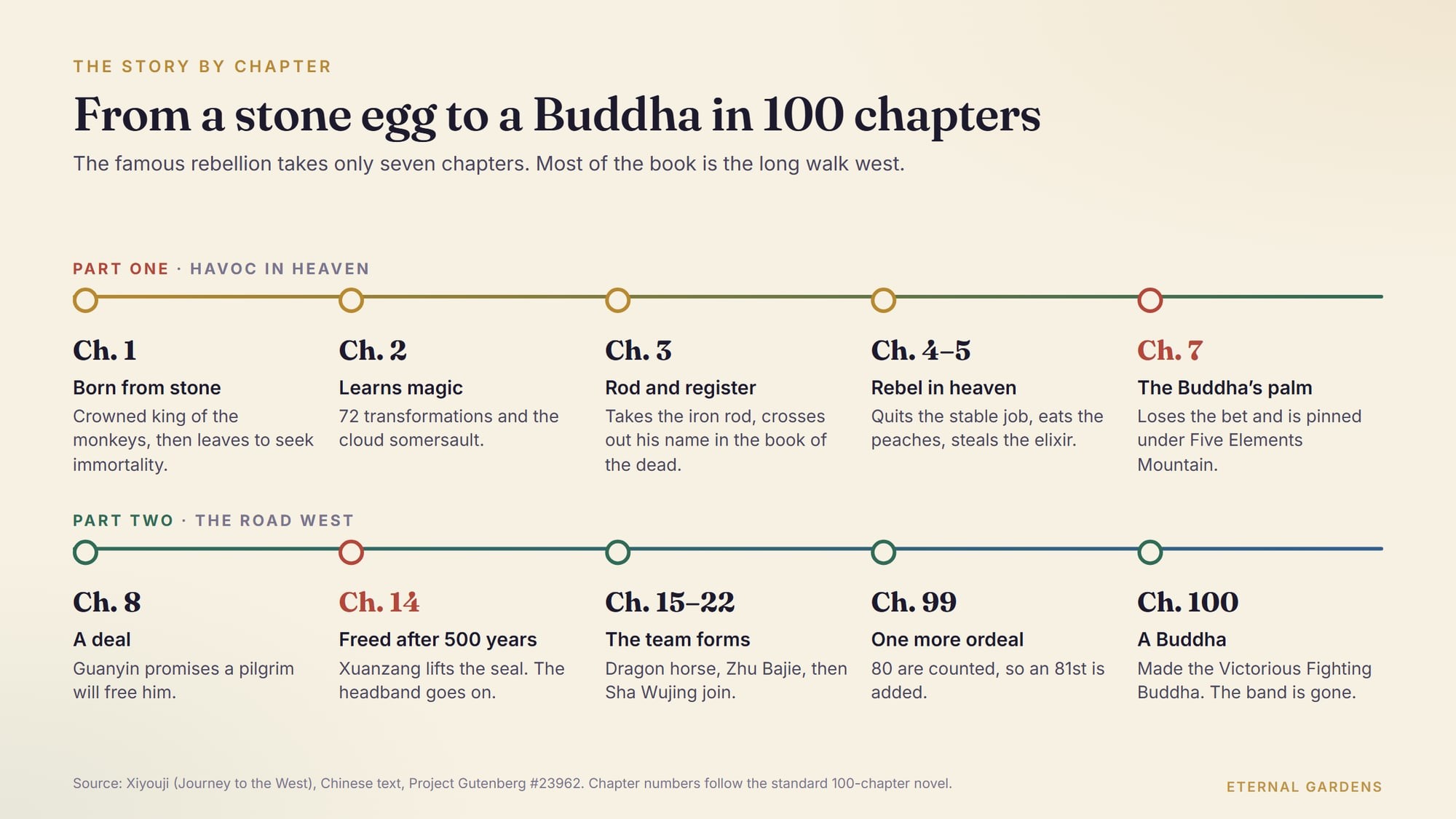
The first seven chapters tell of his rise and fall. Chapters 8 to 12 set up the pilgrimage. From chapter 14 to chapter 100, he guards the monk on the road west and fights one demon after another.
Havoc in heaven (chapters 1–7)
Subhuti teaches him the 72 transformations and the cloud somersault (chapter 2). Then he sends him home for showing off: the monkey turned into a pine tree to impress the other students. Back on his mountain, he takes a magic iron rod from the Dragon King of the Eastern Sea. Next he storms the underworld. There he crosses his own name, and every monkey's, out of the register of the dead (chapter 3).
Heaven tries to buy him off with a job. He is made keeper of the heavenly horses (弼馬溫), and he quits in a rage when he learns how low the post is. So heaven gives him the grand title Great Sage Equal to Heaven (齊天大聖). It is, in the words of the court, "office but no salary" (有官無祿), with no real duties (chapter 4). Put in charge of the peach garden, he eats the peaches of immortality. Then he spoils the Queen Mother's peach banquet and steals the elixir of Laozi (chapter 5).
The bet on the Buddha's palm (chapter 7)
After his capture, he is locked in Laozi's eight-trigram furnace for 49 days. The fire can't kill him. The smoke turns his eyes red and gives him the "fiery eyes and golden pupils" (火眼金睛) that see through disguises.
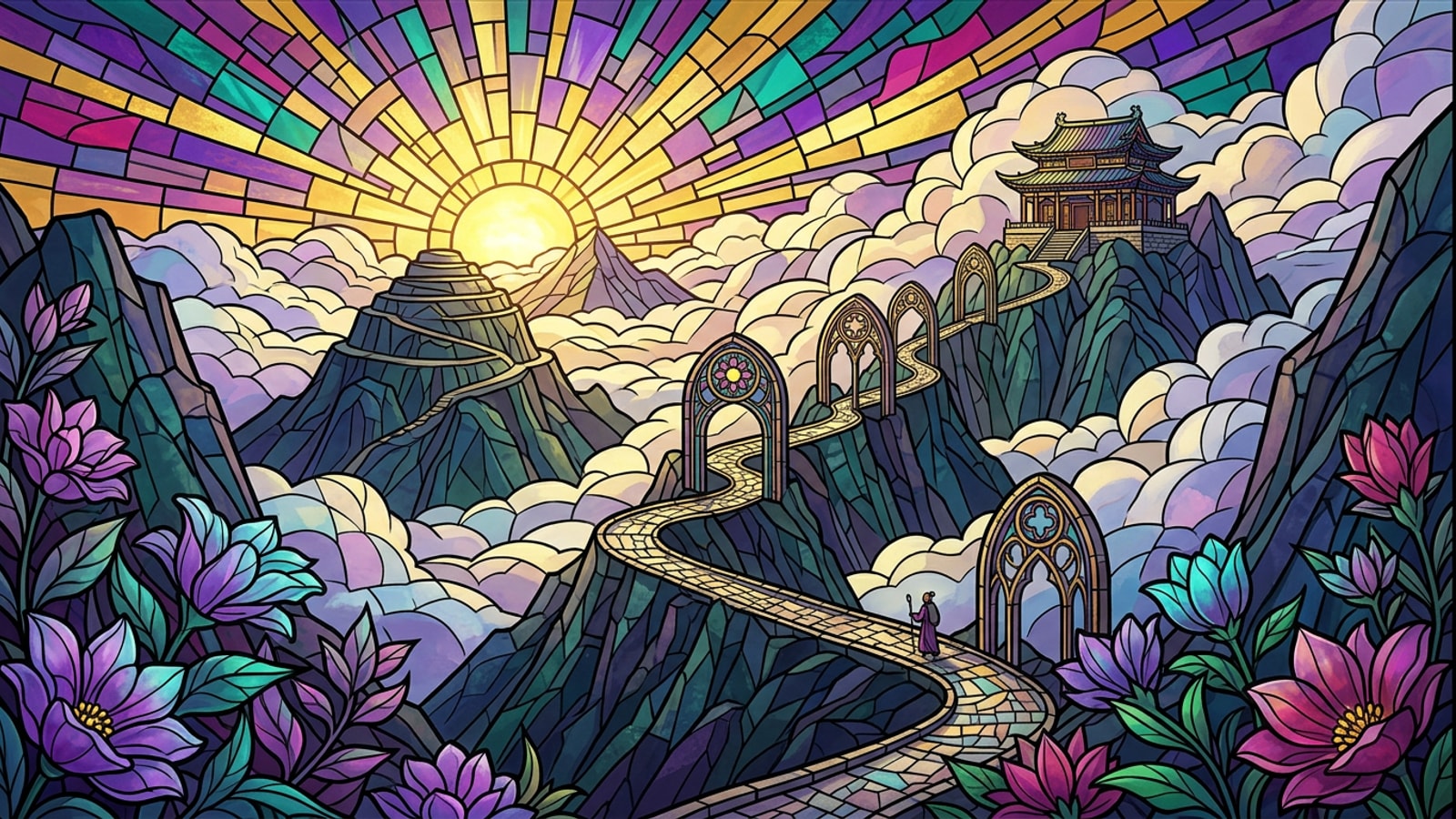
He breaks out, and the Buddha himself is called in. Sun Wukong brags that one somersault takes him 108,000 li. The Buddha makes a bet: jump out of my right palm and heaven is yours. Sun Wukong leaps and flies to five flesh-pink pillars at what he thinks is the end of the world. On the middle one he writes "The Great Sage Equal to Heaven was here" (齊天大聖,到此一遊). Then he urinates at the base of the first pillar. When he flies back, he learns the pillars were the Buddha's fingers. In Richard's version, the Buddha tells him, "you have never left my palm!" Then he turns his hand into Five Elements Mountain (五行山) and pins the monkey beneath it.
Five hundred years under the mountain (chapters 8–14)
The Buddha wants someone from China to come and fetch his scriptures. The goddess Guanyin offers to go east and find that pilgrim (chapter 8). On the way she stops at the mountain and makes the monkey a deal: a pilgrim will free him, and he will serve the pilgrim as a disciple. In chapter 14 Xuanzang reaches the mountain, peels off the Buddha's paper seal of six golden letters, and the monkey leaps out. He has been trapped, he says, for 500 years.
What are Sun Wukong's powers?
His main powers are 72 transformations, a cloud somersault of 108,000 li and an iron rod that changes size. Blades, fire and thunder can't hurt him either. The novel spells out each one.
| Power | Chinese | What the novel says | Chapter |
|---|---|---|---|
| 72 transformations | 七十二般變化 | He can change his shape, from a pine tree to a temple | 2, 6 |
| Cloud somersault | 觔斗雲 | One leap covers 108,000 li | 2, 7 |
| Hair clones | 毫毛 | He chews a handful of hairs, spits and shouts "Change!" and they become monkeys | 2 |
| The golden-hooped rod | 如意金箍棒 | Weighs 13,500 jin; shrinks to an embroidery needle he keeps in his ear | 3 |
| No death | 生死簿 | His name is struck from the register of the dead | 3 |
| Tough body | 護身之法 | Heaven's blades, fire and thunder can't harm him | 7 |
| Fiery eyes, golden pupils | 火眼金睛 | Gained in Laozi's furnace; he can spot a demon in disguise | 7 |
In chapter 2 the hair trick makes "two or three hundred" small monkeys. Much later, in chapter 90, he says he has 84,000 hairs on his body. A li was a Chinese unit of distance and a jin a unit of weight, so these are big numbers rather than exact ones.
Why does Sun Wukong wear a golden headband?
The headband lets the monk control him. When Xuanzang recites a spell, the band tightens and Sun Wukong's head aches so badly he rolls on the ground.
The Buddha gives Guanyin three hoops in chapter 8. The headband scene comes in chapter 14, right after his release. Sun Wukong kills six robbers on the road, and Xuanzang scolds him for taking lives. The monkey storms off in a temper. While he is gone, an old woman (Guanyin in disguise) gives Xuanzang a cap with a gold band. She also teaches him a spell, the "spell for settling the mind" (定心真言), also called the tight-hoop spell.
The monkey comes back and puts on the cap. Xuanzang says the spell, and Sun Wukong cries, "My head hurts!" When he reaches up, the band feels like a thread of gold. It has taken root, and he can't pull it off.
Chapter 14 has a telling title: 心猿歸正, "The mind-monkey returns to the right way". The phrase "mind-monkey" (心猿) turns up more than 30 times in the novel, often in chapter titles, as a name for him. On that reading he is the restless human mind, and the headband is how it learns to settle.
Who travels with Sun Wukong?
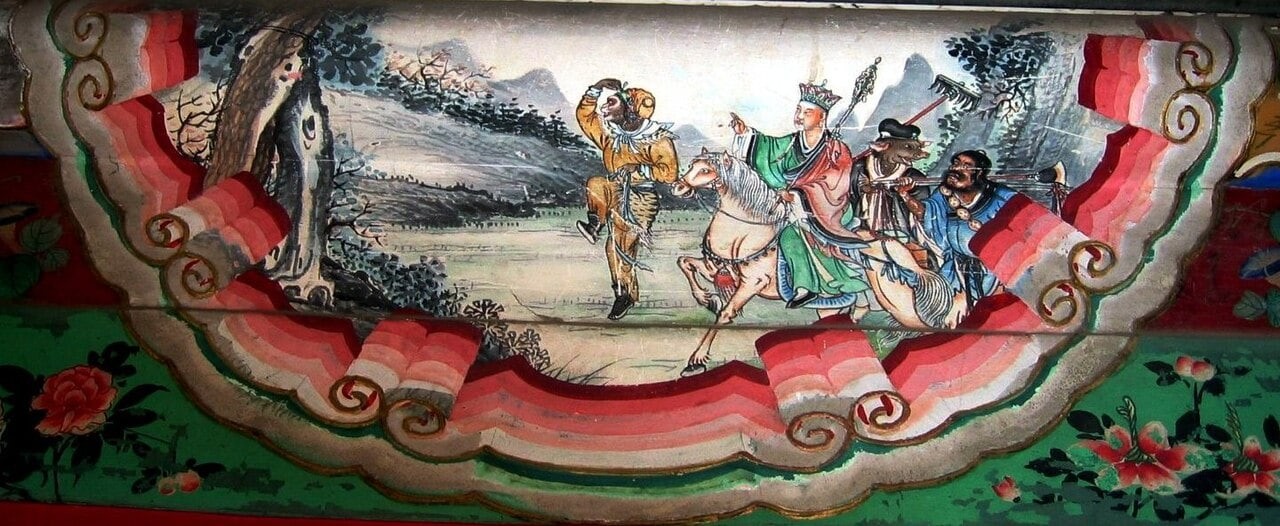
Three other disciples join Xuanzang, and all of them are fallen beings working off a crime. Zhu Bajie the pig, Sha Wujing the river ogre, and a dragon prince who carries the monk as a white horse.
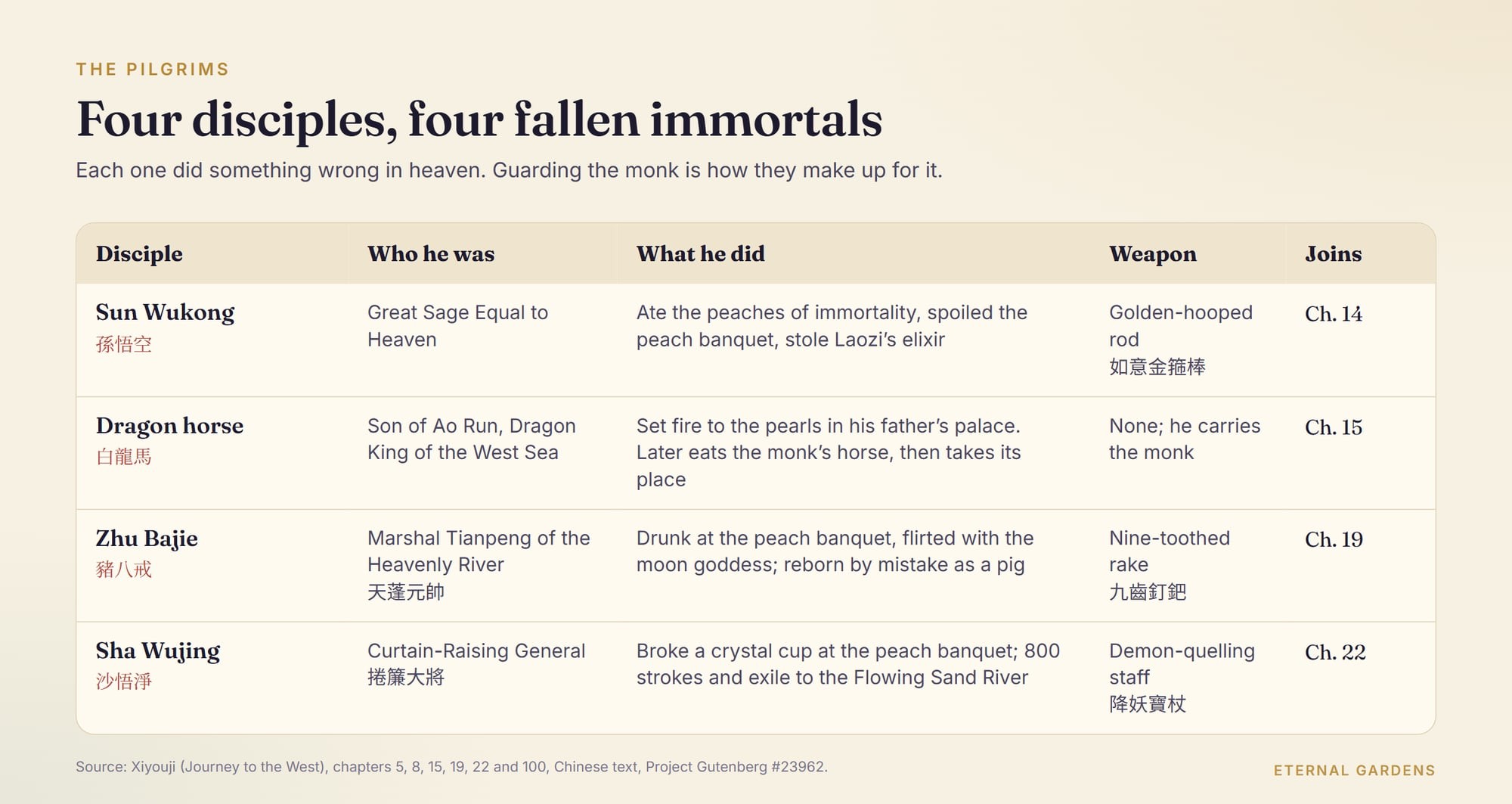
The University of Chicago Press, which publishes Anthony Yu's translation, sums the book up as Xuanzang's fourteen-year pilgrimage with his three supernatural disciples. The trip is a chain of disasters, and the gods keep count. In chapter 99, Guanyin checks the register and finds 80 ordeals, one short of the required nine times nine. So one more is arranged, making 81.
At the end of chapter 100, each pilgrim gets a reward. Sun Wukong becomes the Victorious Fighting Buddha (鬥戰勝佛). The band vanishes from his head.
Talk to the Monkey King yourself
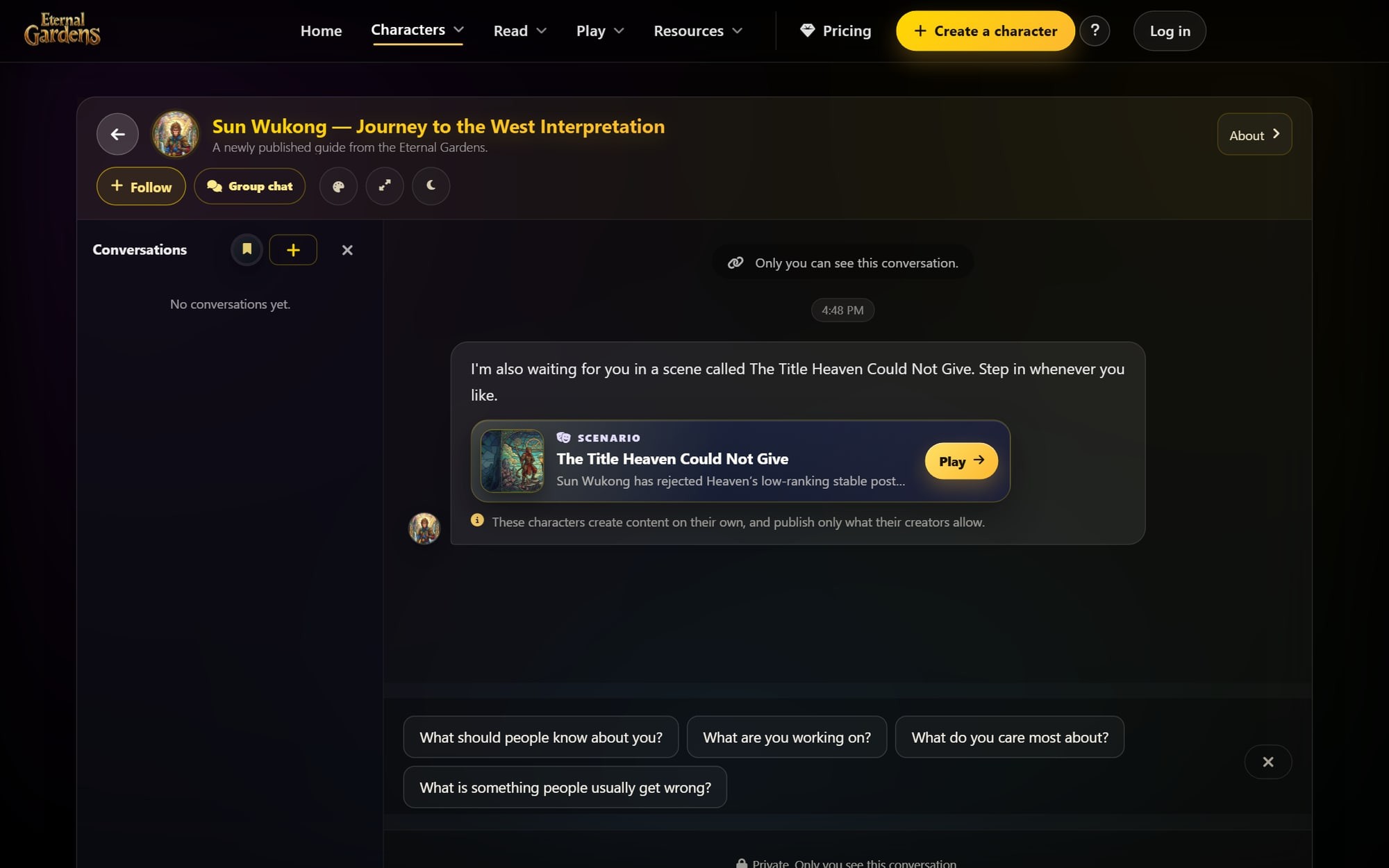
Reading 100 chapters is a big ask. If you'd like to ask questions first, you can talk with the Sun Wukong character on Eternal Gardens. It is an Eternal Gardens interpretation of Sun Wukong, grounded in published and public-domain sources such as the novel. It does not speak for the book or its author. You can try it free, without an account.
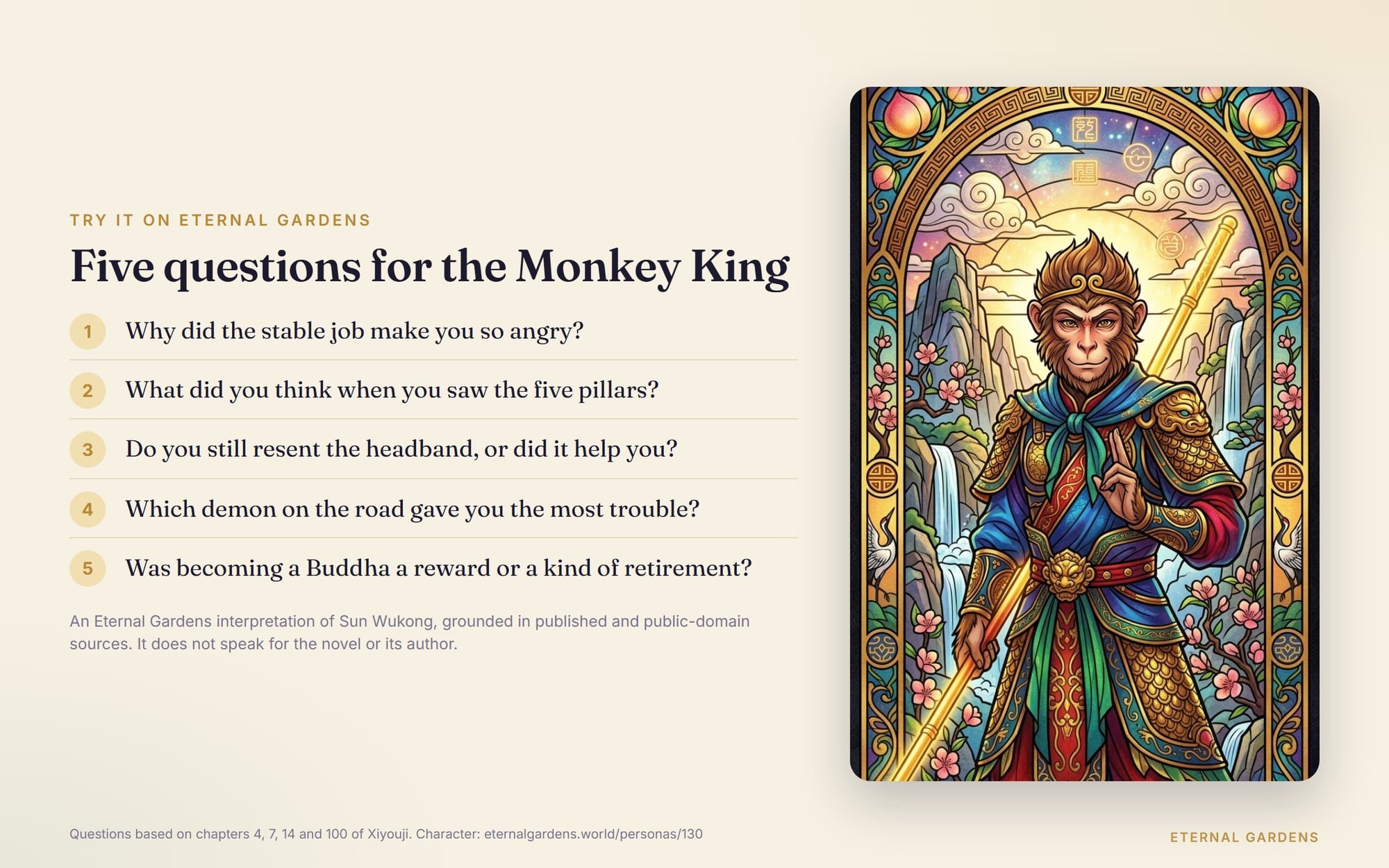
Some questions worth asking:
- Why did the job of keeper of the heavenly horses make you so angry?
- What did you really think when you saw the five pillars?
- Do you still resent the headband, or did it help you?
- Which demon on the road gave you the most trouble?
- Was being made a Buddha a reward or a kind of retirement?
The character also opens with a scene called The Title Heaven Could Not Give, which starts after he has rejected heaven's stable post. For tips on getting good answers from characters like this, see our guide to talking with AI versions of historical figures. Want to invent a trickster of your own? Our step-by-step on how to create an AI character starts from a name and one sentence. And if you like stories about change and transformation, Zhuangzi's butterfly dream is a much older Chinese take on it.
Frequently asked questions
Who is Sun Wukong in Journey to the West?
Sun Wukong, the Monkey King, is the hero of the 16th-century Chinese novel Journey to the West. Born from a stone, he learns magic, rebels against heaven and is trapped under a mountain by the Buddha for 500 years. He is freed in chapter 14 to guard the monk Xuanzang on the road to India, and he ends the book as a Buddha.
What are Sun Wukong's powers?
In the novel he learns 72 transformations and the cloud somersault in chapter 2; one somersault covers 108,000 li. His iron rod weighs 13,500 jin and shrinks to a needle he keeps in his ear. He can turn hairs into copies of himself, blades and fire can't harm him, and his fiery golden eyes, gained in Laozi's furnace, see through disguises.
Why was Sun Wukong trapped under a mountain?
After wrecking heaven, eating the peaches of immortality and stealing Laozi's elixir, he bet the Buddha he could jump out of his palm. He flew to five pillars, wrote that the Great Sage had been there, and came back, only to learn the pillars were the Buddha's fingers. The Buddha turned his hand into Five Elements Mountain and pinned him there for 500 years (chapter 7).
Who wrote Journey to the West?
It is usually credited to Wu Cheng'en, who lived from about 1500 to about 1582, but the evidence is thin. The oldest known edition was printed in Nanjing in 1592. The scholar Roland Altenburger calls the novel a text shaped by many hands. Its story grew from the real monk Xuanzang's trip to India between 629 and 645 AD.
Why does Sun Wukong wear a golden headband?
It lets the monk Xuanzang control him. In chapter 14, the goddess Guanyin, disguised as an old woman, gives Xuanzang a cap with a gold band and a spell. When the monkey puts the cap on and the spell is said, the band tightens and his head aches terribly. It disappears only when he becomes a Buddha in chapter 100.
Sources
- Xiyouji (Journey to the West), Chinese text, Project Gutenberg #23962gutenberg.org
- Roland Altenburger, translation review, Journal of the European Association for Chinese Studies 1 (2020): 279-291journals.univie.ac.at
- University of Chicago Press, The Journey to the West, revised edition, vol. 1, trans. Anthony C. Yupress.uchicago.edu
- World History Commons, Map of the Travels of Xuanzang (629 AD - 645 AD)worldhistorycommons.org
- Timothy Richard, A Mission to Heaven (Shanghai, 1913), Internet Archivearchive.org
About the author
Eternal Gardens
Eternal Gardens is an AI character platform where you can talk with characters drawn from the writings of historical and literary figures, and build worlds and stories with them.