AI marketing tool data privacy: what is safe to share?
Six questions for any vendor, what never to paste, and what PIPEDA and Québec's Law 25 expect from you, in plain words.
By Réson
8 min read
In this article
- Is it safe to put business data into an AI marketing tool?
- What should you never paste into an AI tool?
- Strip names before you ask
- AI marketing tool data privacy: six questions for any vendor
- What do Canadian privacy laws expect from you?
- PIPEDA, the federal law
- Québec's Law 25
- What if customer data ends up somewhere it shouldn't?
- How can you use AI for marketing without sharing customer data?
- A worked example: reading Réson's privacy policy
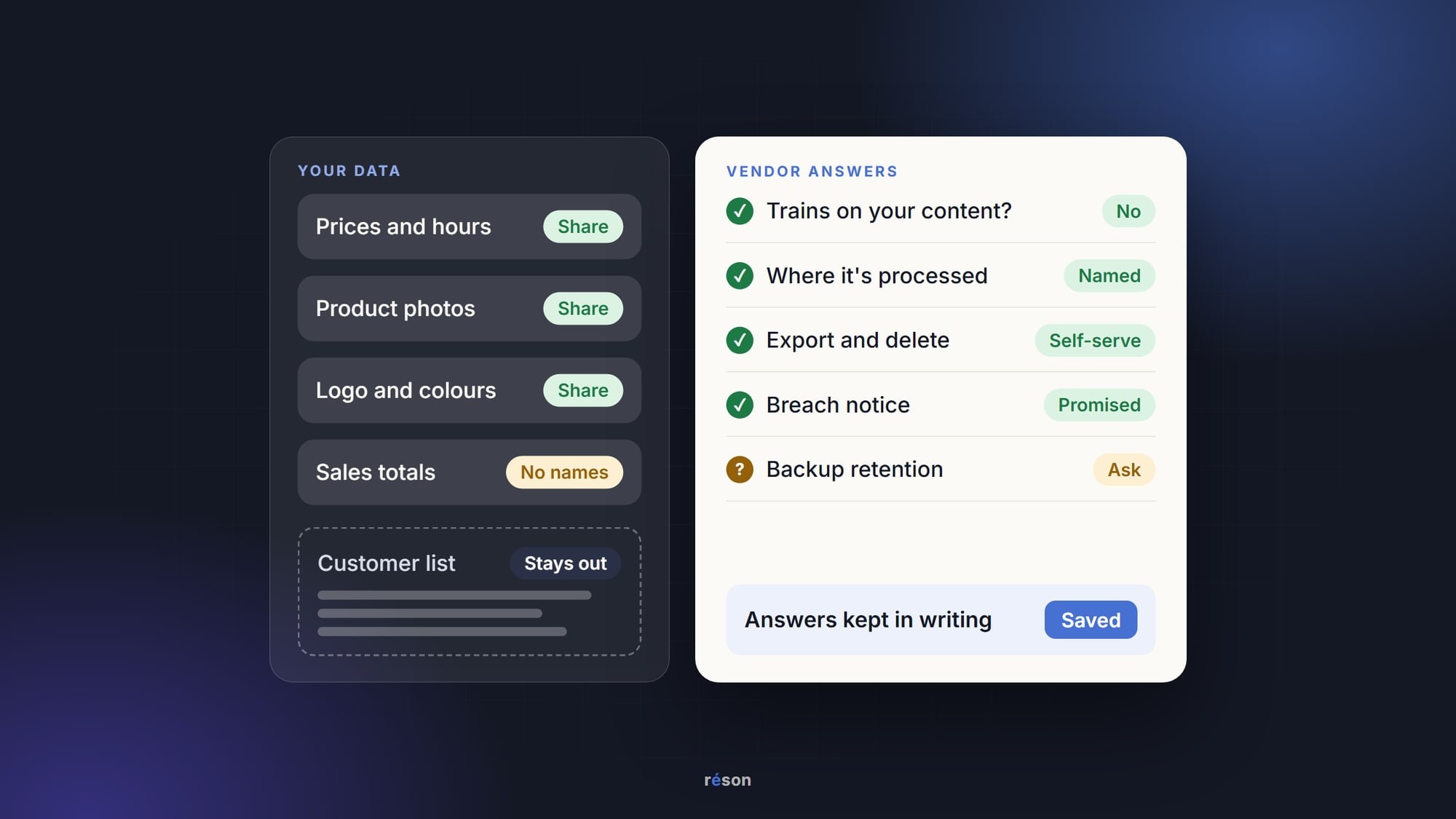
Yes, it can be safe, if you pick the tool with care and limit what goes in. For AI marketing tool data privacy, get written answers on four points. Ask whether your data trains the vendor's models and where it is processed. Then ask how long it is kept and how you delete it. Most marketing work needs no customer personal information at all.
One more thing before you start. In Canada, the business that collects customer information stays responsible for it, even after it goes into someone else's software. This guide explains what that means in plain words. It draws on pages from the federal privacy commissioner and from Québec's privacy regulator. It is general information, not legal advice. Before you decide anything about sensitive data, talk to a lawyer.
Is it safe to put business data into an AI marketing tool?
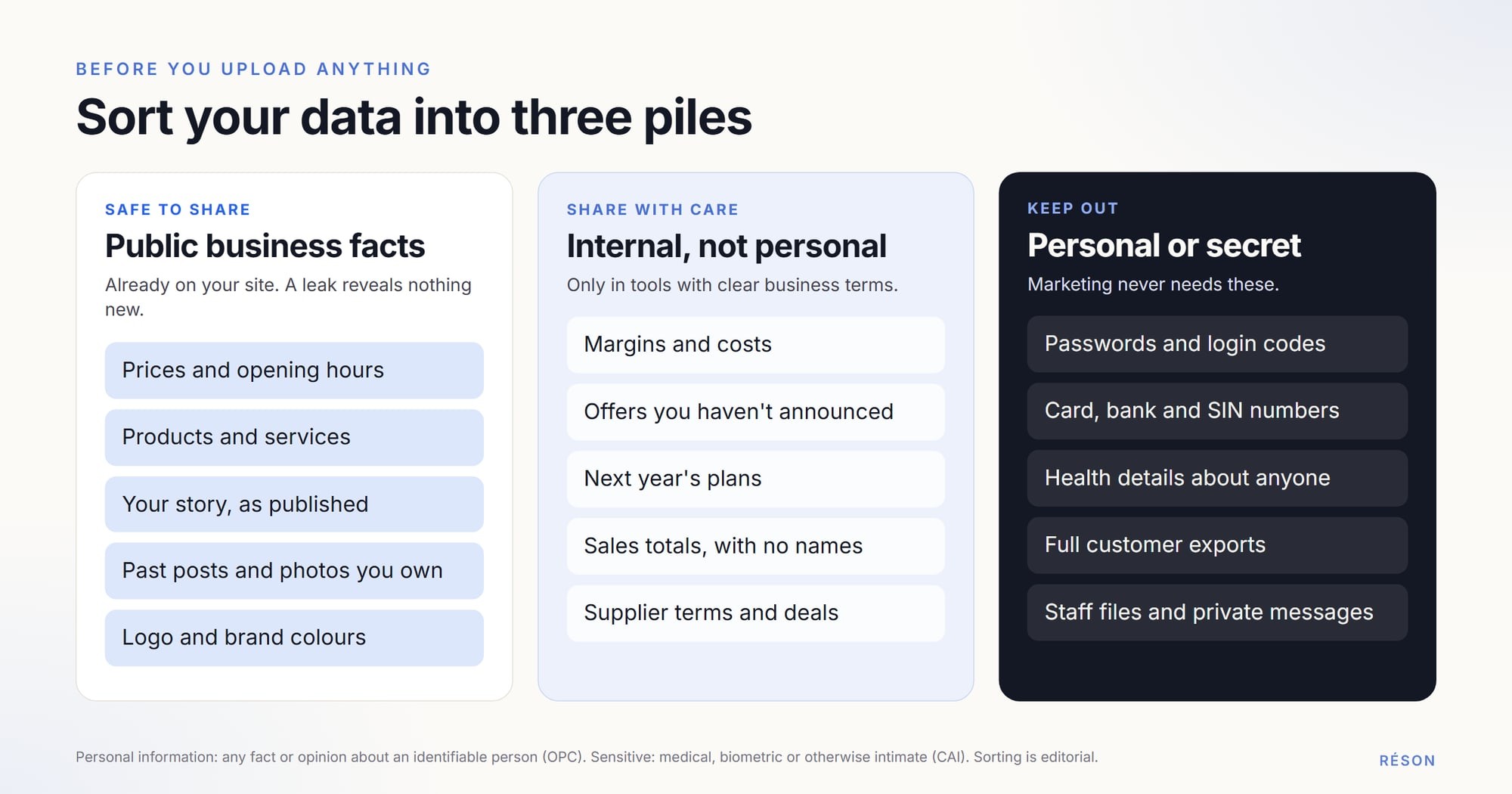
Your public business facts are low risk. The real risk sits with customer personal information. Sort what you have into those two piles before you upload anything.
Public facts are already on your website. Think of prices and opening hours. An AI tool needs them to write about you, and a leak would reveal nothing new. Internal details sit in the middle. Your margins or an offer you haven't announced are not personal. Still, you would not want a competitor to read them, so keep them to tools with clear business terms.
Customer personal information is different. The federal privacy law is called PIPEDA. Under it, personal information means any fact or opinion about a person who can be identified. A list of names and emails counts. So does a note that a customer plans to buy a new car next spring.
What should you never paste into an AI tool?
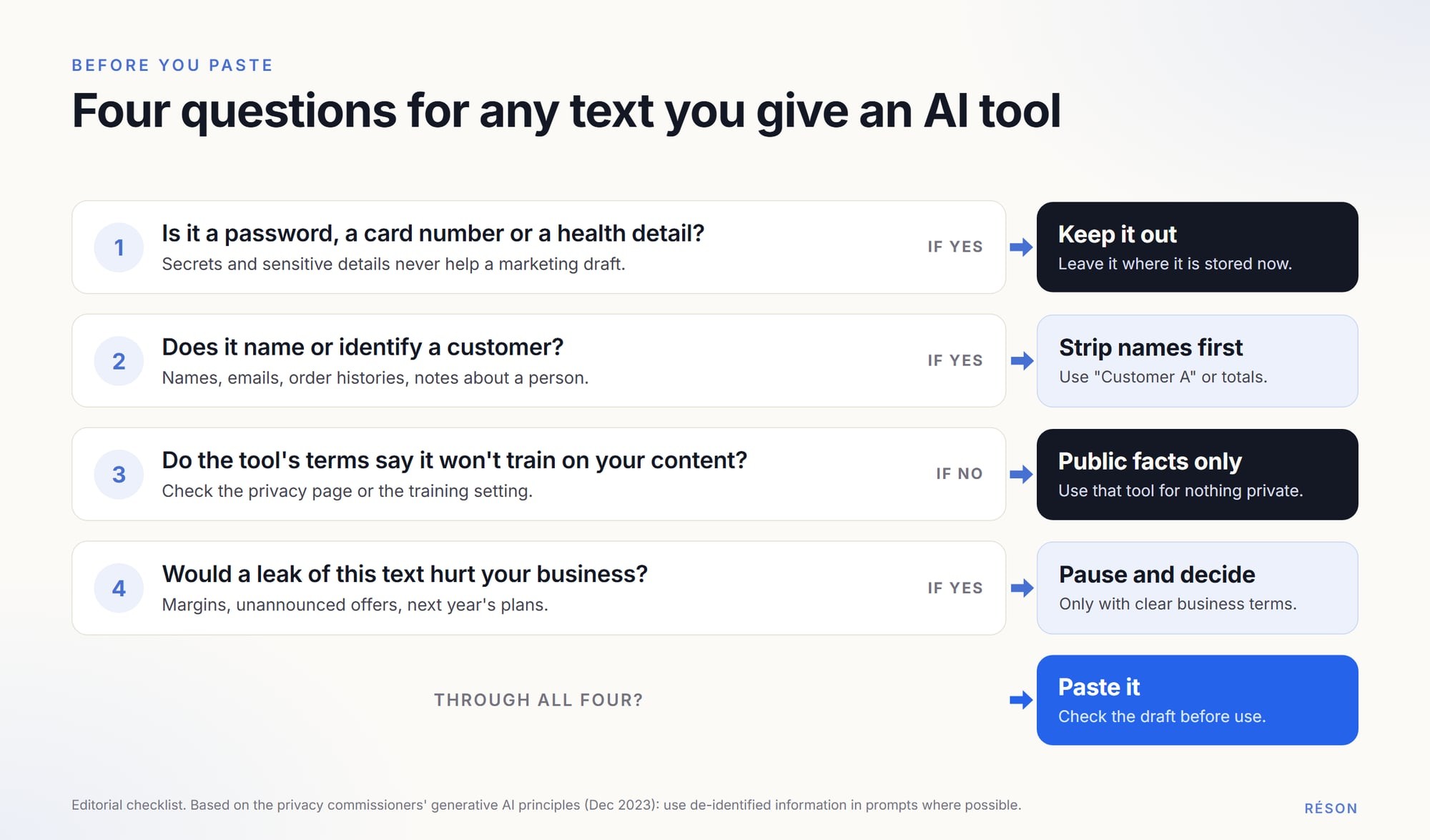
Keep out anything that could hurt a person, or your business, if a stranger read it. Passwords and card numbers are the obvious ones. Sensitive customer details belong on the same list, and marketing never needs them.
Here is a list to keep near the desk:
- Passwords and login codes, including in screenshots.
- Card numbers and banking details.
- Social Insurance Numbers.
- Health details, such as a client's allergy notes.
- A full customer export from your till or CRM, uploaded "just to see what the AI finds".
- Private messages from other people, or staff files.
- Client documents covered by a confidentiality agreement.
Québec's privacy regulator is the Commission d'accès à l'information (CAI). Its definition page calls information sensitive when it is medical or biometric, or otherwise intimate. Its examples include health and religious beliefs, as well as a person's finances. The same page makes a point that is easy to miss. The CAI considers information that an AI system generates or infers about a person to be personal information. So an AI "profile" of a named customer falls under the law, even if you never typed a word of it.
Strip names before you ask
Canada's privacy commissioners published principles for generative AI in December 2023. They ask organizations to use anonymized or de-identified information in prompts where they can. When personal information has to go in, they set a limit: "Where personal information (and, in particular, sensitive or confidential information) must be entered into a prompt, only do so where authorised."
In practice, ask about patterns, not people. "Write a thank-you email for a customer who bought two bikes this year" works as well as pasting a real name and order history. Replace names with "Customer A". Summarize a spreadsheet yourself and share only the totals.
AI marketing tool data privacy: six questions for any vendor
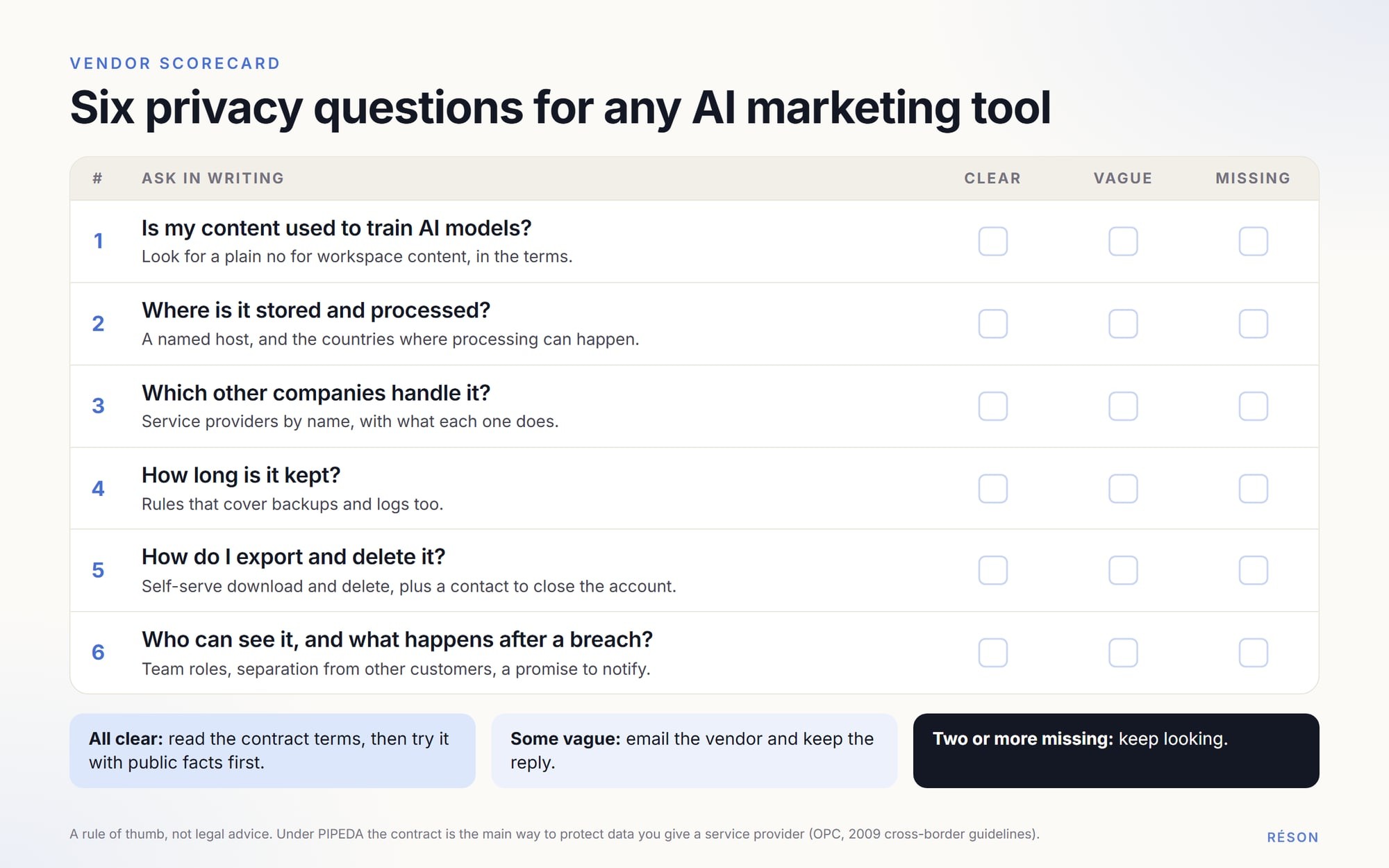
Ask every vendor these six questions and keep the answers. A good vendor answers most of them on its privacy page or in its terms, in plain words.
| Question | A good answer | A warning sign |
|---|---|---|
| Is my content used to train AI models? | A clear no for your workspace content, in the terms | "May be used to improve our services", with no way to opt out |
| Where is my data stored and processed? | A named hosting provider and the countries where processing can happen | No location at all |
| Which other companies handle my data? | A list of service providers and what each one does | "Trusted partners", with no names |
| How long do you keep it? | Retention rules that cover backups and logs too | Nothing on retention |
| How do I export and delete it? | Self-serve download and delete, plus a contact to close the account | Deletion "on request" with no contact |
| Who can see it, and what happens after a breach? | Team roles, separation from other customers, a promise to notify | No mention of incidents |
Get the answers in writing. The privacy policy and terms are best, and an email will do. A sales call is not enough. As the next section explains, the contract is your main way to protect information you hand to a service provider.
What do Canadian privacy laws expect from you?
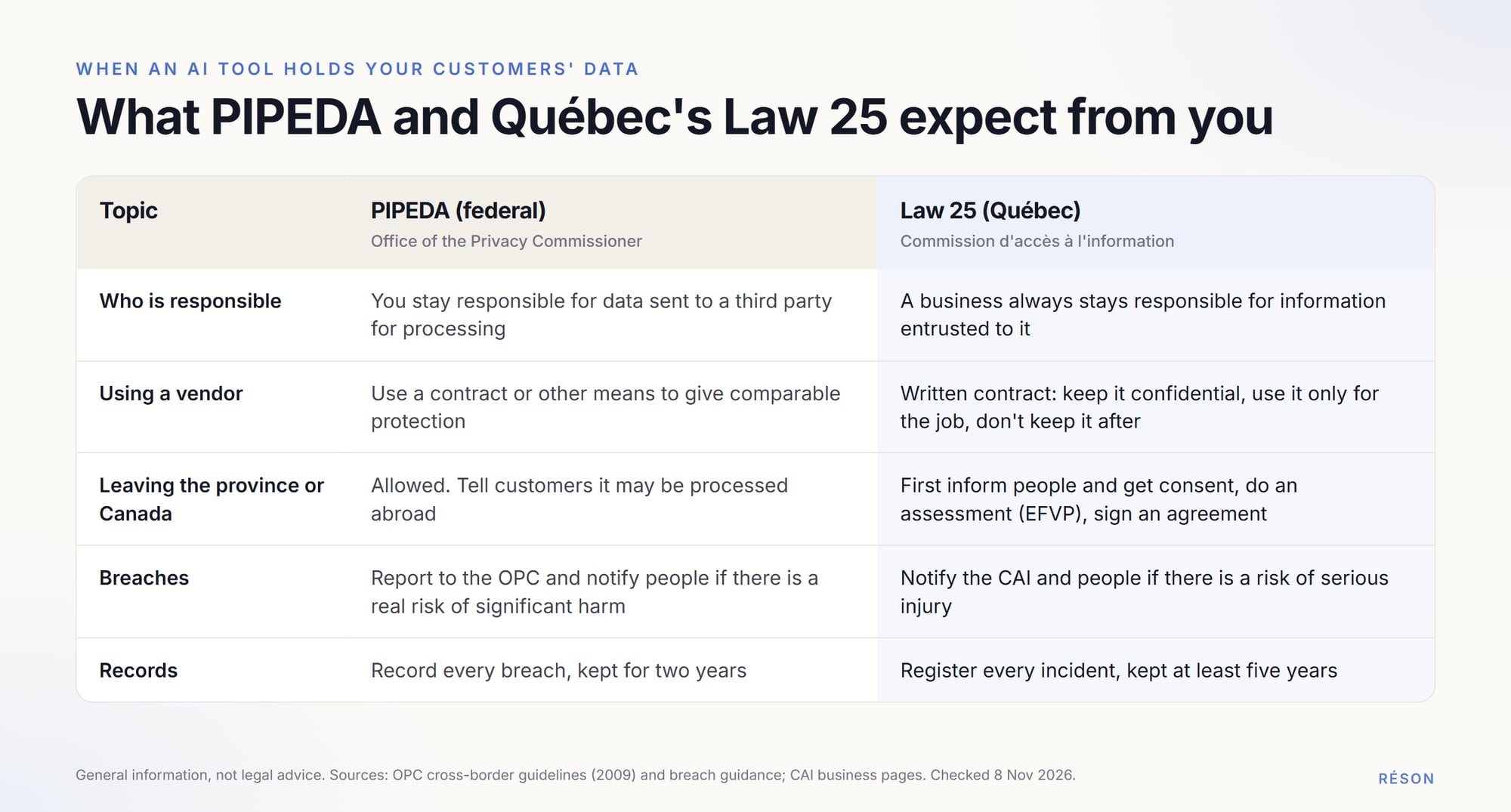
Both PIPEDA and Québec's private-sector law put the duty on you, the business that holds the information. Picking a well-run tool helps, but the responsibility does not move to the vendor.
PIPEDA, the federal law
The Office of the Privacy Commissioner of Canada (OPC) says PIPEDA covers private businesses that handle personal information in commercial activity. Québec has its own private-sector law. So do Alberta and British Columbia. In those three provinces, the provincial law generally applies instead for activity inside the province. But information that crosses a provincial or national border falls under PIPEDA wherever you are based.
The OPC's 2009 guidelines for processing personal data across borders explain how this works with a service provider. You may send data to a software company for processing, whether it is in Canada or abroad. You stay responsible, though. You must use "contractual or other means" to give the data a comparable level of protection.
The guidelines add that no contract can override another country's laws. So the OPC says businesses need to tell customers, in clear language, that their information may be processed abroad. There, it may be open to that country's law enforcement and national security authorities.
If the vendor has a breach, the OPC's breach guidance treats you as the one in control of the data. You report a breach to the OPC when it poses a real risk of significant harm, and you notify the people affected. You also keep a record of every breach for two years, even minor ones.
Québec's Law 25
The CAI's page on using and sharing personal information sets extra steps before information leaves Québec. "Outside Québec" includes other provinces. It also covers hiring a company outside Québec to keep or use the information for you.
Before that happens, the CAI lists these duties:
- Inform the people concerned and get their consent.
- Do a privacy impact assessment, called an EFVP, that shows the information will be properly protected.
- Sign a written agreement with the company.
The page adds that a business always stays responsible for the information entrusted to it.
By default, the person with the highest authority in the business is in charge of personal information. The role can be delegated in writing, and the person's title and contact details must be on your website. The CAI's page on confidentiality incidents adds two duties. You keep a register of every incident for at least five years. When an incident carries a risk of serious injury, you notify the CAI and the people concerned. Both duties still apply when a third party was holding the data. For consent rules on marketing email in Québec, see our French guide to email marketing under the anti-spam law and Law 25.
What if customer data ends up somewhere it shouldn't?
Act fast, then write it down. Ask the vendor to delete the data, and change any password that was exposed. Then judge the risk to the people involved.
The CAI suggests six quick questions for that judgment. Who is affected, and are they staff or customers? How many people? What kind of information, and is it sensitive? When did it happen, and when did you find out? Where did it happen? At your business, or at a supplier? And why did your safeguards fail?
If the answers point to a risk of serious harm, the reporting duties above apply. Either way, the incident goes in your register or breach record. The CAI counts any use or sharing the law doesn't allow as an incident. A teammate pasting a client list into a personal chatbot account can fit that definition.
How can you use AI for marketing without sharing customer data?
Feed the tool facts about your business, and keep facts about your customers where they already live. Most marketing tasks work fine that way.
- Build a fact sheet from public information, such as your website and price list. Our guide to a business knowledge pack shows what to put in it.
- Share totals, not exports. "Most orders come in on Fridays" helps a campaign plan as much as the raw sales file does.
- Keep your mailing list in your email service, next to its consent records. Our CASL checklist for small businesses covers consent for email.
- In a general chatbot, use a plan whose terms say your chats don't train its models, or switch that setting off. Our comparison of ChatGPT and dedicated marketing tools shows where that setting is.
- Give each teammate a separate login with the lowest role they need. Remove people the day they leave.
- Add a line to your own privacy policy. Say which kinds of tools process customer data, and in which countries.
A worked example: reading Réson's privacy policy
Réson is an AI marketing workspace for small businesses in Canada and Québec. Here is how its privacy policy answers the six questions, as of 8 November 2026.
| Question | What Réson's policy says |
|---|---|
| Training | "We don't use your workspace content to train AI models." |
| Location | Stored on Google Cloud; some processing, in particular by AI services, may happen outside Québec and Canada, including the US |
| Providers | Google Cloud Vertex AI, Google Cloud hosting, Google sign-in, Stripe |
| Retention | Kept while the account is active; backup copies of deleted items are overwritten over time |
| Deletion | Delete items in the app; email privacy@resonai.world to delete the workspace |
| Access and incidents | Owner, admin, editor and viewer roles; notice of serious incidents as the law requires |
For a Québec business, the location line matters most. If you add customer contacts, check how the outside-Québec steps above apply to you. The policy also says plainly: "No system is perfectly secure." Ask any vendor, Réson included, about backup timing before you rely on it.
Réson builds your profile from your website or a few files, so you can plan campaigns without uploading a customer list. You can start a free 14-day Réson trial with no credit card, and plans then start at CA$79 a month.
Frequently asked questions
Is it safe to put customer data into an AI marketing tool?
It can be, but most marketing doesn't need customer data. Prices, products and past posts are enough to write campaigns. If you do add customer information, pick a tool whose terms say your content won't train its models and that names where data is processed. In Canada you stay responsible for that information, so keep the vendor's answers in writing. This is general information, not legal advice.
Do AI marketing tools use my data to train their models?
Some do and some don't, and it can differ between free and business plans. Look for a plain statement in the privacy policy or terms, such as "we don't use your content to train AI models". Canada's privacy commissioners say providers should tell users when prompts are used to train or refine a model. If the policy is vague, email the vendor and keep the reply.
Can a Canadian business use an AI tool that processes data in the United States?
Under PIPEDA, yes. The OPC's guidelines say transfers for processing are allowed, but you stay responsible and must protect the data by contract. You also need to tell customers their information may be processed abroad. In Québec, the CAI lists extra steps before information leaves the province, including a privacy impact assessment and a written agreement. Ask a lawyer about your own case.
What should I never paste into ChatGPT or another AI tool for my business?
Keep out passwords and login codes, card and bank numbers, Social Insurance Numbers and health details. Don't upload full customer exports, staff files or documents under a confidentiality agreement. For marketing, replace names with "Customer A" and share totals instead of raw records. Québec's CAI also considers information an AI infers about a person to be personal information.
Where does Réson store and process data?
Réson's privacy policy says information is stored on Google Cloud infrastructure, and that some processing, in particular by AI services, may take place outside Québec and Canada, including in the United States. It says Réson doesn't use workspace content to train AI models and uses Google Cloud Vertex AI for AI tasks. Questions go to privacy@resonai.world.
Sources
- PIPEDA requirements in brief (OPC)priv.gc.ca
- Principles for responsible, trustworthy and privacy-protective generative AI technologies (OPC and provincial/territorial commissioners, 2023)priv.gc.ca
- Guidelines for processing personal data across borders (OPC, 2009)priv.gc.ca
- What you need to know about mandatory reporting of breaches of security safeguards (OPC)priv.gc.ca
- Utilisation et communication de renseignements personnels (CAI)cai.gouv.qc.ca
- Incidents de confidentialité et mesures de sécurité (CAI)cai.gouv.qc.ca
- Responsabilité des entreprises (CAI)cai.gouv.qc.ca
- Qu'est-ce qu'un renseignement personnel? (CAI)cai.gouv.qc.ca
- Réson Privacy Policyresonai.world
About the author
Réson
Réson is an AI marketing workspace for small businesses. It learns your business from your website, drafts posts, campaigns and articles, and waits for your approval before anything goes out.