How to get your business cited by ChatGPT: what OpenAI documents, and four fixes
Crawler access, sentences an answer can quote, matching profiles and real FAQs, with a small case study from Réson's own site.
By Réson
7 min read
In this article
- What counts as being cited by ChatGPT?
- How does ChatGPT search choose its sources?
- Step 1: make sure OAI-SearchBot can reach your site
- Step 2: write sentences ChatGPT can quote
- Which pages tend to get cited?
- Step 3: make every profile say the same thing
- Step 4: put real questions and answers on your site
- Can you pay to be listed in ChatGPT?
- How do you know if it's working?
- A small case study: Réson's own descriptions
- Run the same check on your business
To get your business cited by ChatGPT, first let OpenAI's search crawler, OAI-SearchBot, read your site. Then state the facts customers ask about in plain sentences on your own pages, and make every other profile of your business say the same thing. Nobody can promise a citation, but each step removes a reason to skip you.
This guide goes further than the basics. If you're starting from zero, our sister blog has a shorter checklist on how to make your business show up in ChatGPT. Here we look at what OpenAI actually documents, what it doesn't, and the fixes that follow.
What counts as being cited by ChatGPT?
A citation is a link to your page, shown as the source for something ChatGPT said. Being mentioned or listed is weaker: your name appears, but the link may go to someone else's page about you.
The difference matters. When ChatGPT names you but cites a directory, the directory decides what the customer reads next. When it cites your own page, you do. So the goal is a page of yours that states the fact more clearly than anyone else's.
There's a third case. OpenAI's crawler documentation says sites that block its search crawler "will not be shown in ChatGPT search answers, though can still appear as navigational links." In other words, a blocked site can still turn up as a bare link. It just won't be used as a source in the answer.
How does ChatGPT search choose its sources?
OpenAI hasn't published how it ranks or picks sources. What it has published is which crawler feeds ChatGPT search, and how to let it in or keep it out.
Here is what OpenAI's crawler page says, in its own words:
| Bot | What OpenAI says | What it means for citations |
|---|---|---|
| OAI-SearchBot | "used to surface websites in search results in ChatGPT's search features" | This is the one that matters. Block it and you can't be a source. |
| GPTBot | crawls content "that may be used in training" its models | Separate choice. Blocking it doesn't remove you from search. |
| ChatGPT-User | visits a page "when users ask ChatGPT or a CustomGPT a question" | A sign that someone's chat opened your page. OpenAI says robots.txt "may not apply". |
Beyond that, it helps to think about what any answer engine needs. Microsoft's Bing team put it plainly in a May 2026 post on the changing role of the search index: "The unit of value shifts from documents to groundable information – discrete, supportable facts with clear provenance."
That's Microsoft describing its own systems, not ChatGPT's. But it's a useful test for any page. Does it state a fact clearly, and is it obvious who is saying it?
Step 1: make sure OAI-SearchBot can reach your site
Check robots.txt first, then your firewall. Many sites pass the first test and fail the second without knowing it.
Open yourdomain.com/robots.txt in a browser. Look for Disallow: / under User-agent: * or under User-agent: OAI-SearchBot. Either one keeps the crawler out of the whole site. OpenAI recommends "allowing OAI-SearchBot in your site's robots.txt file", and says changes can take "~24 hours" to apply.
The firewall is the part people miss. A bot blocker at your host can turn crawlers away even when robots.txt lets them in. Google's own guidance on AI features and your website warns about the same thing for its crawler: crawling must be allowed "in robots.txt, and by any CDN or hosting infrastructure." If you're not sure, ask your web host whether they block AI crawlers.
OpenAI publishes the addresses its search crawler uses, at openai.com/searchbot.json. Your host can use that list to let the real crawler through while still blocking impostors.
Then look at your server logs, if your host shows them. Search for "OAI-SearchBot". Visits from it mean the crawler is reading your pages. Visits from "ChatGPT-User" mean a ChatGPT conversation opened a page of yours.
Step 2: write sentences ChatGPT can quote
A citable sentence answers one customer question on its own, with a specific fact. If you read it aloud with nothing around it, it should still make sense.
Compare two versions for an invented business, a bike shop in Moncton:
- "We're passionate about getting you rolling!"
- "Riverside Cycles in Moncton repairs road and e-bikes, with same-day tune-ups booked online, Tuesday to Saturday."
The first says nothing an answer can use. The second answers four questions: what, where, which bikes and when. An assistant can repeat it, and a customer can check it.
Which pages tend to get cited?
The pages that answer the question asked. For most small businesses, that means:
- a home page whose first sentence says what you do, for whom and where
- one page per main service or product, with prices or how pricing works
- a page with your address, the areas you serve and your hours
- an about page that names the people behind the business
- a page of real customer questions with short answers
Put these facts in text, not only in images or PDFs. Google's list for its own AI features includes "making sure that important content is available in textual form." It's sound advice for any assistant that reads your page.
Step 3: make every profile say the same thing
When your website, your Google Business Profile and a directory disagree, an assistant has to pick one. It may pick the wrong one, or cite the directory instead of you.
Microsoft's index post is blunt about why this matters: "Stale facts can directly produce wrong answers." An old price on a forgotten page can outlive the new one on your home page.
List every place your business is described. Common ones are your website, your Google Business Profile, Bing Places, local directories, review sites and your social bios. Then check five facts in each place: your name, your one-line description, your address, your hours and your prices.
When something is wrong, fix it at the source. Adding a correct page doesn't remove the old one.
If you use structured data, the code that labels facts like your hours for search engines, keep it in step with the page. Google asks that structured data match "the visible text on the page." OpenAI's crawler page says nothing about structured data either way.
Step 4: put real questions and answers on your site
An FAQ is one of the simplest ways to be citable, because each answer is written to stand alone. Keep it to the questions customers really ask you by phone, email or at the counter.
Write each answer in two or three sentences, and lead with the answer itself. For example, "Yes, we deliver within 10 km of downtown, for $8" beats a paragraph that ends with the answer. Use the customer's words in the question, not your internal terms.
Keep the FAQ as visible text on the page. FAQ structured data can sit on top of it, but it's not a replacement for words a reader can see.
Can you pay to be listed in ChatGPT?
You can pay for ads, but an ad isn't a citation. As of November 2026, OpenAI's developer site describes an ads platform for creating "ads in ChatGPT." Nothing in OpenAI's crawler documentation describes a paid route into the sources of an answer.
Shops have one more option. OpenAI accepts product feeds, so ChatGPT can "accurately surface their products in search and shopping experiences." But its getting-started guide says: "Onboarding product feeds in ChatGPT is currently available to approved partners." For most small businesses, the free route through OAI-SearchBot is the one to work on.
How do you know if it's working?
Ask ChatGPT, with search on, the questions your customers ask. Open the sources it shows. Note whether one is yours, and whether the facts match your site. Our guide to running an AI visibility checker has a full set of questions and a sheet to record them.
Give each change time. A crawler has to visit again before a fixed page can be used, and answers vary from day to day. Check the same questions once a month, not once an hour.
A small case study: Réson's own descriptions
Réson ran its website check on its own site, resonai.world, on 5 November 2026. Most things passed: HTTPS, one main heading per page, schema.org data, the sitemap, Open Graph, page language and alt text. All five AI crawlers it tests, including OAI-SearchBot, were allowed.
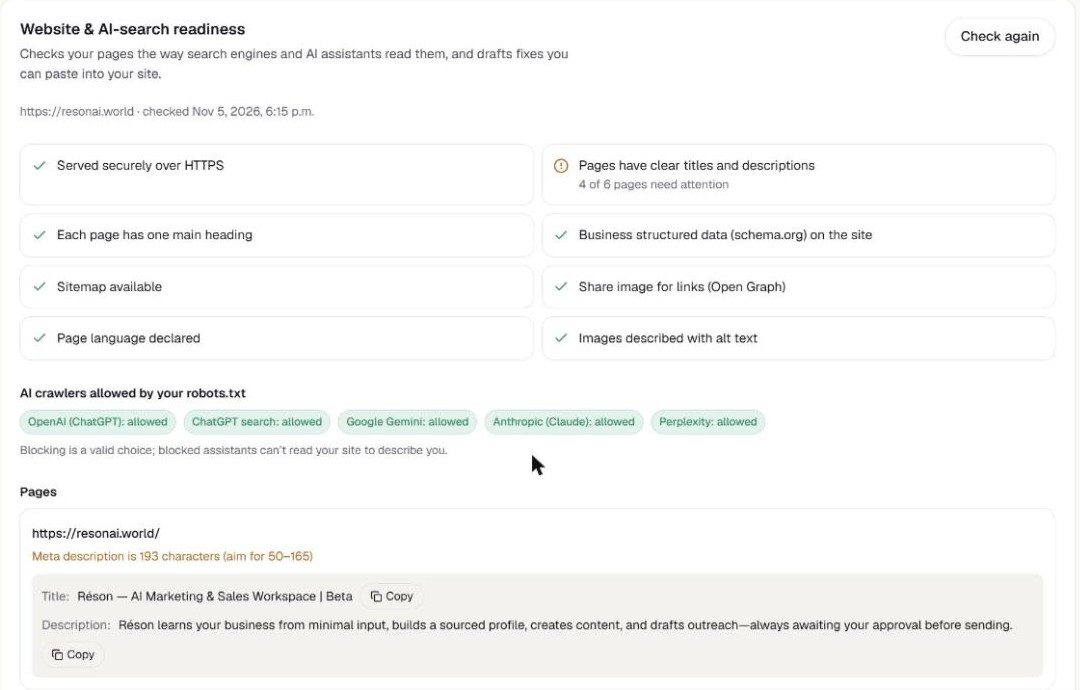
One item failed. Four of six pages had titles or descriptions out of range. The home page description was 193 characters, against an aim of 50 to 165. The about page title was 13 characters, against 15 to 65. Réson shortened every marketing description to 160 characters or less. It also added "free during the beta" to the home description, because an AI answer about Réson had left that fact out.
Run the same check on your business
Réson's Visibility page runs two checks you can use for the steps above. The website check reads up to six of your pages, reports titles, descriptions and structured data, and shows whether robots.txt lets five AI crawlers in. The AI check asks a search-connected AI about your business and compares the answer with your profile, claim by claim. You can try Réson free during the beta.
Whatever you use, start with the crawler, then the one sentence on your home page that says what you do. For more on how answer engines treat content, see our plain guide to generative engine optimization, and for Google, how to rank in Google AI Overviews.
Frequently asked questions
How do I get my business cited by ChatGPT?
Allow OpenAI's search crawler, OAI-SearchBot, in robots.txt and in any firewall or bot blocker. Then write plain sentences on your own pages that state what you sell, where, when and for how much, and make your other profiles say the same thing. OpenAI doesn't publish how it picks sources, so no one can guarantee a citation.
Does blocking GPTBot stop ChatGPT from citing my site?
No. OpenAI treats them as separate choices. GPTBot crawls content that may be used to train its models, while OAI-SearchBot is used to surface websites in ChatGPT's search features. You can block GPTBot and still allow OAI-SearchBot. OpenAI says robots.txt changes can take about 24 hours to take effect for search.
Can I pay to be listed in ChatGPT?
OpenAI's developer site describes an ads platform for ChatGPT, but an ad is a paid placement, not a citation in an answer. OpenAI's crawler documentation describes no paid route into an answer's sources. Product feeds for shopping exist, but as of November 2026 OpenAI says feed onboarding is available to approved partners.
Why does ChatGPT cite a directory instead of my website?
Often because the directory states your facts more clearly, or your own site blocks OpenAI's search crawler. Check robots.txt and your firewall first. Then make sure your home page says in its first sentence what you do and where, and that your hours, prices and address are written as text, matching every listing.
How can I tell if OpenAI's crawler visits my site?
Look in your server or hosting logs for the user agent OAI-SearchBot, which is the crawler for ChatGPT search. Visits from ChatGPT-User mean a ChatGPT conversation opened one of your pages. OpenAI publishes the IP addresses its search crawler uses, so your host can confirm the visits are real.
Sources
- OpenAI: Overview of OpenAI Crawlersdevelopers.openai.com
- OpenAI: OAI-SearchBot IP addressesopenai.com
- OpenAI Commerce: Get starteddevelopers.openai.com
- OpenAI Ads documentationdevelopers.openai.com
- Bing Search Blog: Evolving role of the index, from ranking pages to supporting answersblogs.bing.com
- Google Search Central: AI features and your websitedevelopers.google.com
- Google Search Central: Add and manage your business details on Google Searchdevelopers.google.com
About the author
Réson
Réson is an AI marketing workspace for small businesses. It learns your business from your website, drafts posts, campaigns and articles, and waits for your approval before anything goes out.